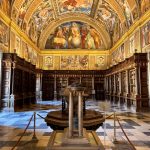
Chapter Three: Royal Site of San Lorenzo de El Escorial
December 7, 2025
Chapter Five: A Hidden Gem Highlights A Busy Day In Madrid
December 29, 2025Celebrating España: MaiTaiTom’s Still “Insane For Spain”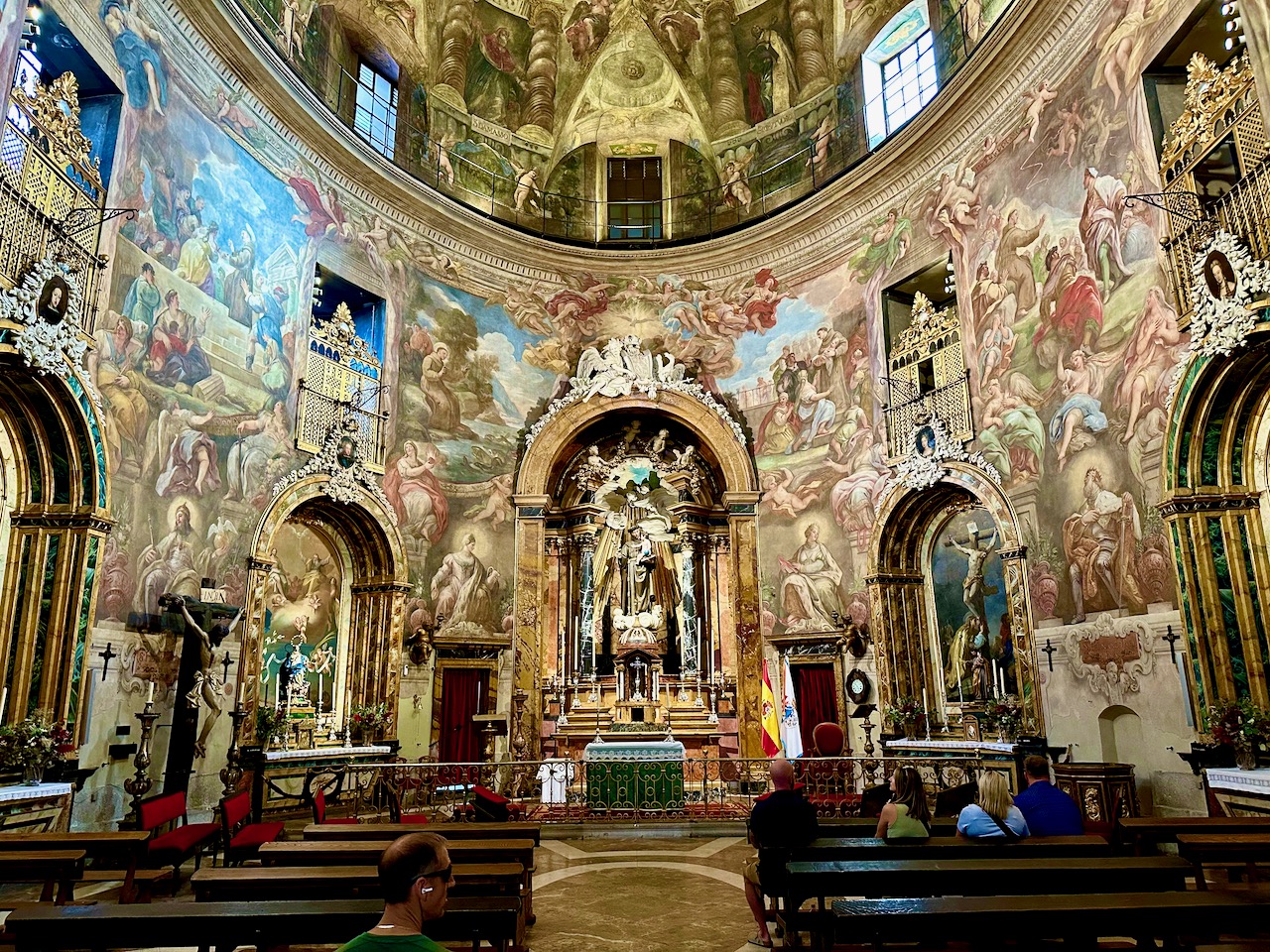
Chapter Four: Get Me To The Church(es) On Time
Day Four: Bear With Me, First Church Of The Dei, Sistine Chapel Of Madrid, Convent Of The Barefoot Royals, Fab Frescoes, Marvelous Monastery, ¿hablas inglés?, Oh My God Is That Stanley Tucci?, A Monastery Steeped In Legend, A Mistake In Judgement, Finally A Walk In The Park, Mercado Mania and Okey Gnocchi
Had Kim and Mary joined us on this trip, this probably would have been the day they called in sick. It was time for a full day of churches, convents and monasteries.
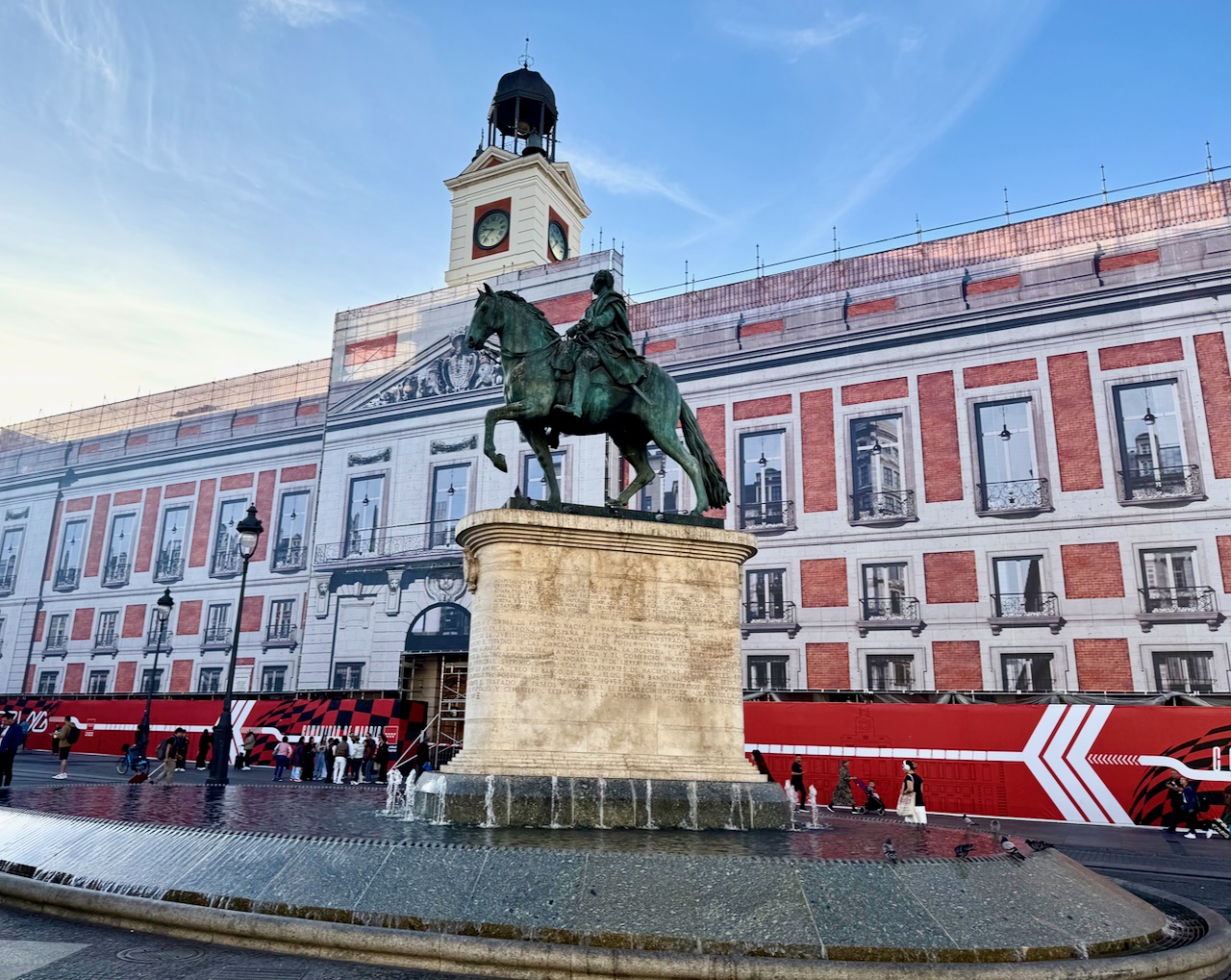
The walk from our hotel to the first church took us through Puerta del Sol, which is known as the Sun Gate, because it once was where one of the city’s gates was located. It’s also where the bronze statue El Oso y el Madroño stands. The Bear and the Strawberry Tree represents Madrid’s coat of arms with a history that dates back to Alfonso VIII in the 12th century. The statue was erected in 1967.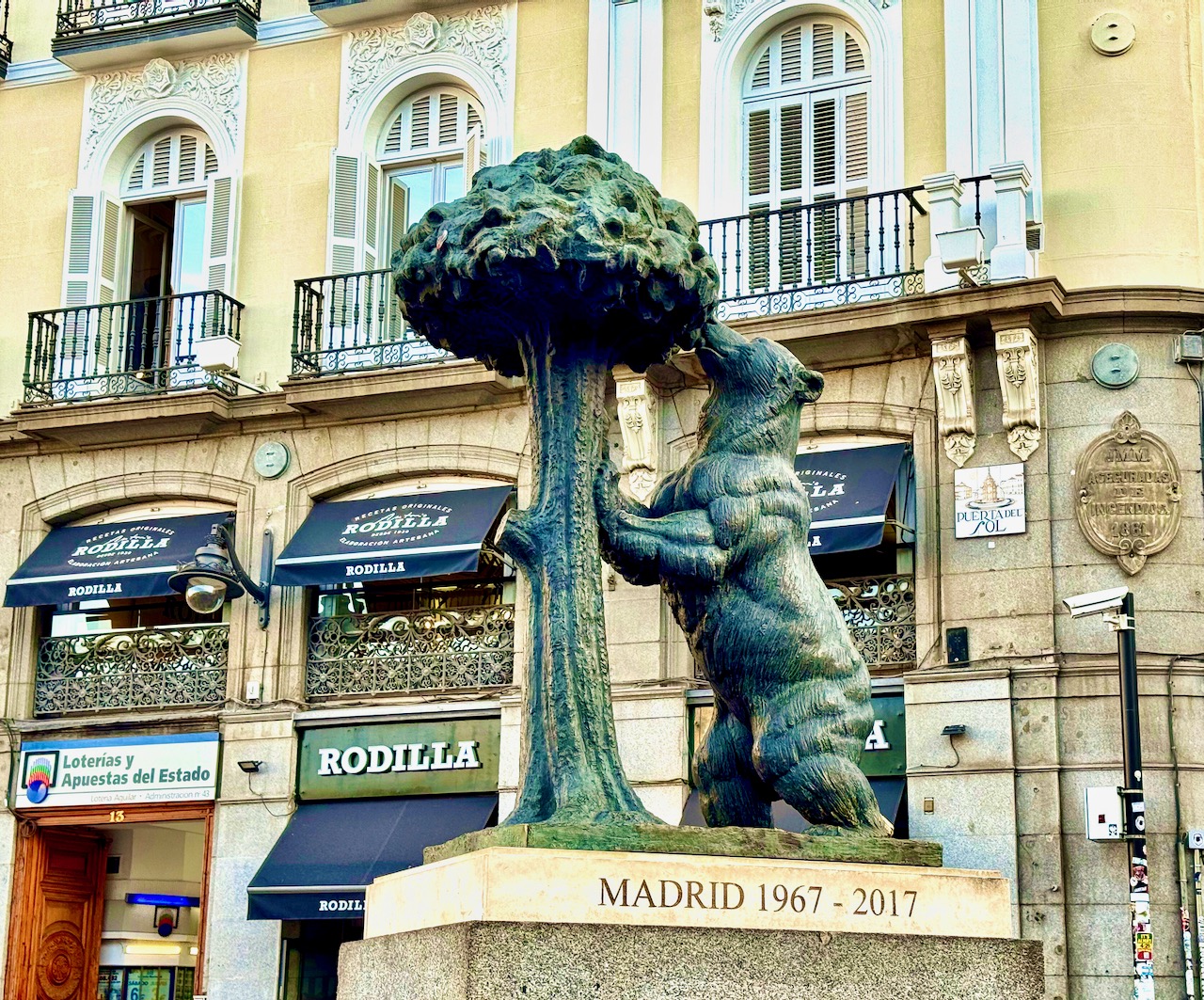
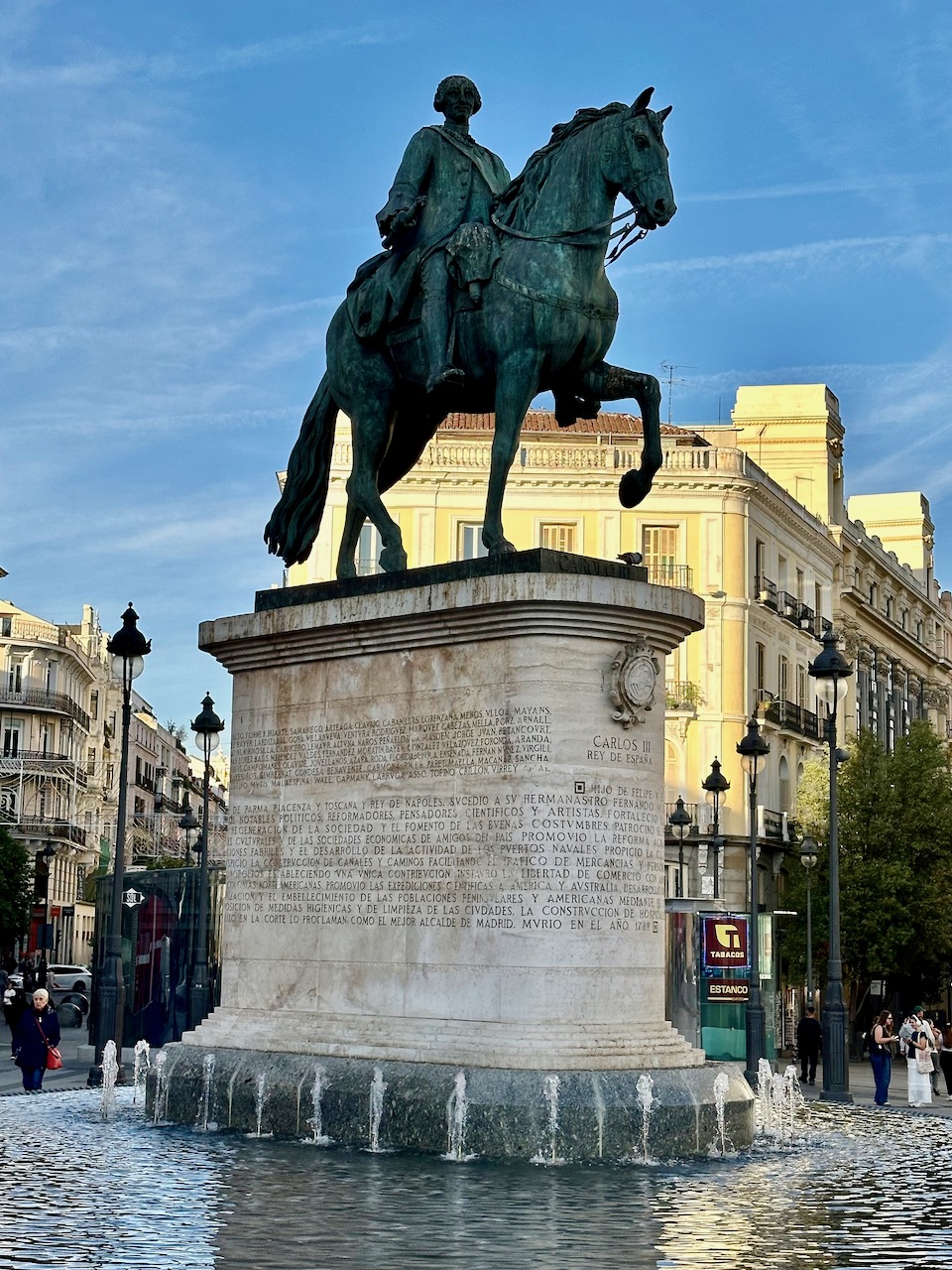
The square holds yet another landmark, the Equestrian Statue of Charles III, a 1994 replica of a smaller 19th century statue of the king nicknamed “Madrid’s best mayor.” He’s called that because (according to my buddy AI), “as king, he enacted massive urban and public works reforms, transforming the city by adding sewers, streetlights, monuments (like the Prado Museum’s building), and public spaces, modernizing Madrid into a true capital.”
Probably the most recognizable site at Puerta del Sol is a bottle of Tío Pepe sherry holding a guitar. The only thing missing was Frankie Valli singing, “Sherry, Sherry baby.”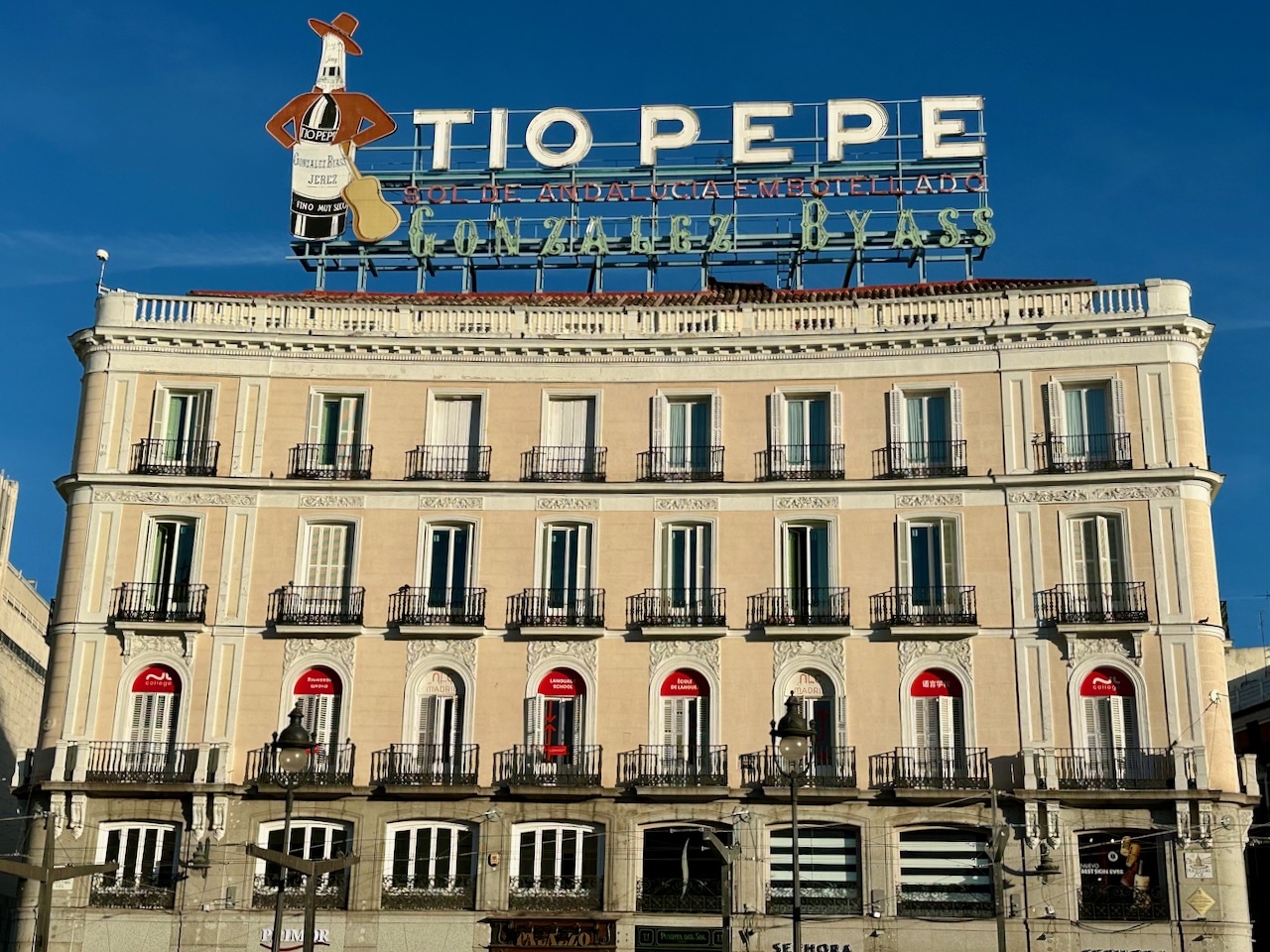
At the edge of the square is a statue of Venus called La Mariblanca.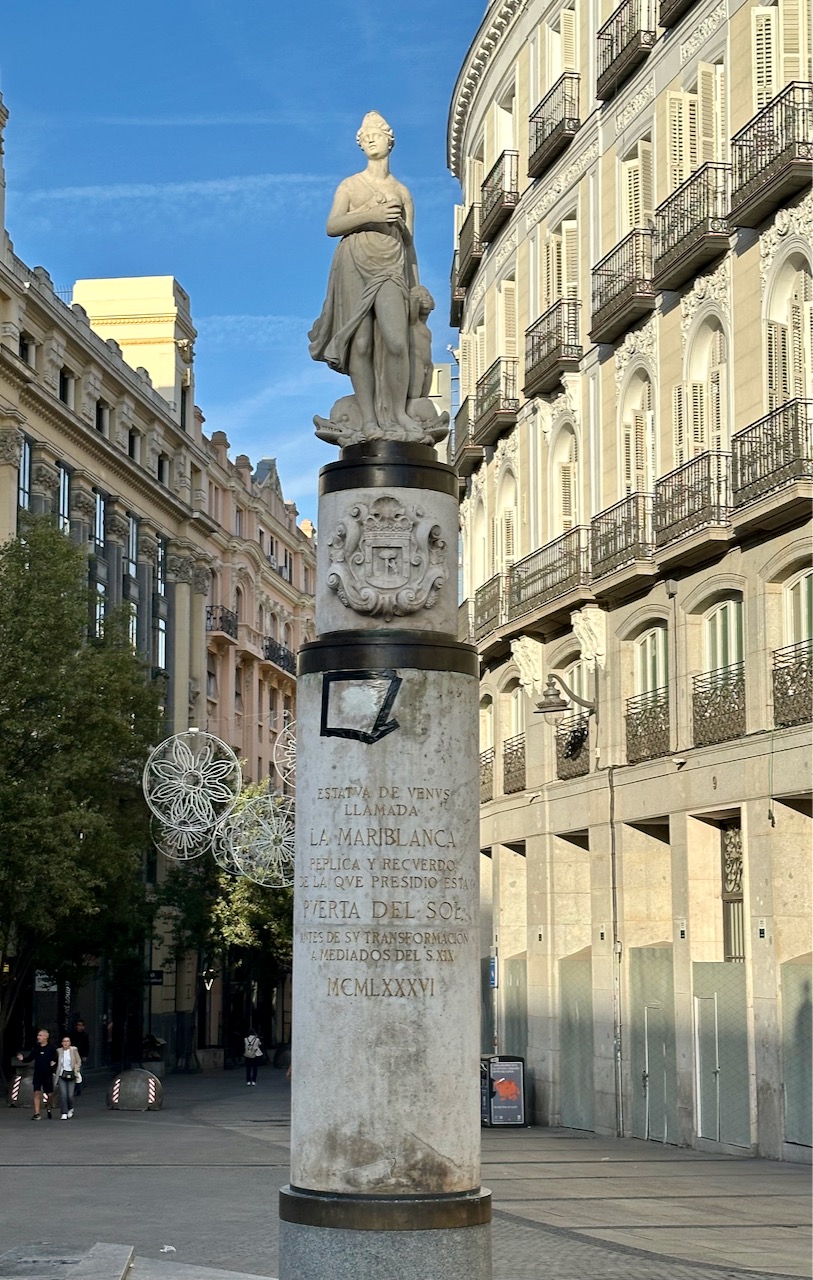
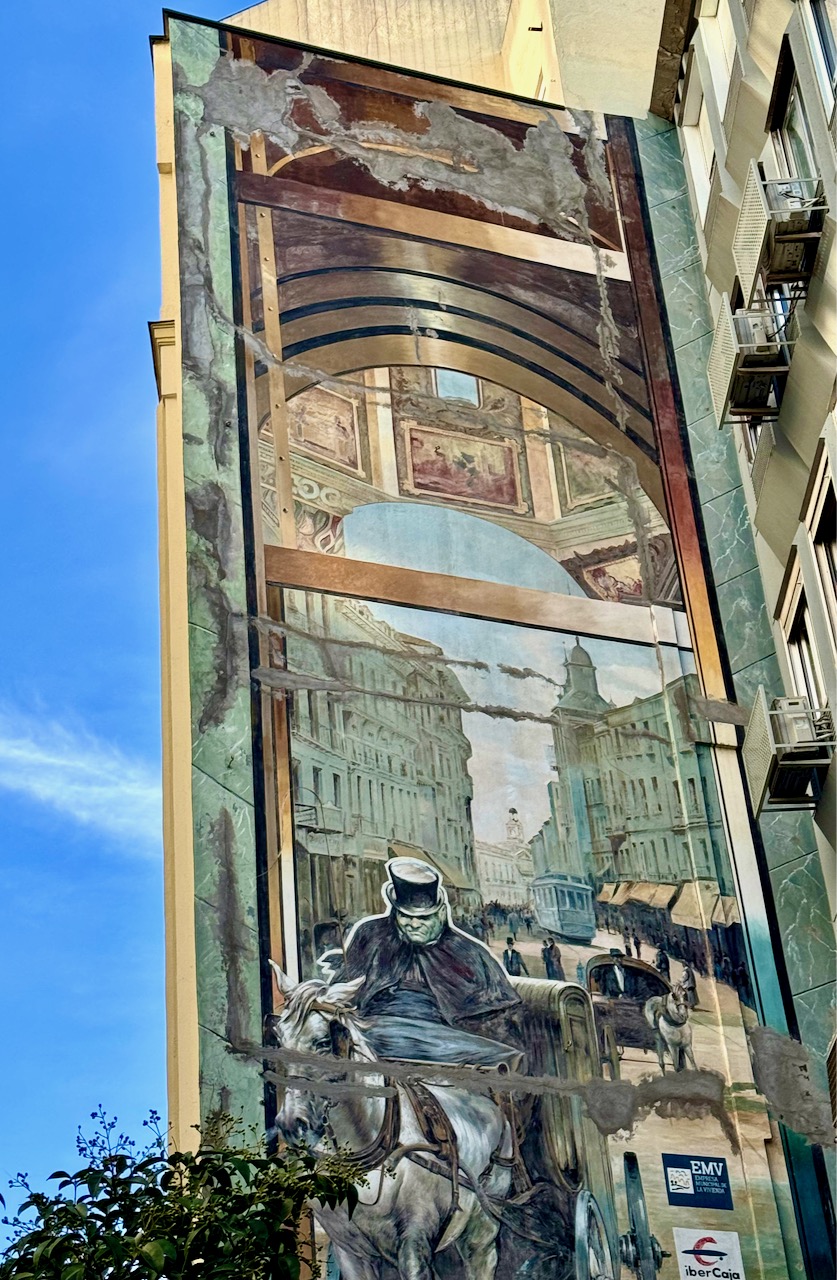
We also passed a cool trompe-l’œil mural on the side of a building, and the stone entrance to the Gran Via metro station, complete with Madrid’s Coat of Arms (El Oso y el Madroño).
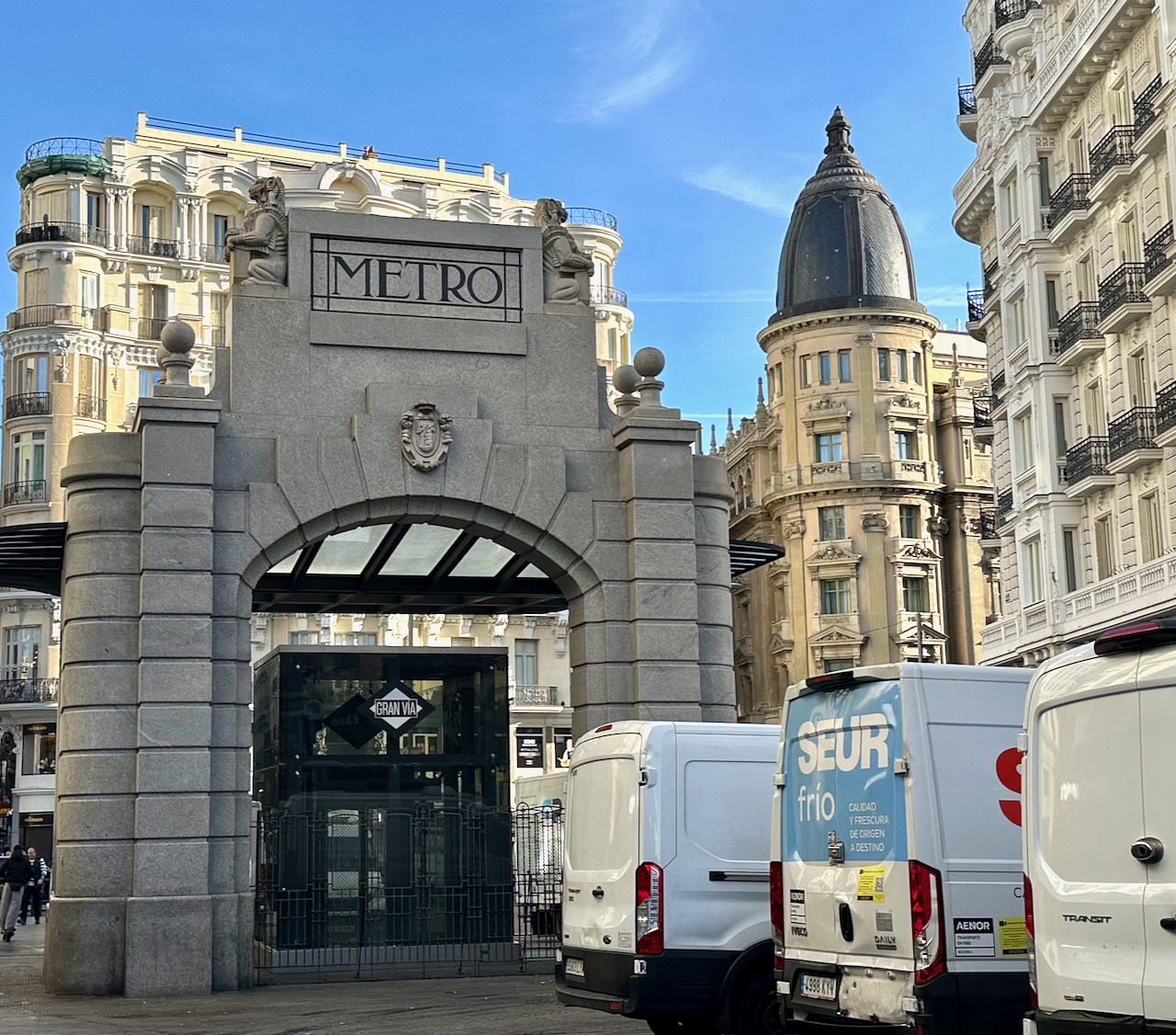
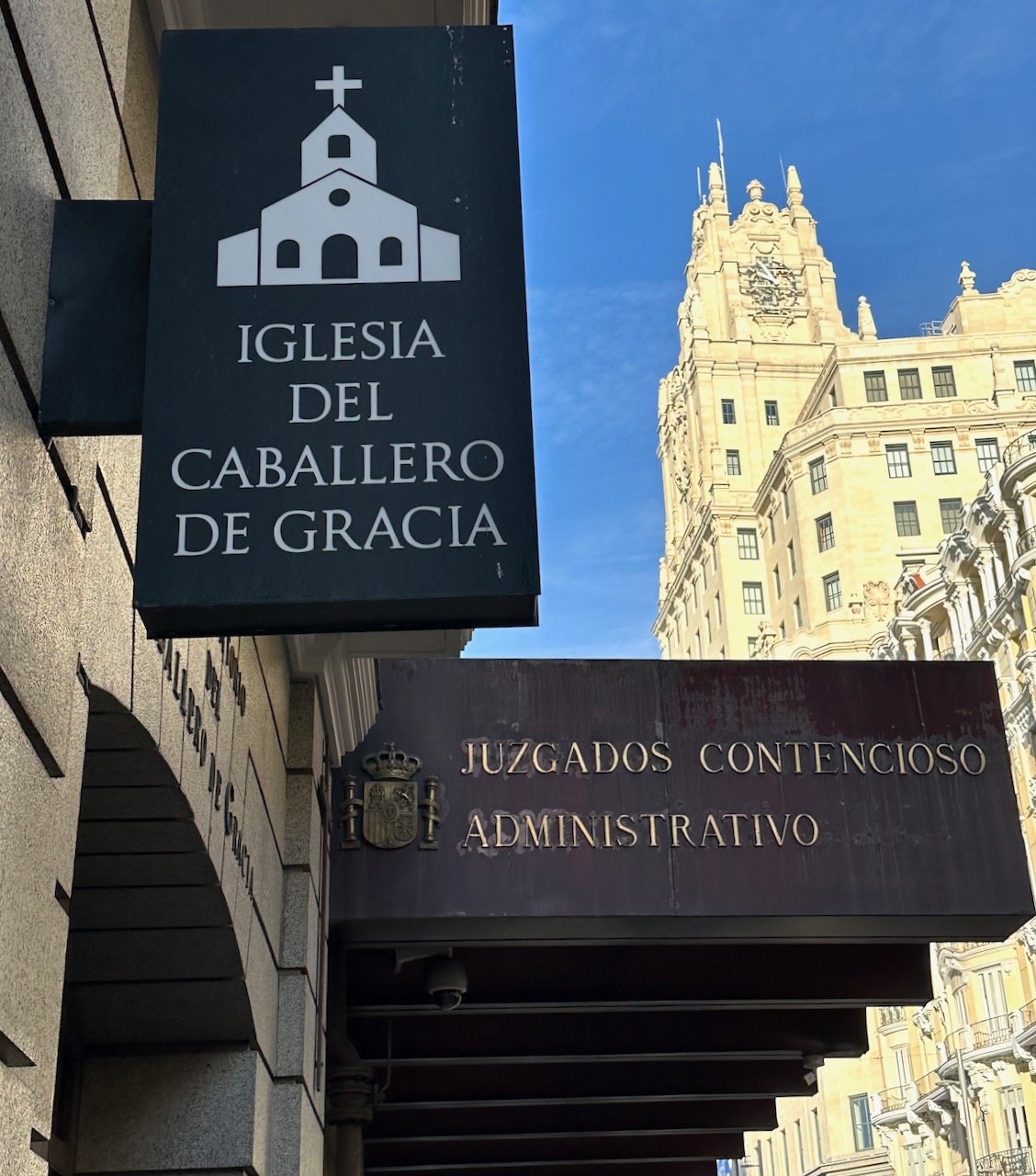
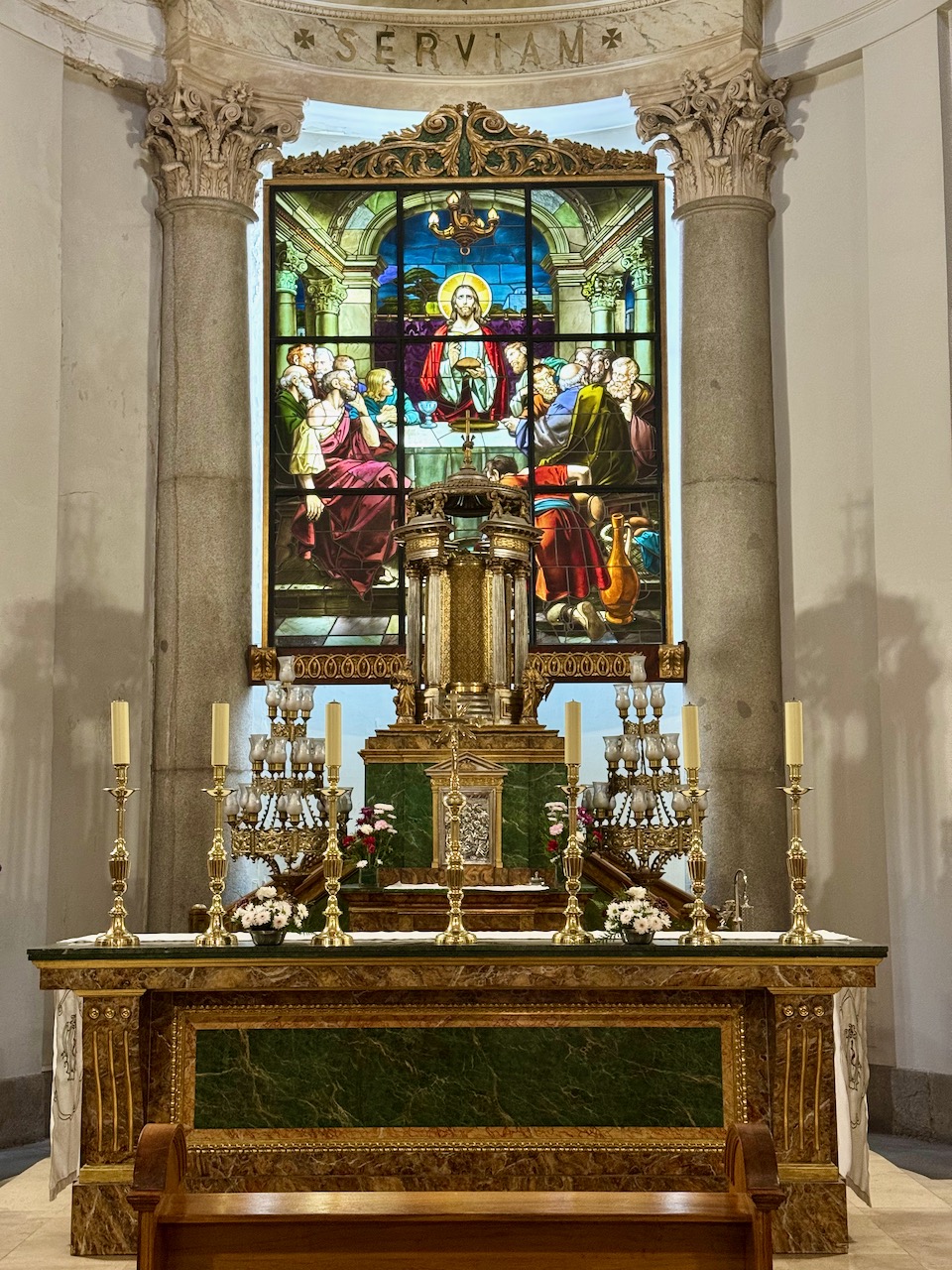
We were searching near the metro station on Calle Gran Via for La Iglesia del Caballero de Gracia (Royal Oratory of Caballero de Gracia). If there hadn’t been this sign we would have never seen it. Well, I guess the big cross on the building kind of gives it away, too.
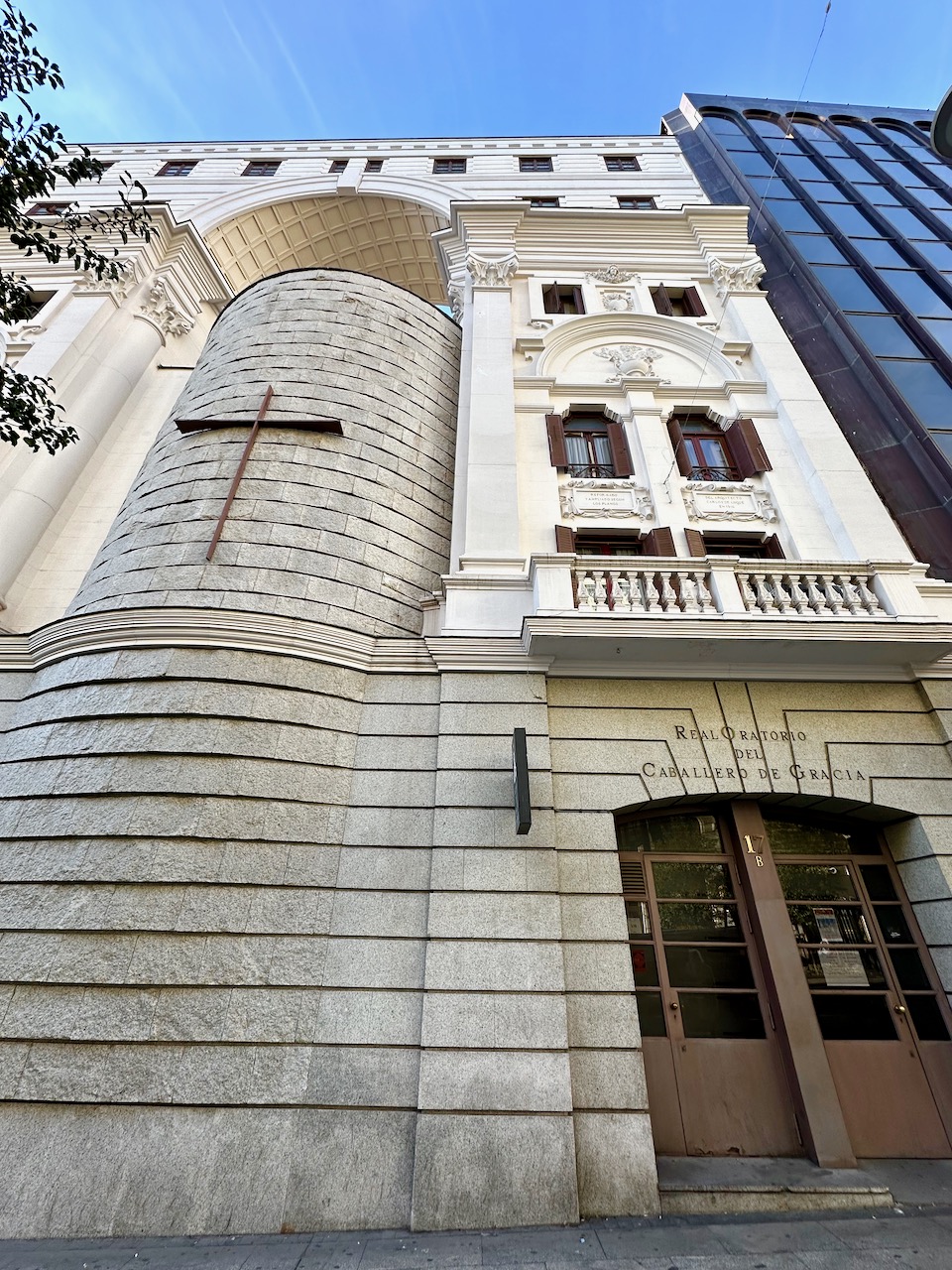
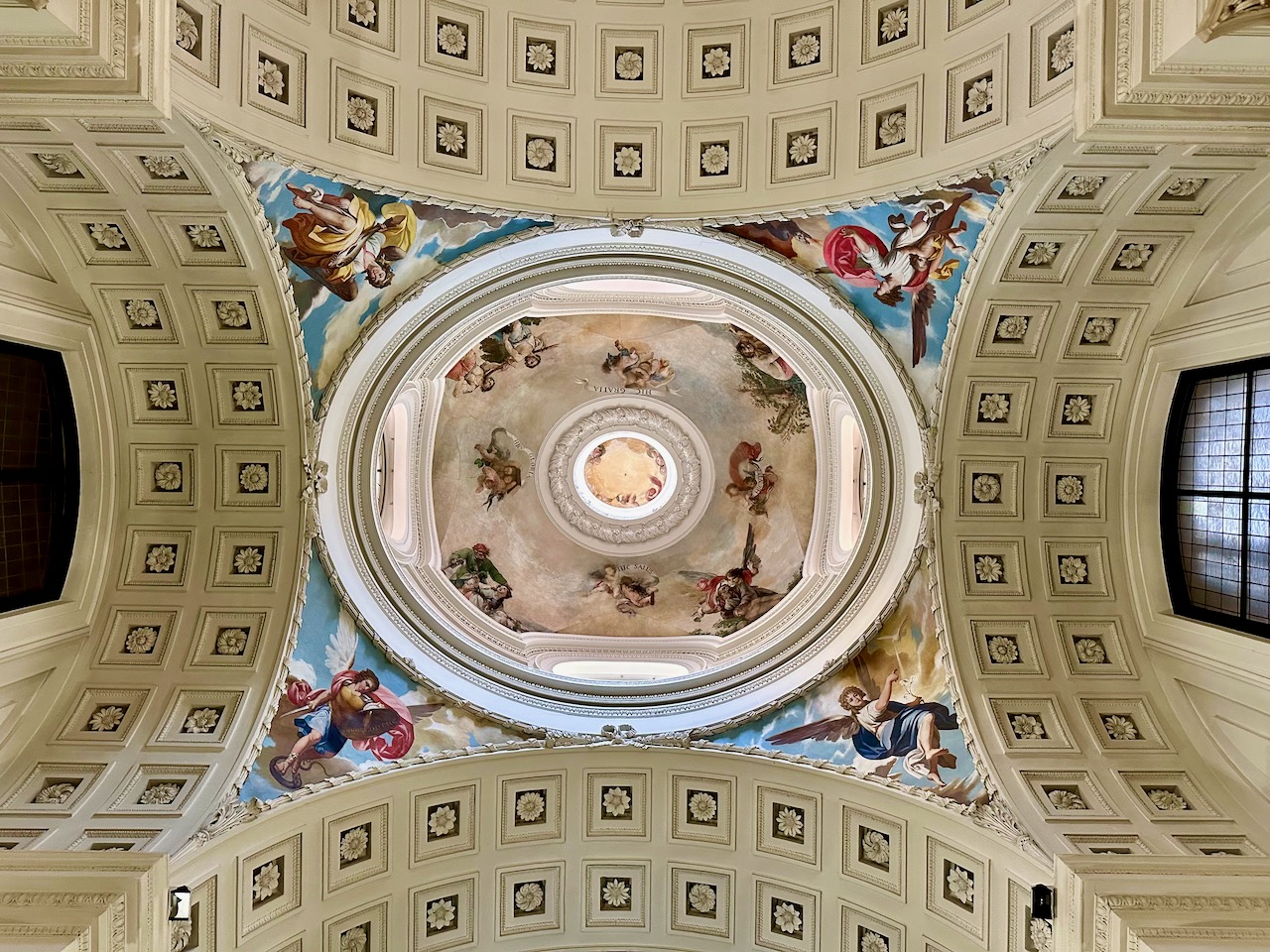
The church is designed with a Roman basilica-style interior.
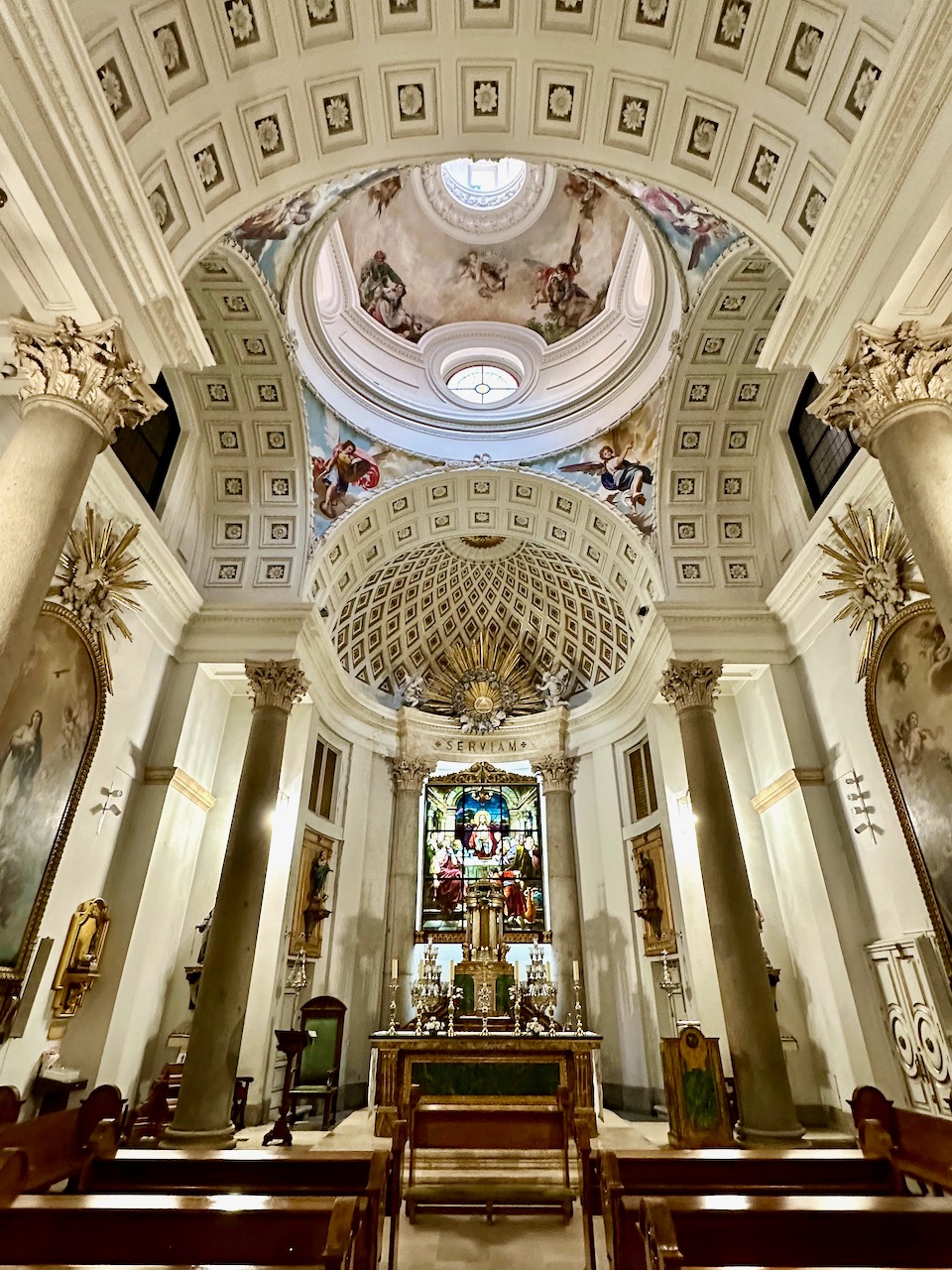
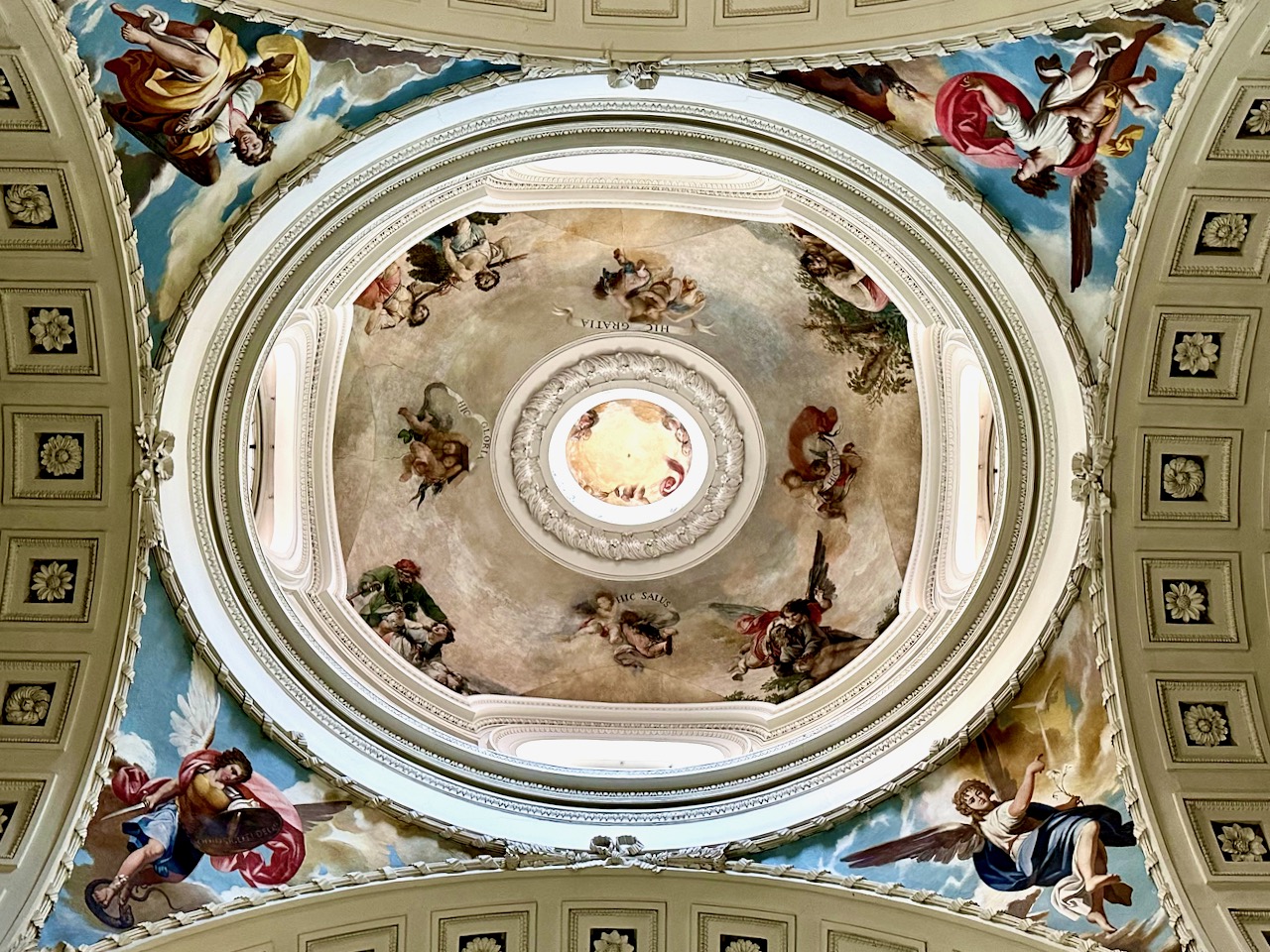
Zacarías González Velázquez painted the dome and the archangels surrounding it.
A 1790 Dutch organ was installed here in 2011.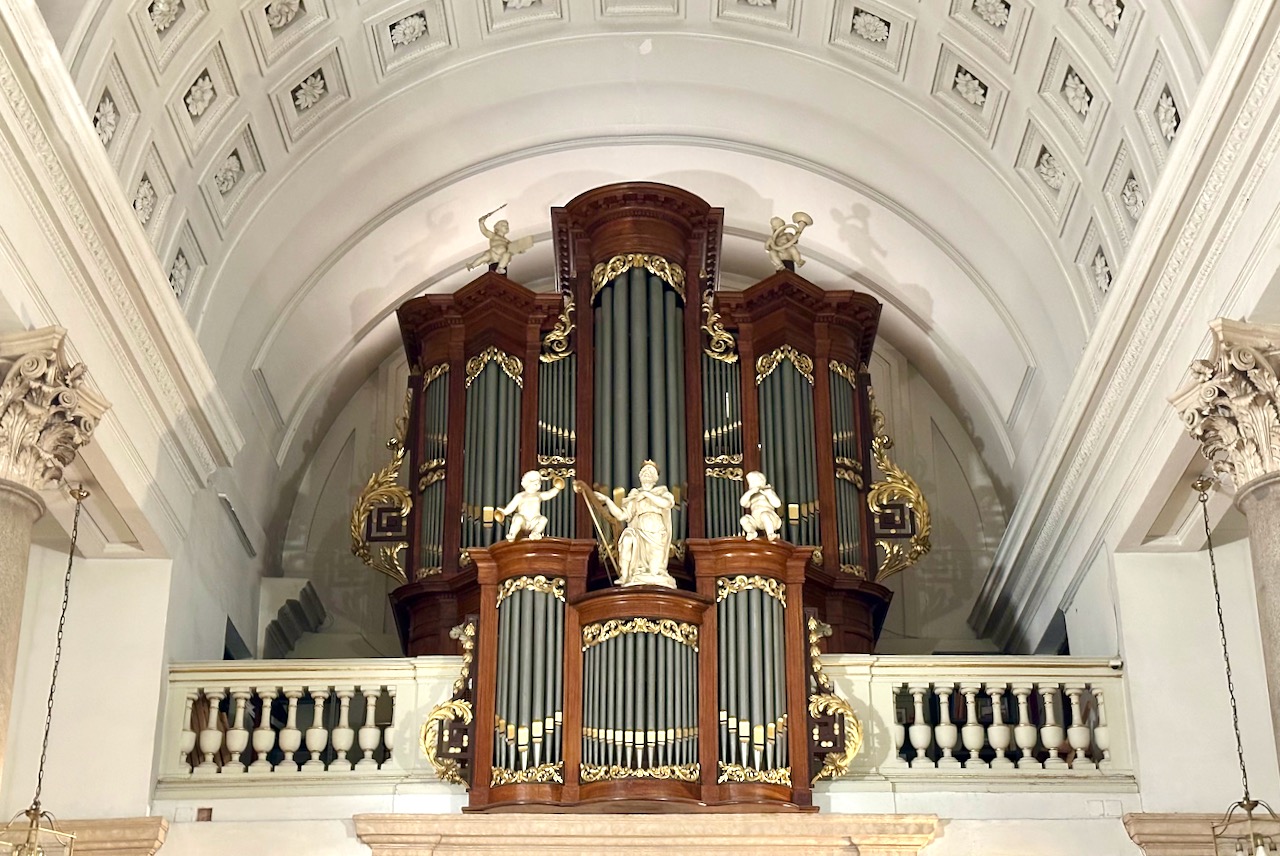
Today, the church is run by Opus Dei. I immediately texted Dan Brown to see if he had another book in him.

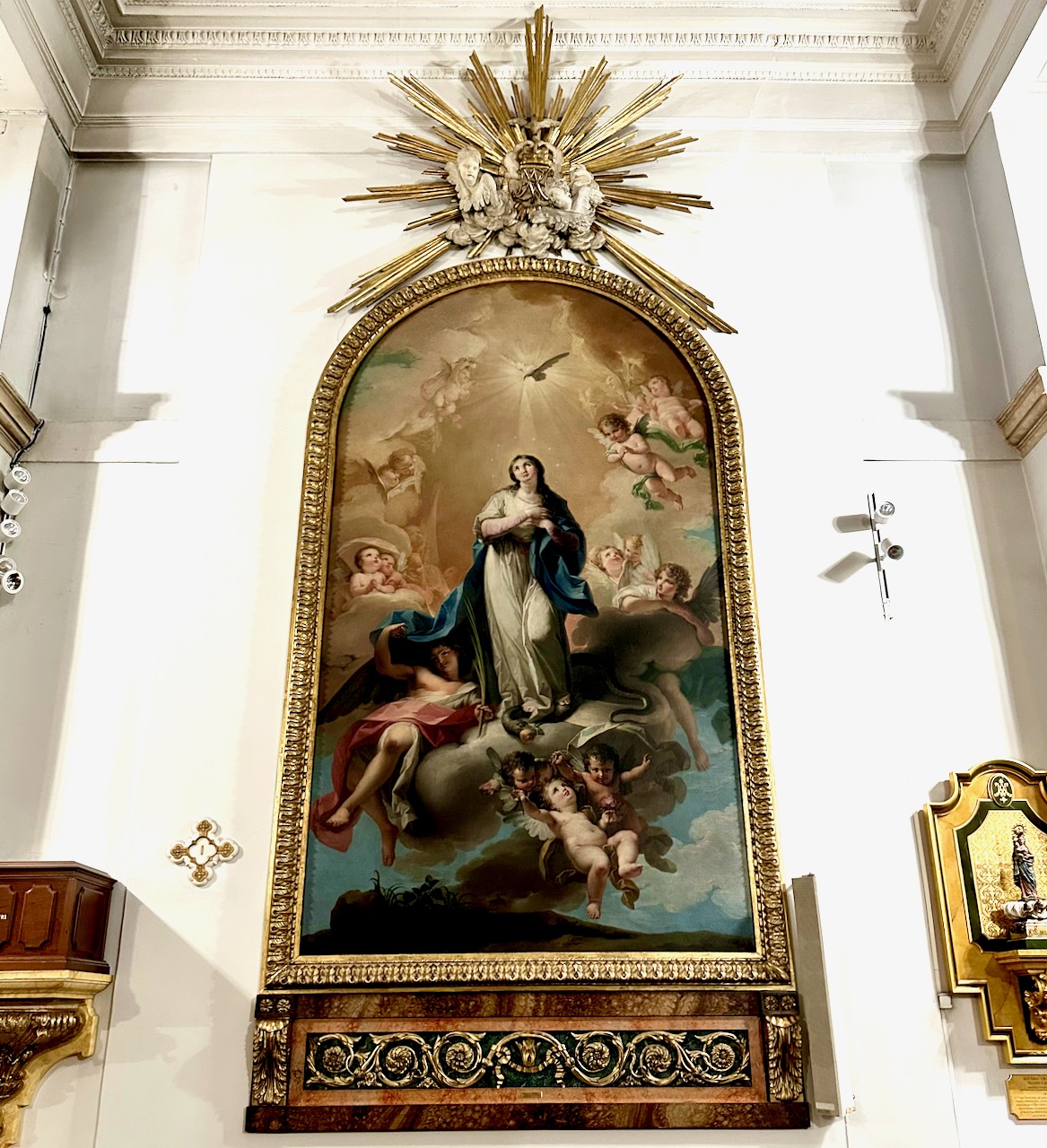
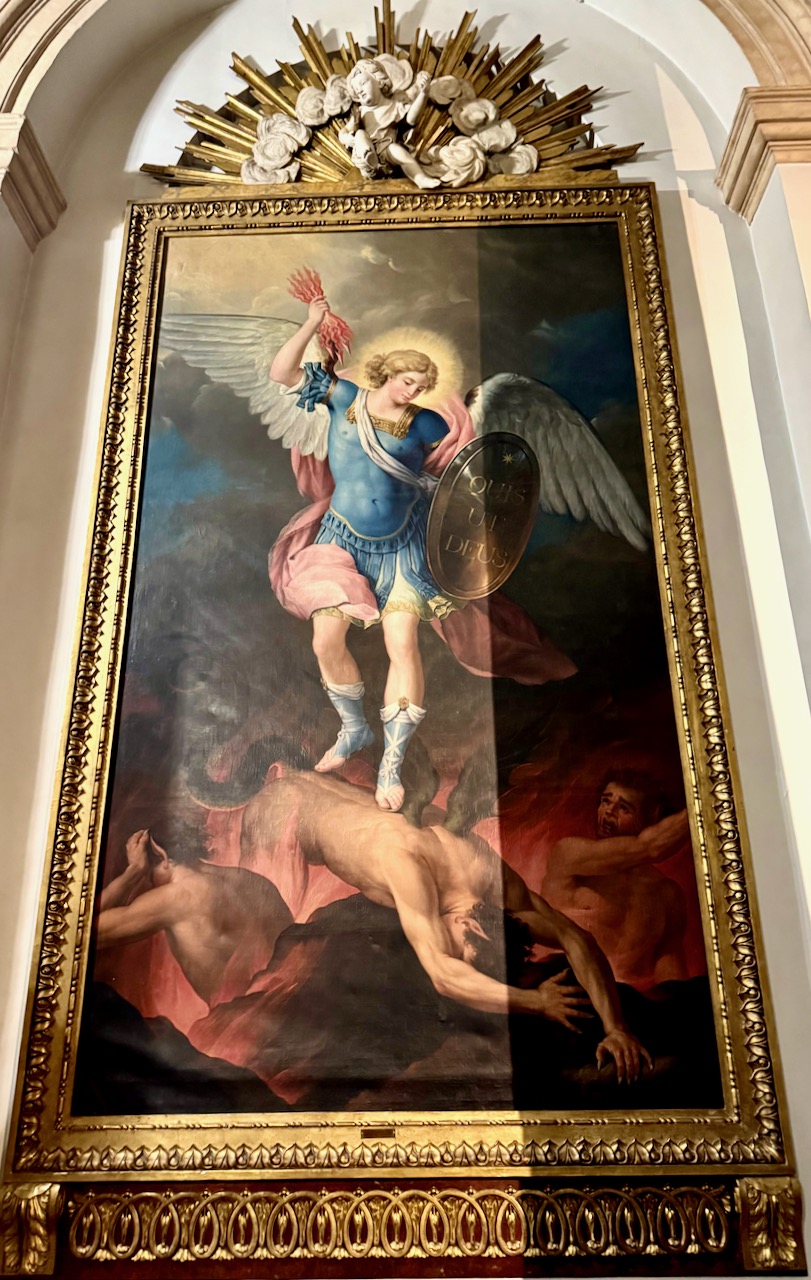
Back out on the Gran Via we headed to our next church destination, stopping briefly to look at the Winged Goddess Victoria.
Nearby was a long line of people who seemed to be buying lottery tickets.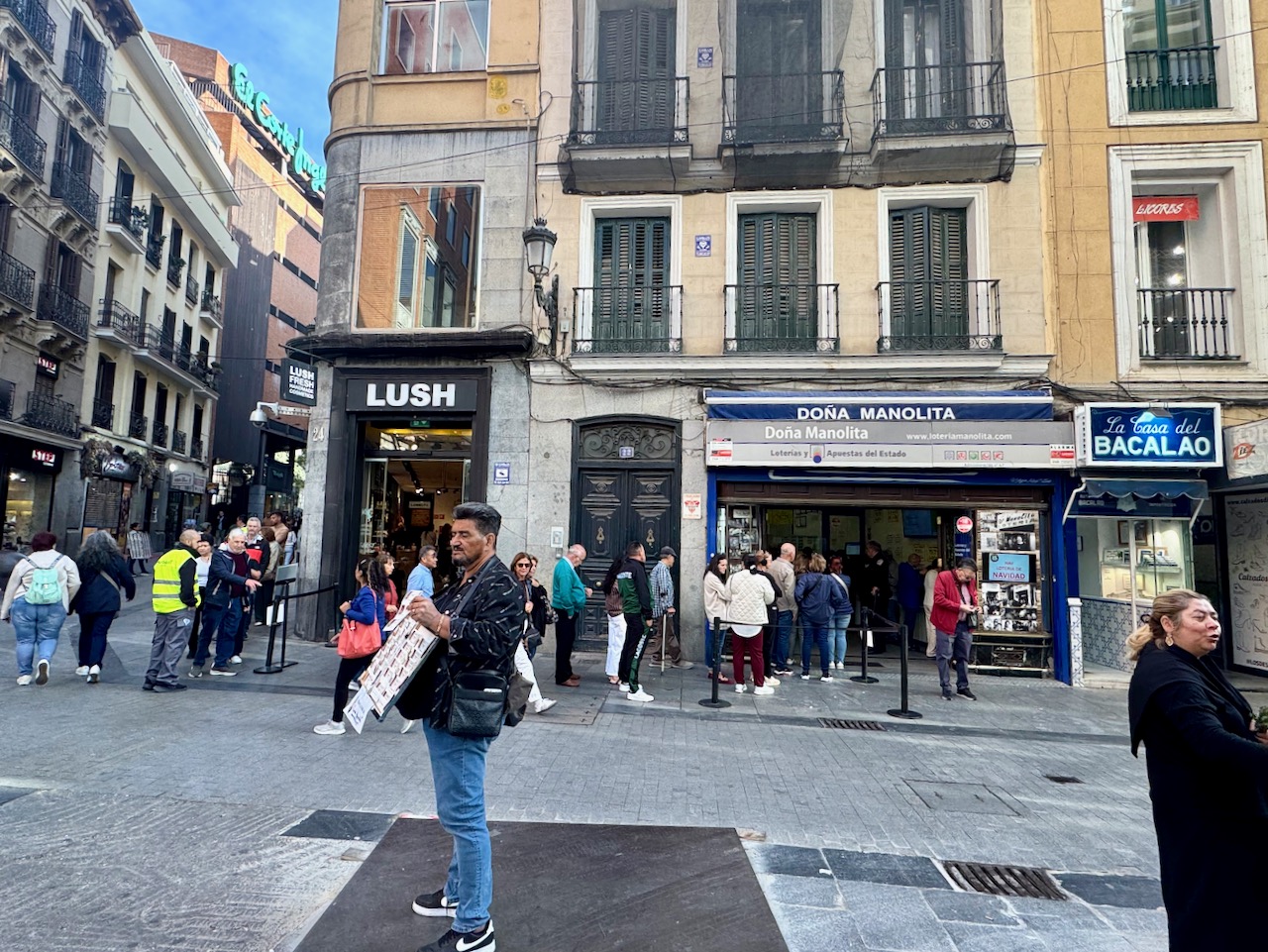
Next, we visited a church I would definitely go out of my way to see, and which has been described as “The Sistine Chapel of Madrid.” The early 17th-century Iglesia de San Antonio de los Alemanes (Church of Saint Anthony of the Germans) might appear nondescript from the outside, but once stepping inside you will be wowed by the frescoes surrounding its baroque interior.
Founded by King Philip III in the early 1600s, it was constructed as the chapel for the Hospital of San Antonio de los Portugueses, a place of refuge for immigrants from Portugal.
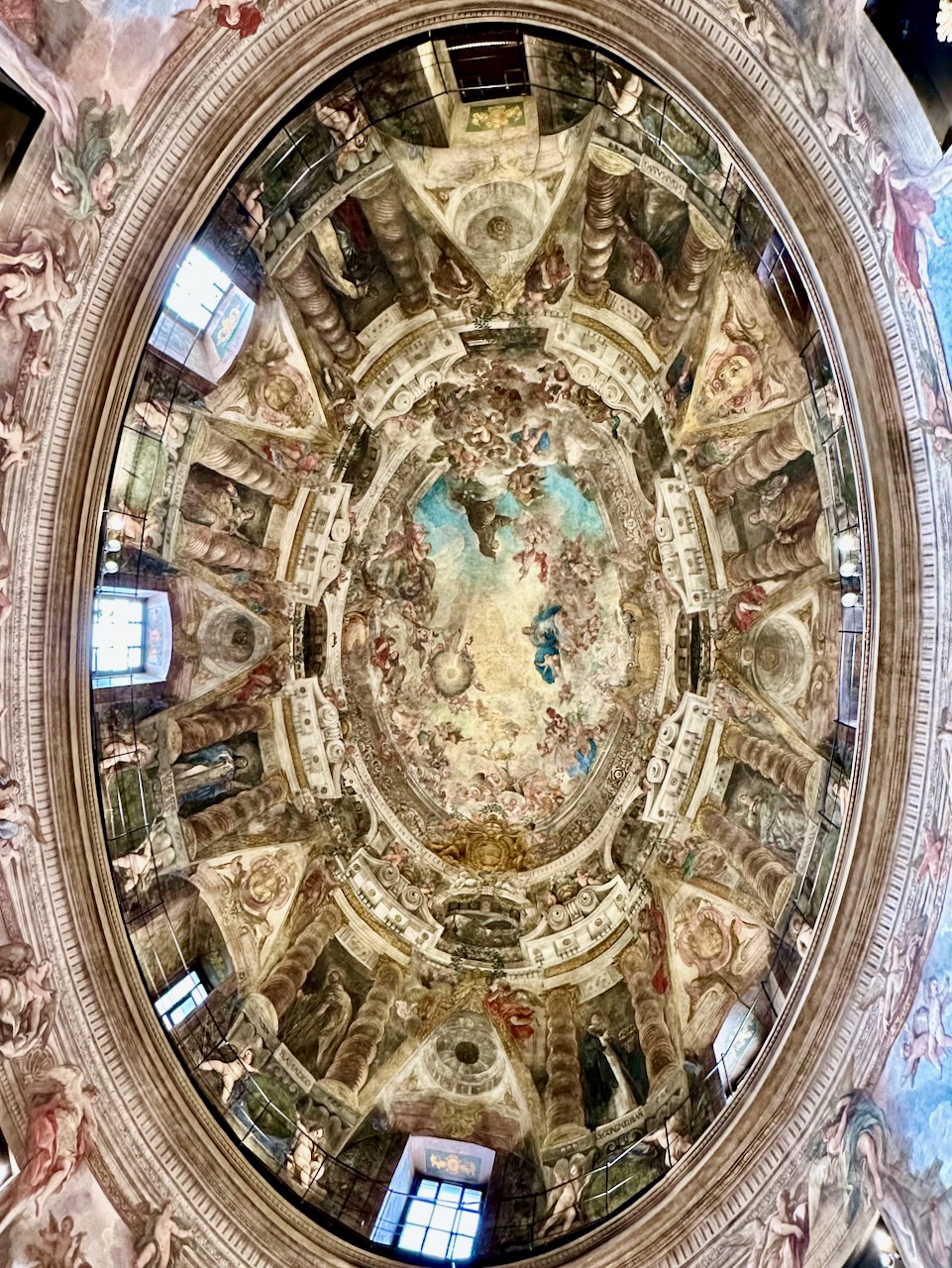
The frescoes “depict the life and miracles of St. Anthony of Padua” … as well as stories of other saints.
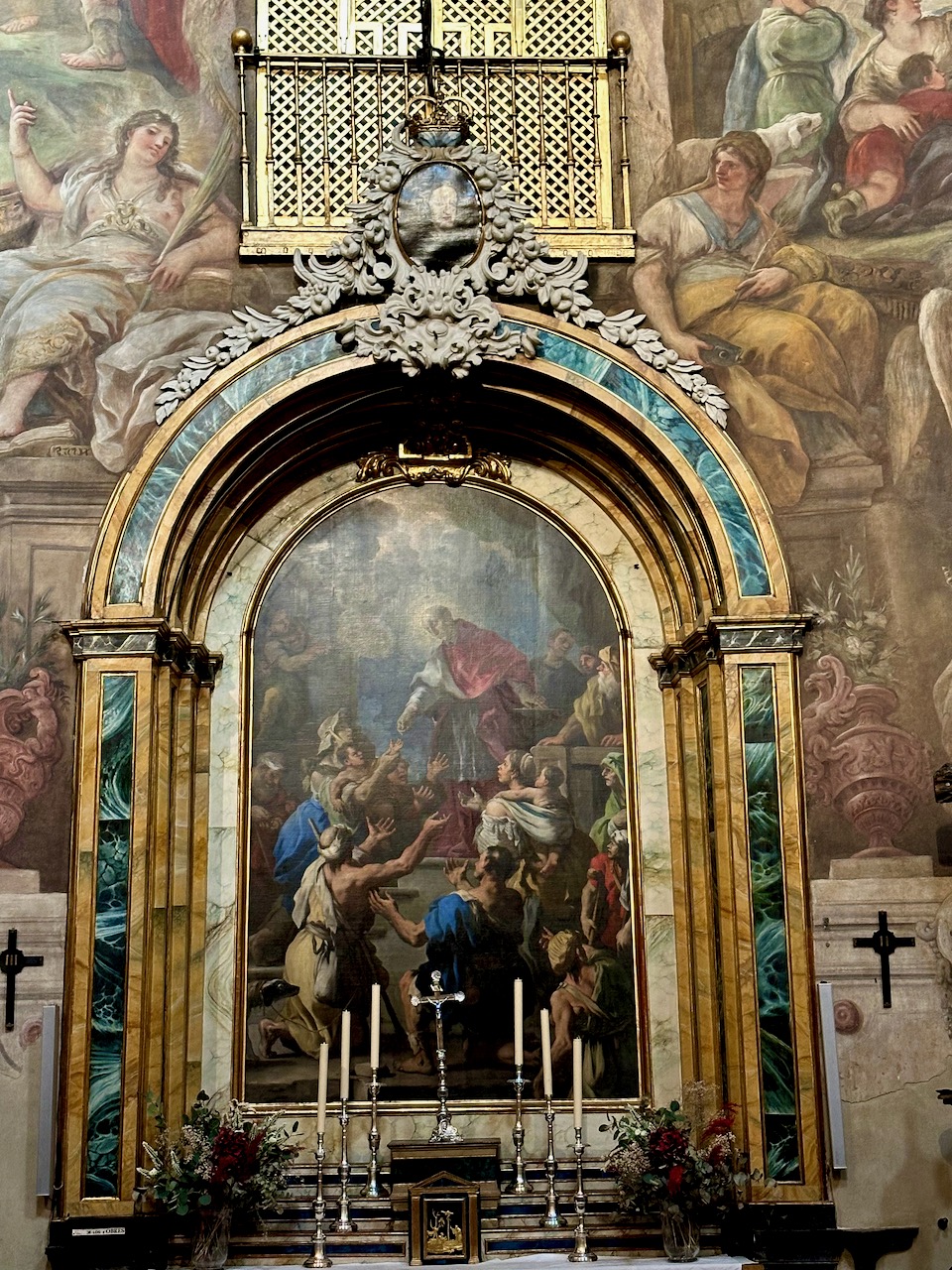
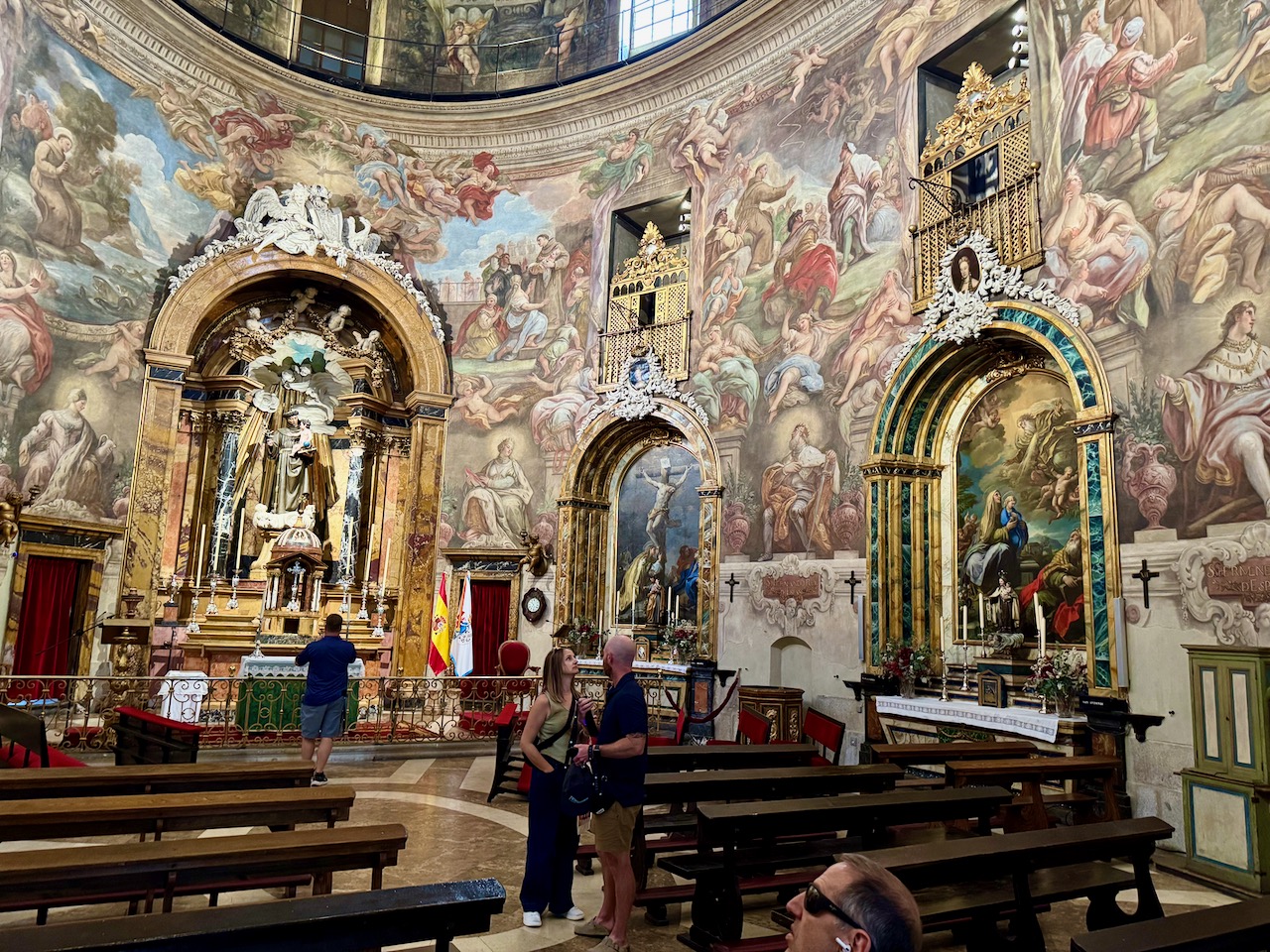
It includes a 1604 painting by Luca Giordan called Saint Anne, Saint Joachim, and the Virgin Mary as a child.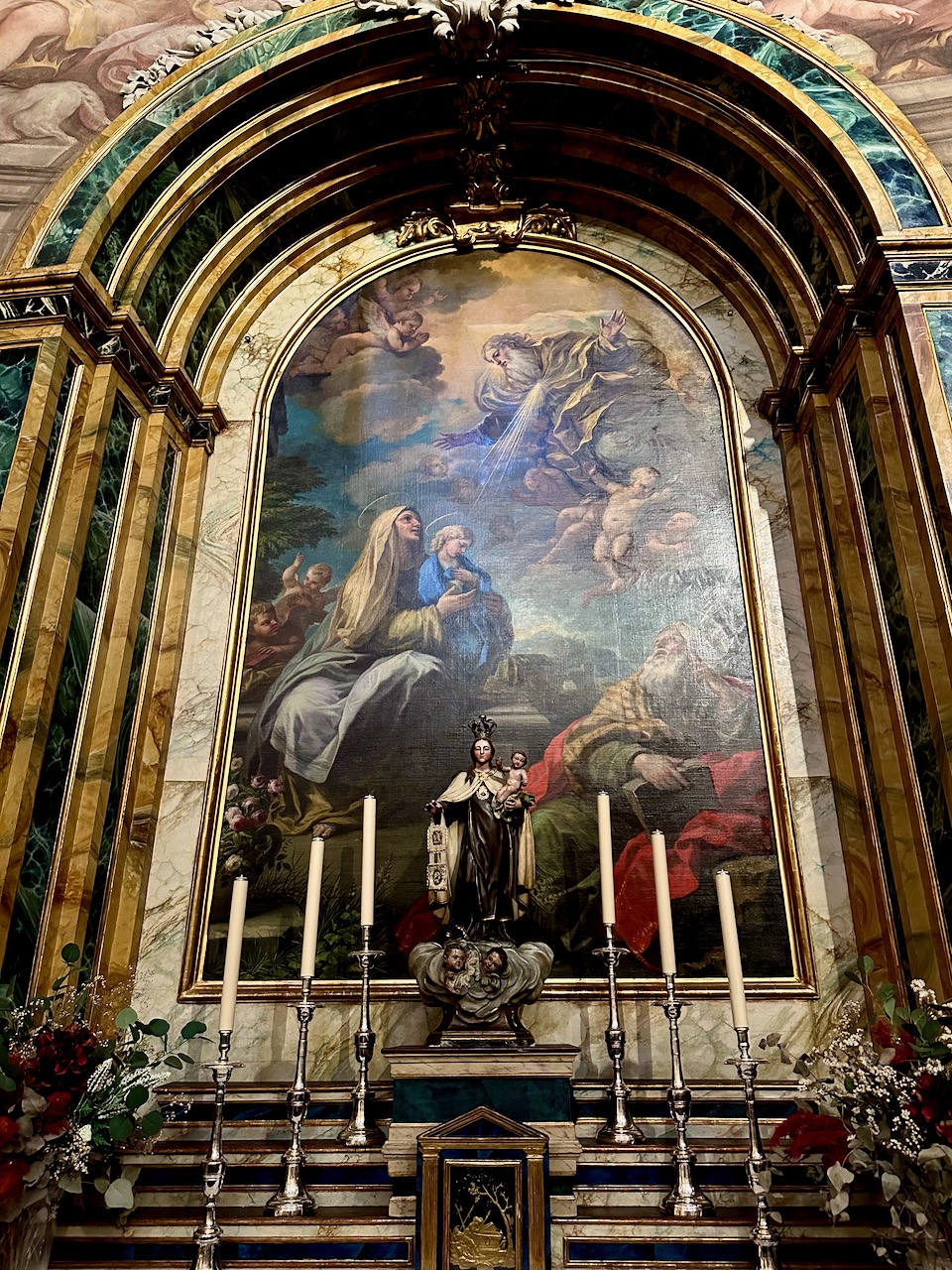
If you have better eyes than me, you can see St. Anthony in the dome.
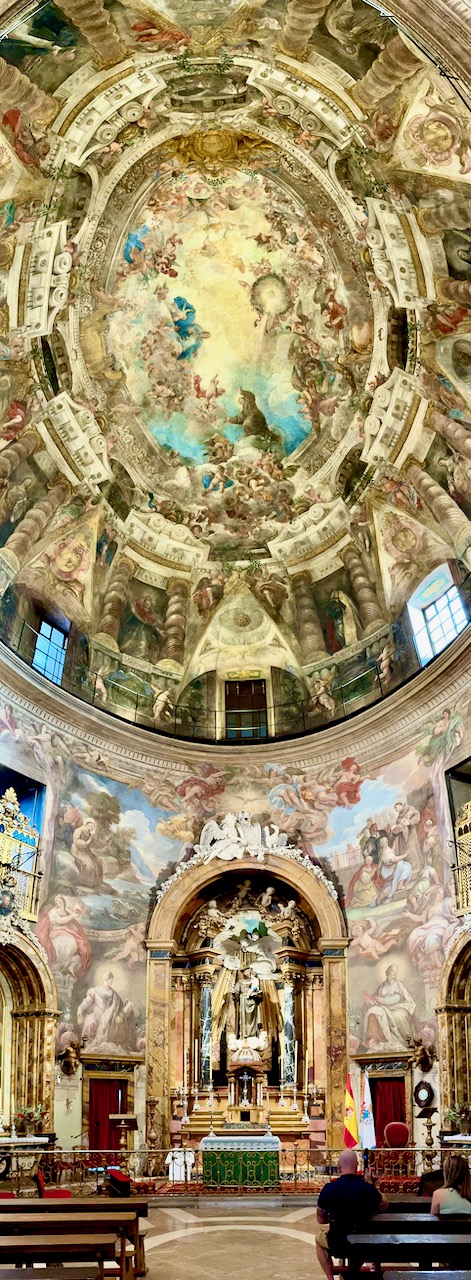
The central altarpiece features a statue of Saint Anthony holding baby Jesus that was created by Miguel Fernández. 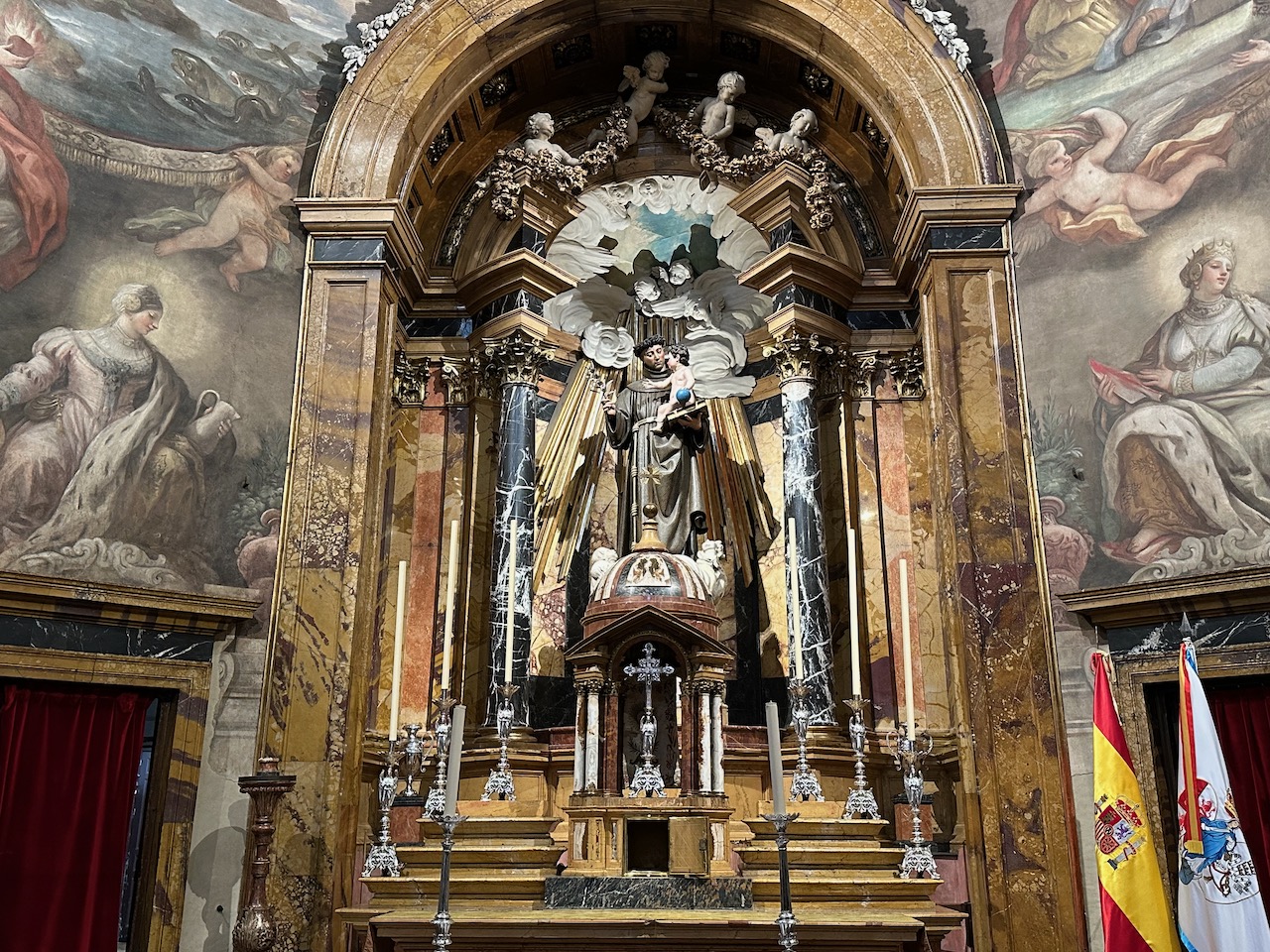
In addition to an audioguide, there are guided tours of the crypt (Spanish only), but since it was nearing 11:30, we had to hurry over to Monasterio de las Descalzas Reales where we had pre-booked another tour.
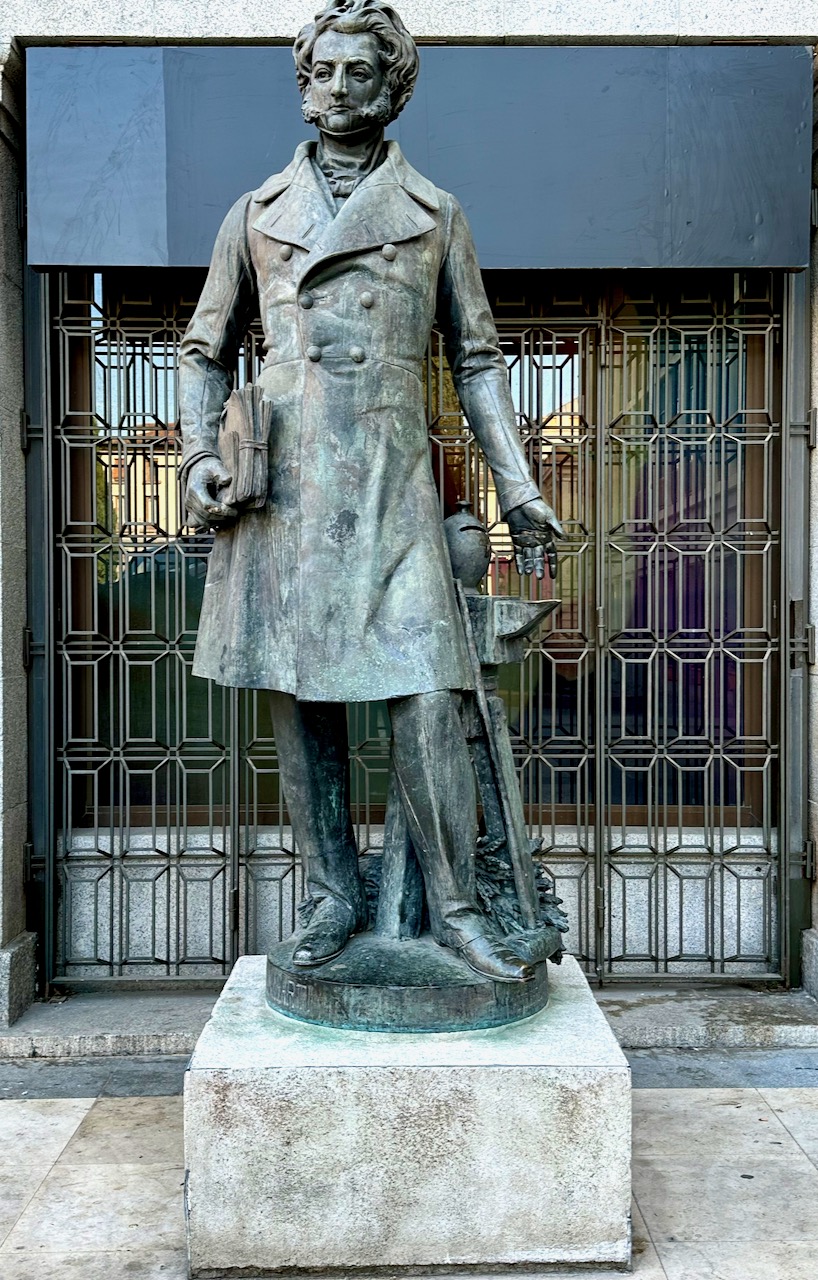
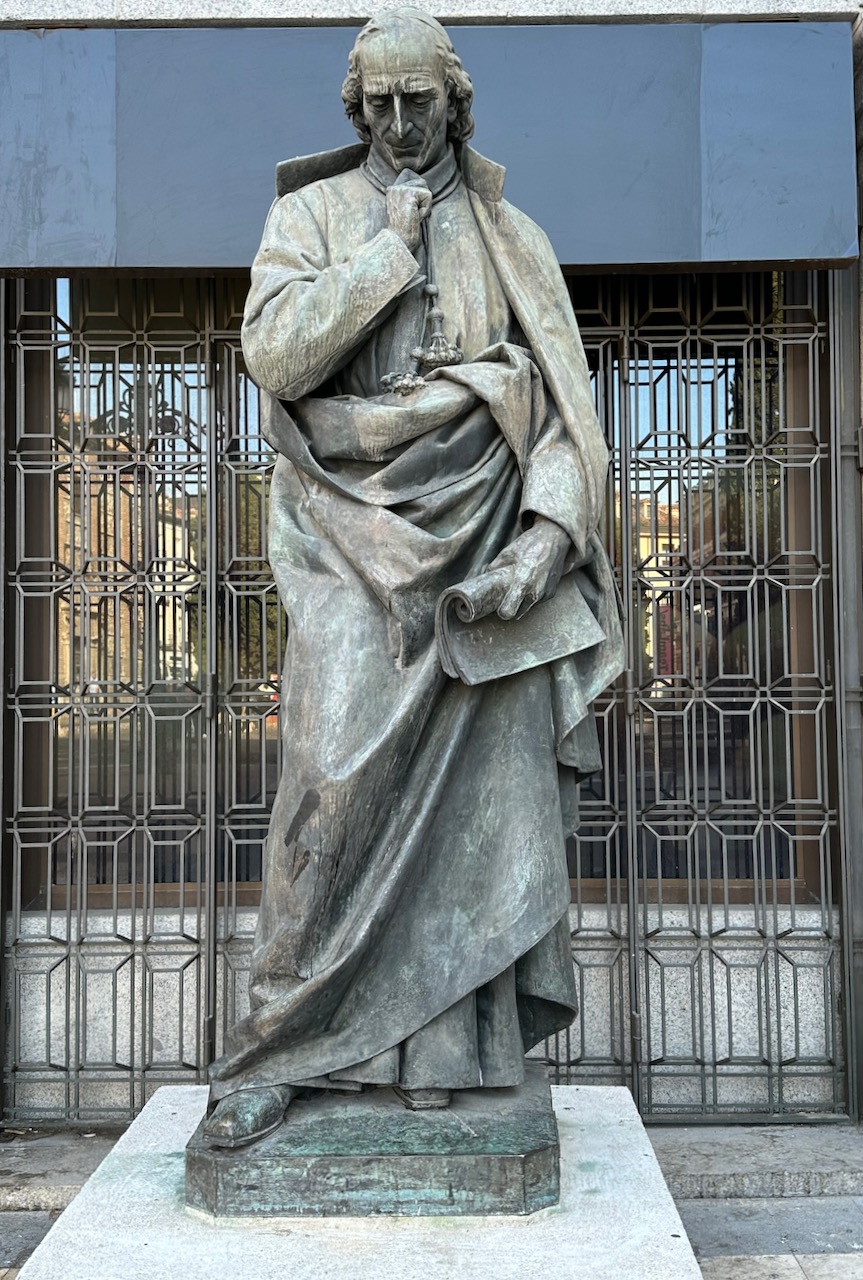
Nearby the monastery stood two statues, Spanish politician Joaquín Vizcaíno y Moles, the Marqués de Pontejo, and a monument honoring Francisco Piquer y Rodilla, a Spanish priest well-known for his charitable work.
Monasterio de las Descalzas Reales is located inside the former palace of Emperor Charles V and Empress Isabel of Portugal, but it was their daughter (and sister of Philip II), Joanna of Austria (hard to keep all the countries and Habsburgs straight), who founded a convent here for the nuns of the Poor Clares Order in the mid 1500s. She was widowed after two years of marriage to João Manuel of Portugal (nephew of Isabella of Portugal), and she became quite an important political figure in Spain. Joanna became more religious as the years went by, and over the following centuries young widowed women and spinsters joined the monastery bringing with them their dowries, making the palace/monastery one of the richest convents in Europe, and one reason there are so many famous and valuable pieces of artwork here.
The nuns walked barefoot in the monastery in imitation of Saint Clare which is why the monastery is called the “Convent of the Barefoot Royals.” It is still a working monastery. The entire tour is in Spanish, and there are no signs indicating what we were looking at, but the interior of the monastery is so mesmerizing it is well worth visiting. We started at the stunning Renaissance staircase and landing.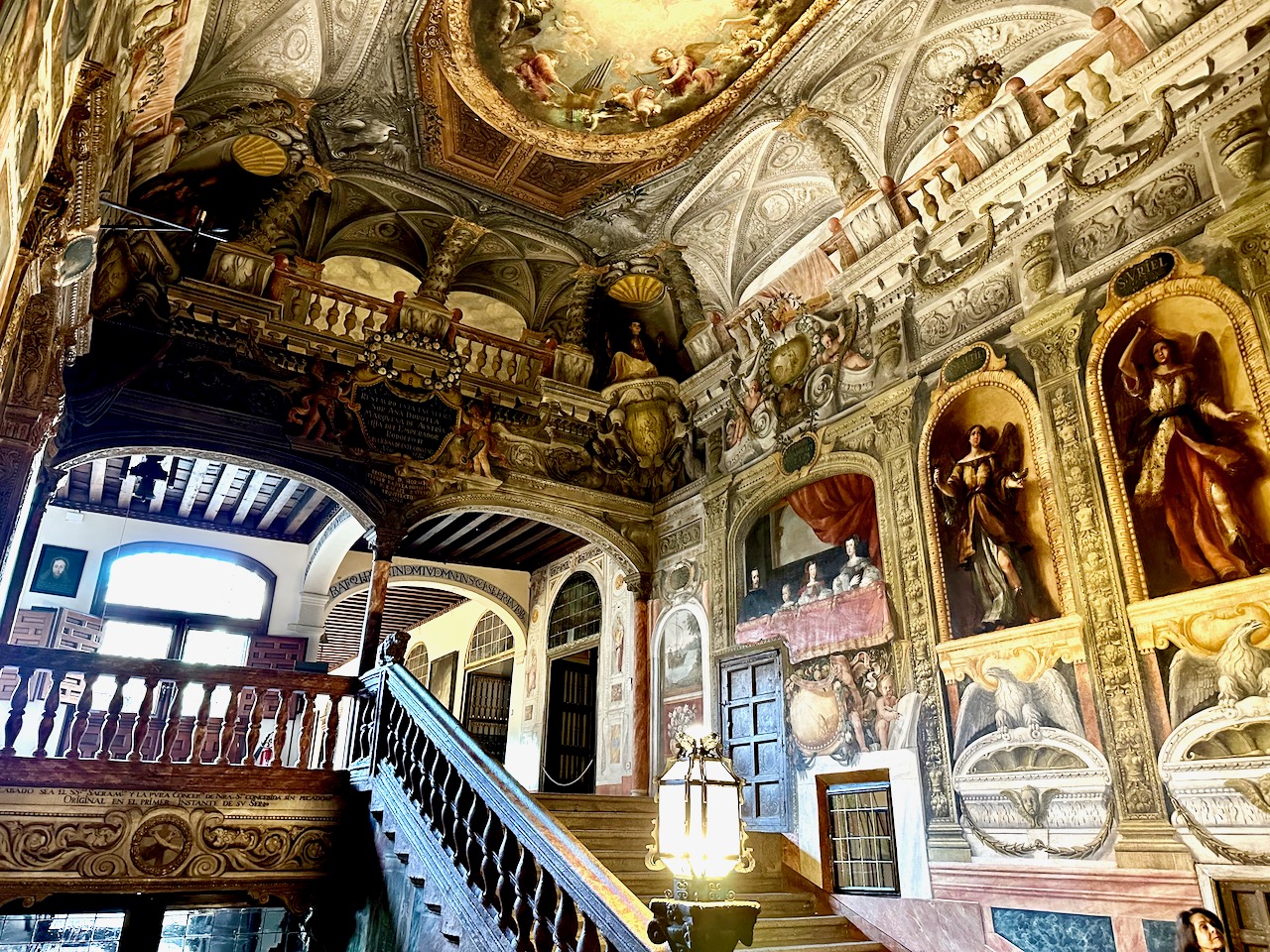
The murals on the walls depict the wealth of the Spanish monarchy. The magnificent ceiling adds to the dramatic effect.
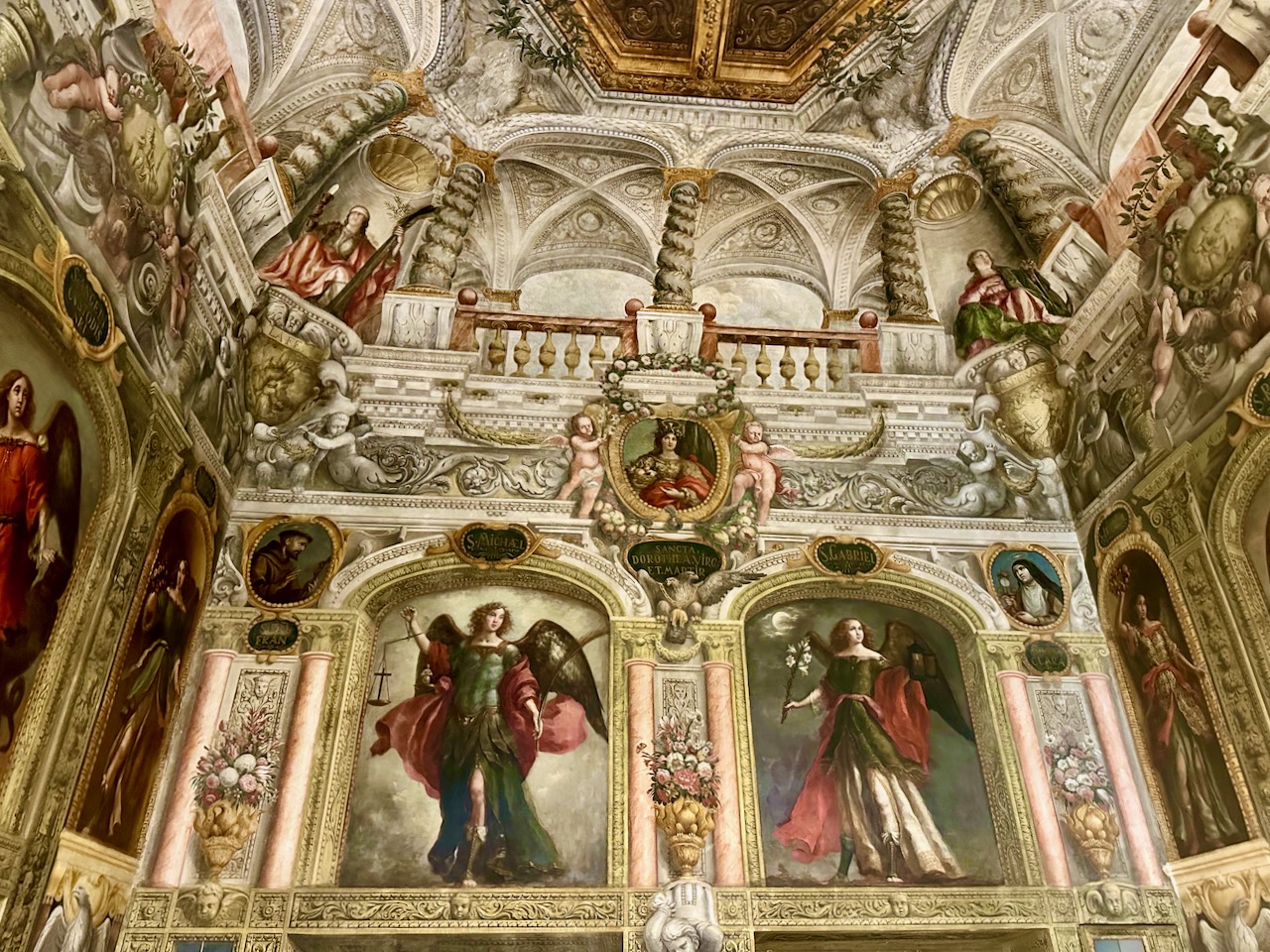
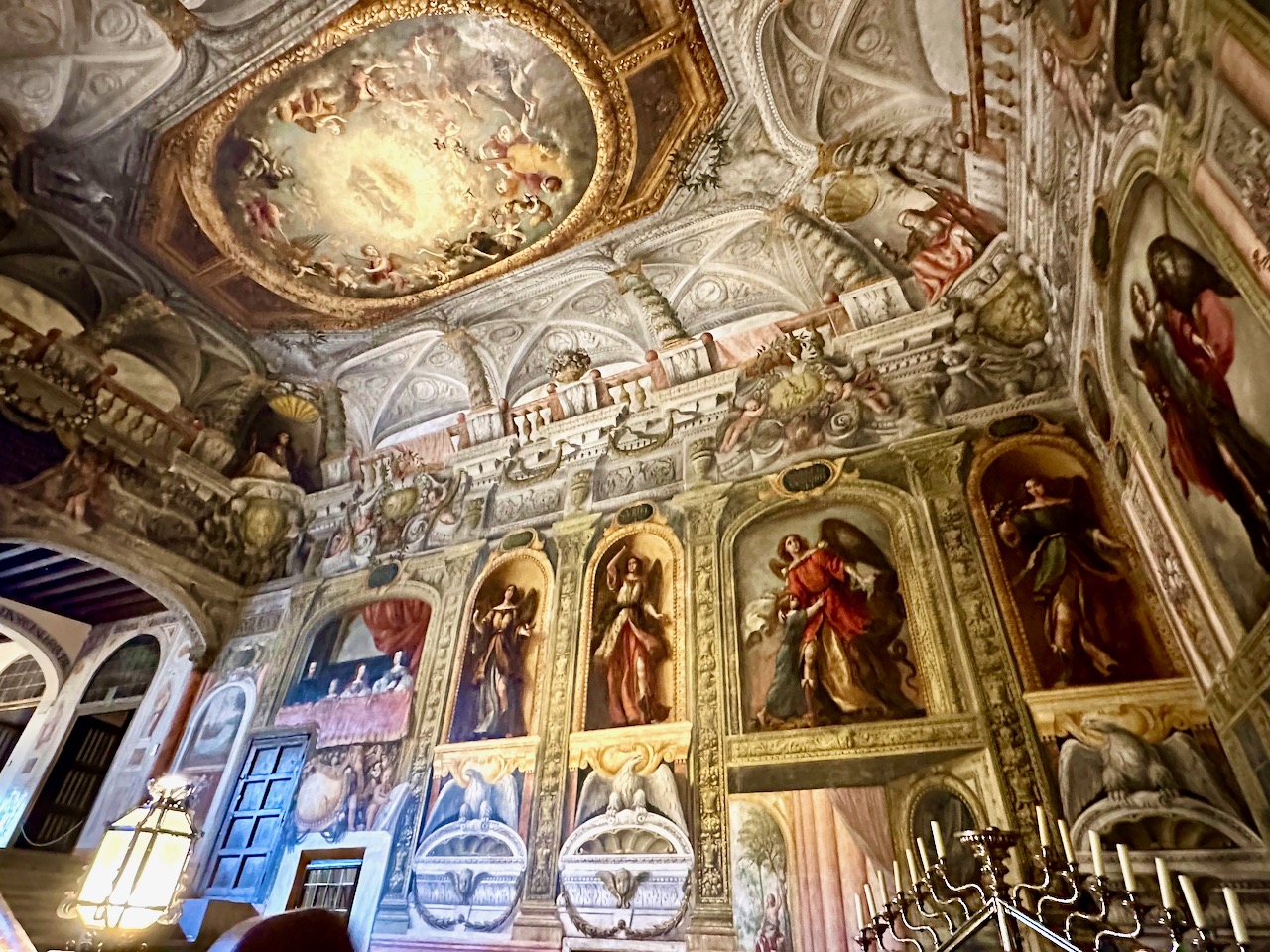
The trompe-l’œil mural below features El Palco Real (The Royal Box) with King Philip IV of Spain and his family looking out upon us mere peasants.
A closer look at that ceiling.
From the landing, the view of the surroundings is even more spectacular.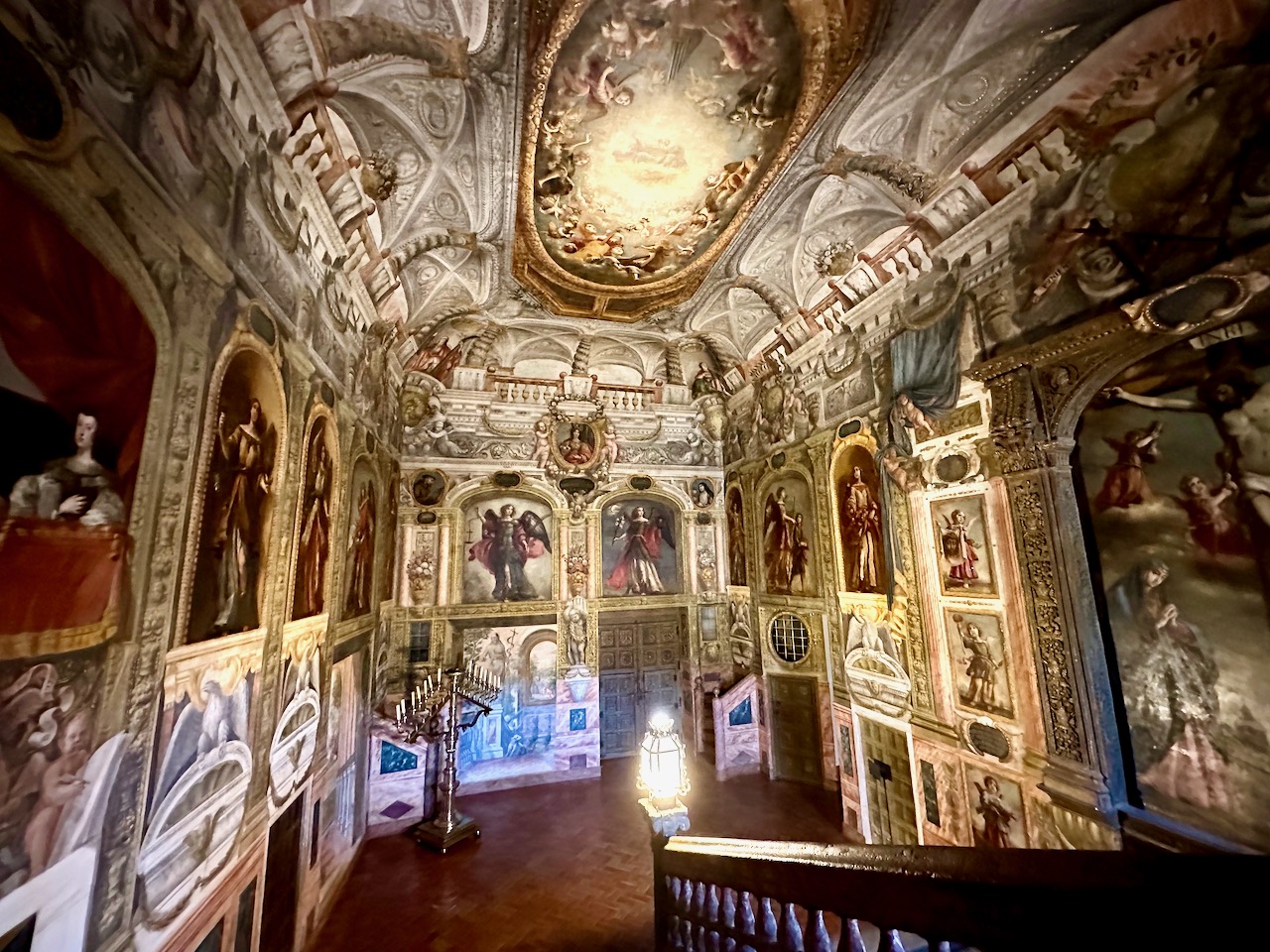
As the tour continued, Tracy whispered, “Doesn’t our tour guide remind you of Stanley Tucci?” If he had said, “Oh, my God!” (or in his case, “Ay dios mío!”) then I would have known for certain it was him.
In the Chapel of the Recumbent Christ by Gaspar Becerra is this 16th century (1563) piece.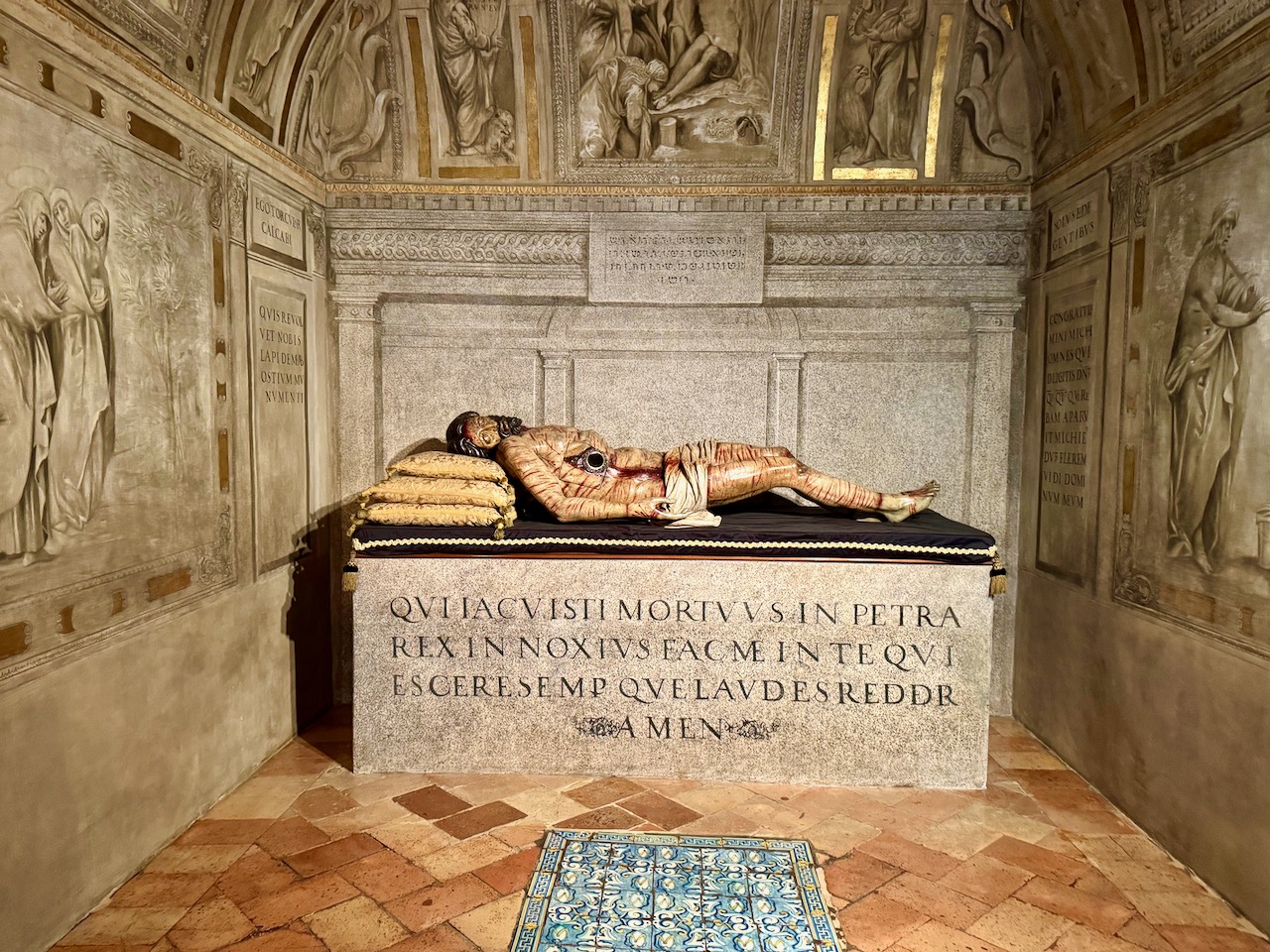
There are, I believe, 33 chapels …
 x
x 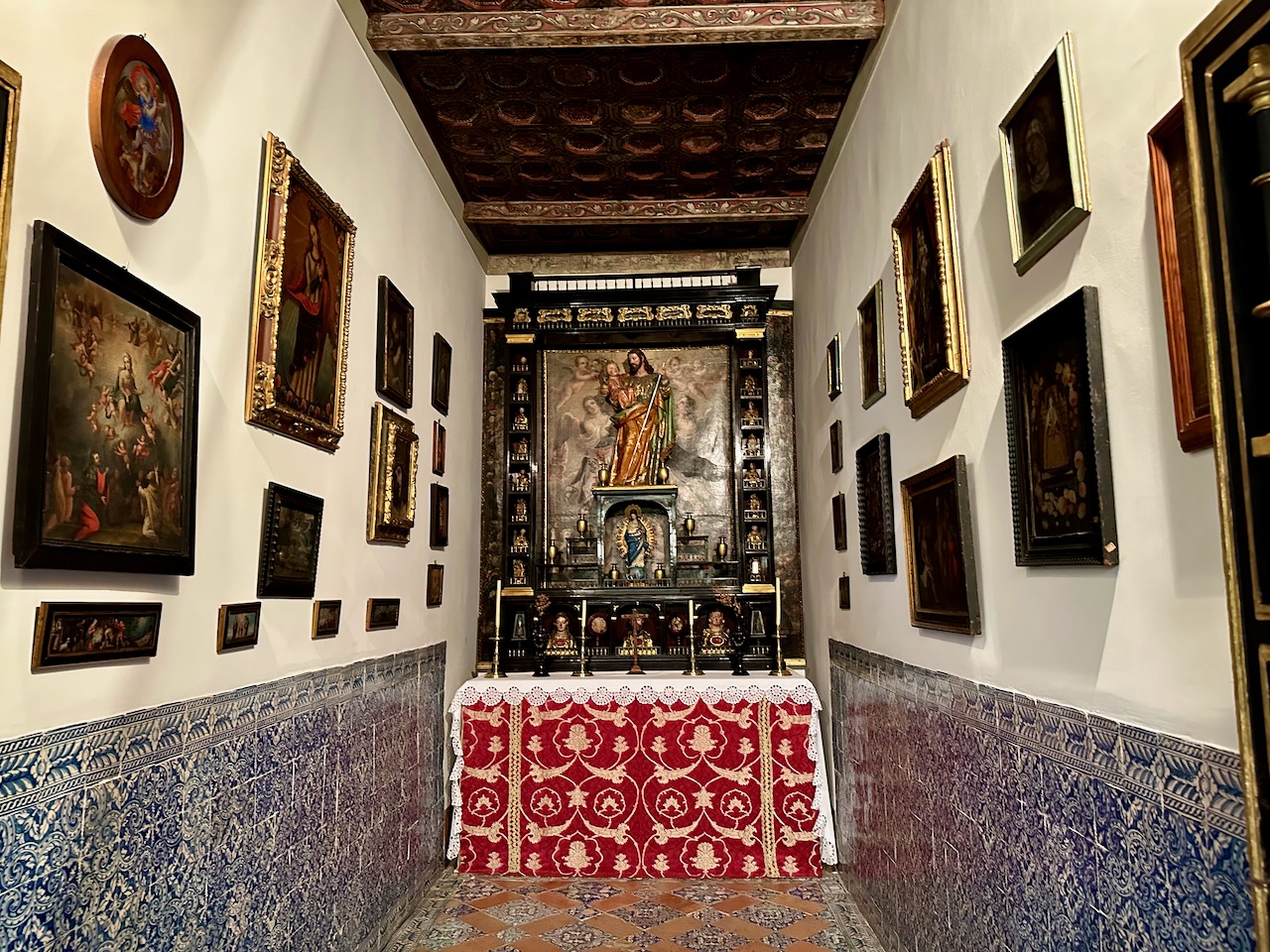
… along the Upper cloister route.
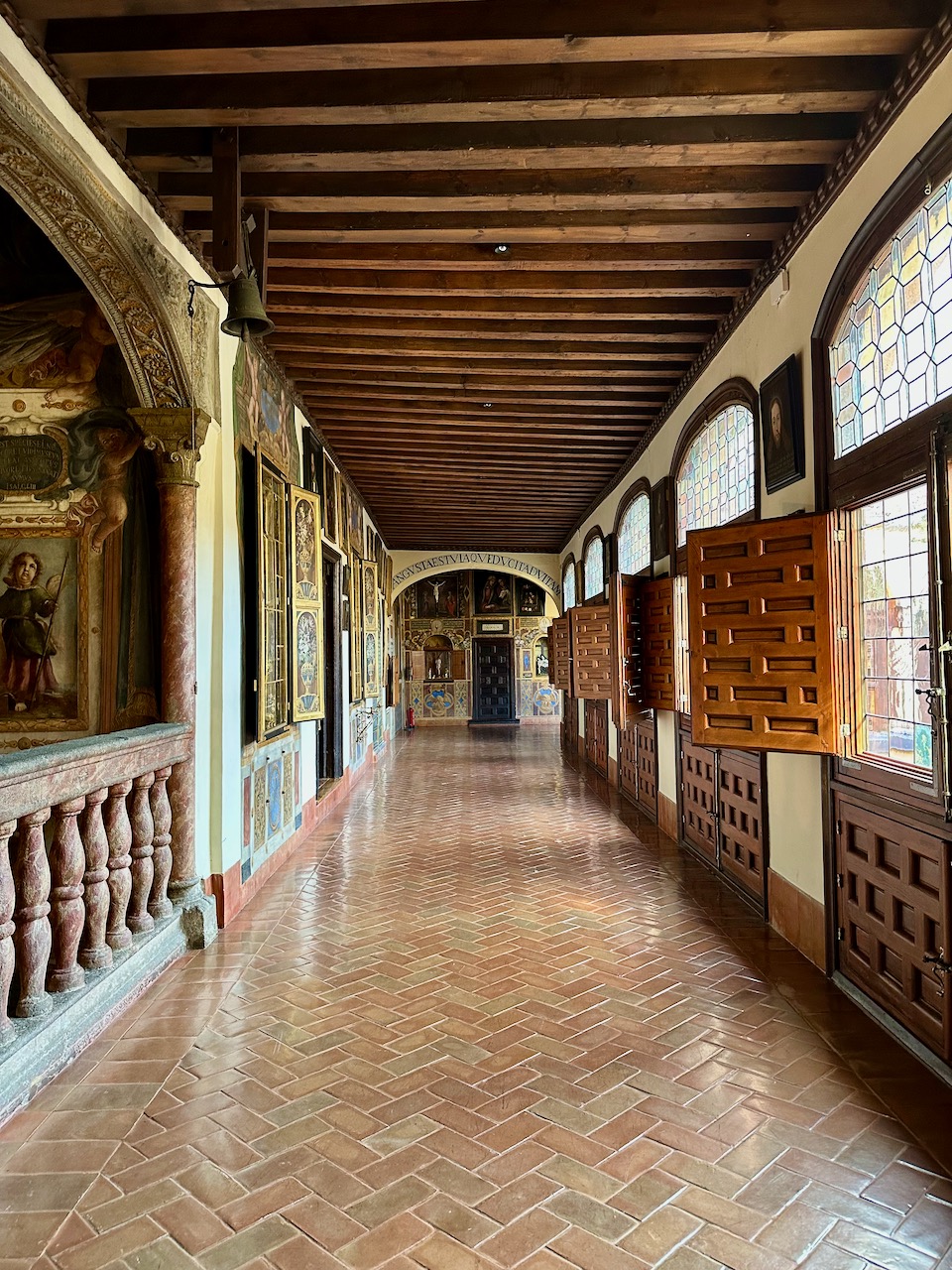
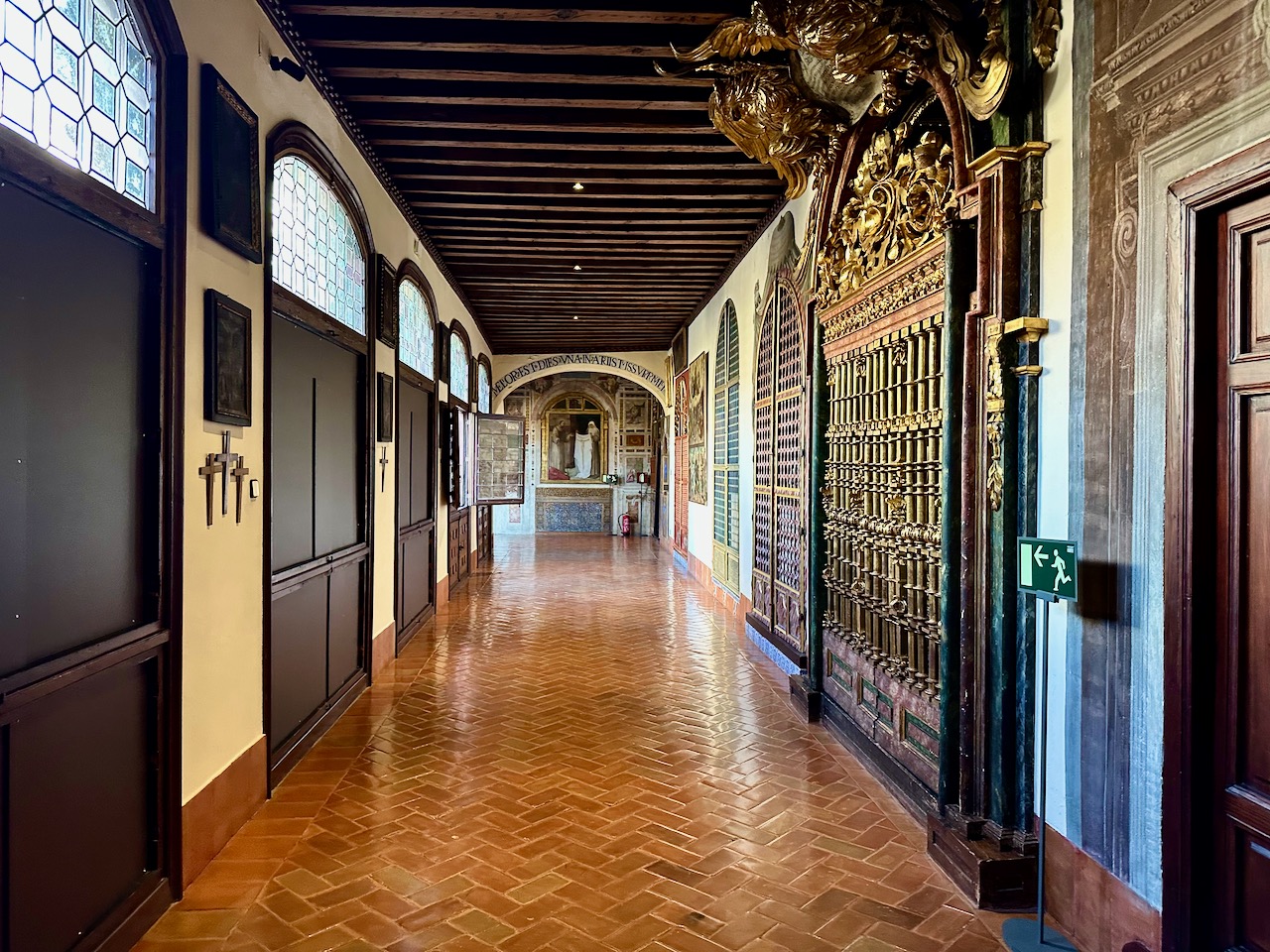
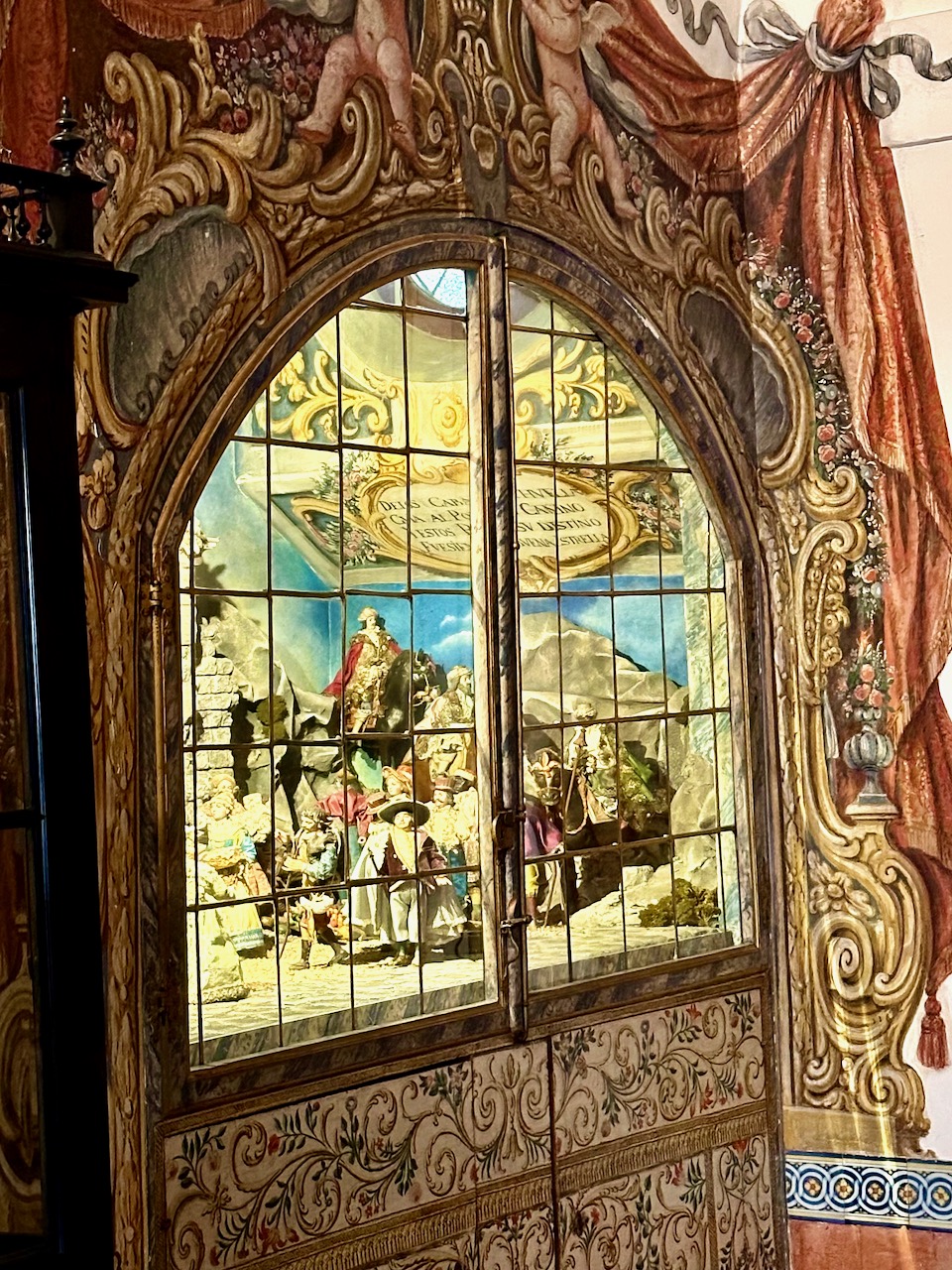
This one contained a cabinet with something going on inside.

We looked out onto the inner courtyard.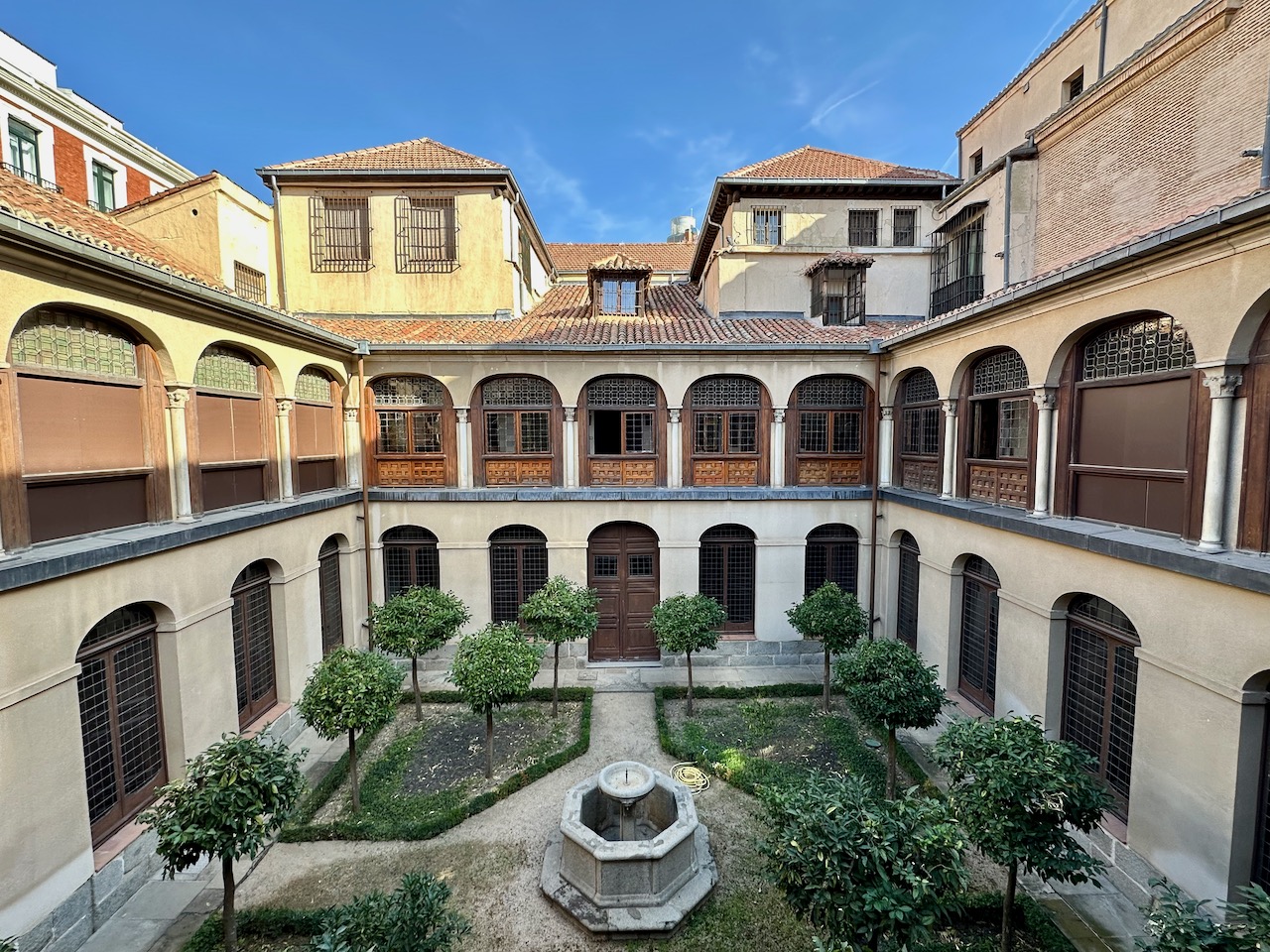
The 1650s painting on the right is The Seven Archangels by Massimo Stanzione.
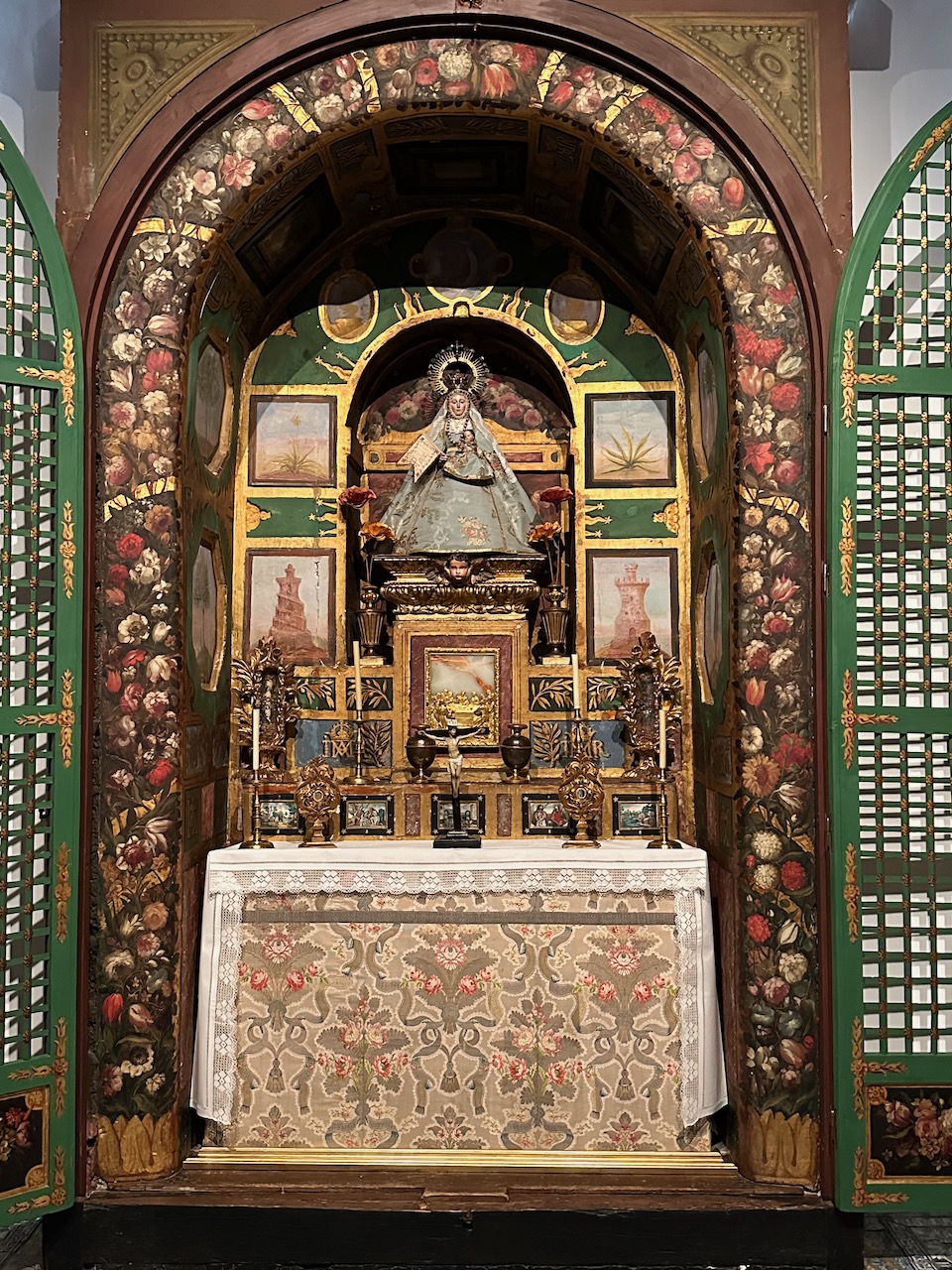
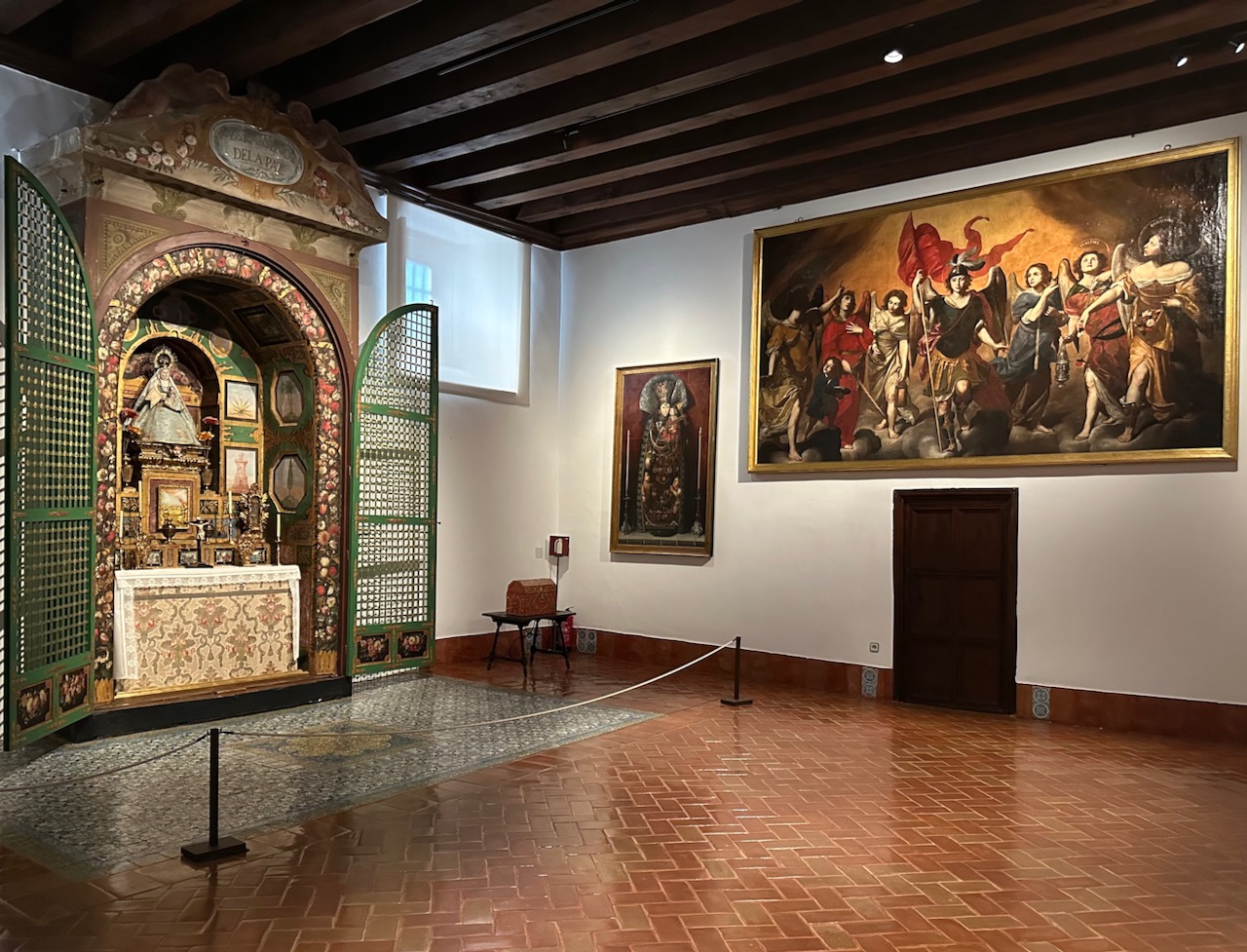
Next stop was the Choir, which contains the tombs of Empress María and her daughter, Infanta Margarita. The room has wooden choir stalls where the nuns gathered to pray.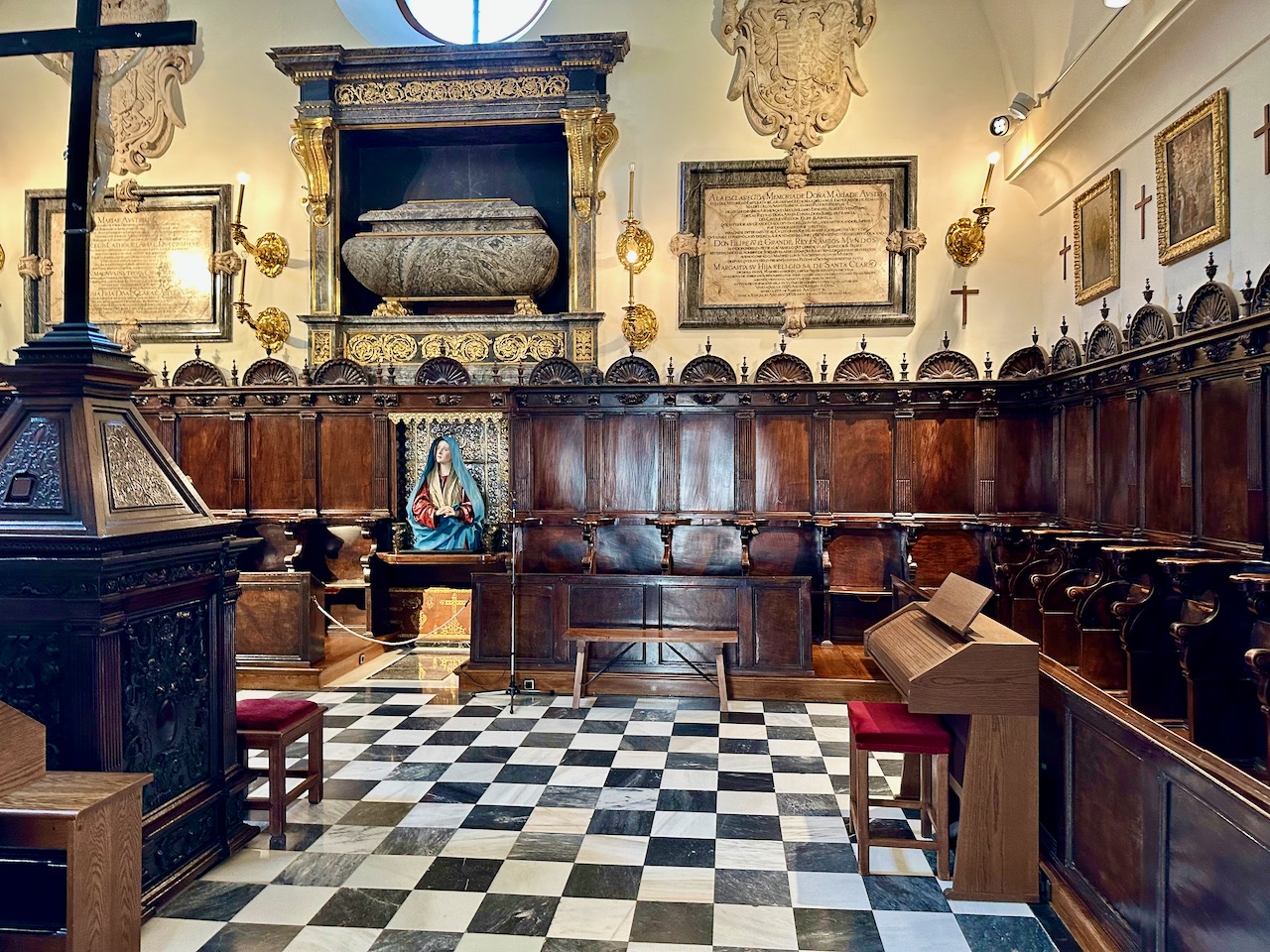
In the middle is Mater Dolorosa (Mother of Sorrows).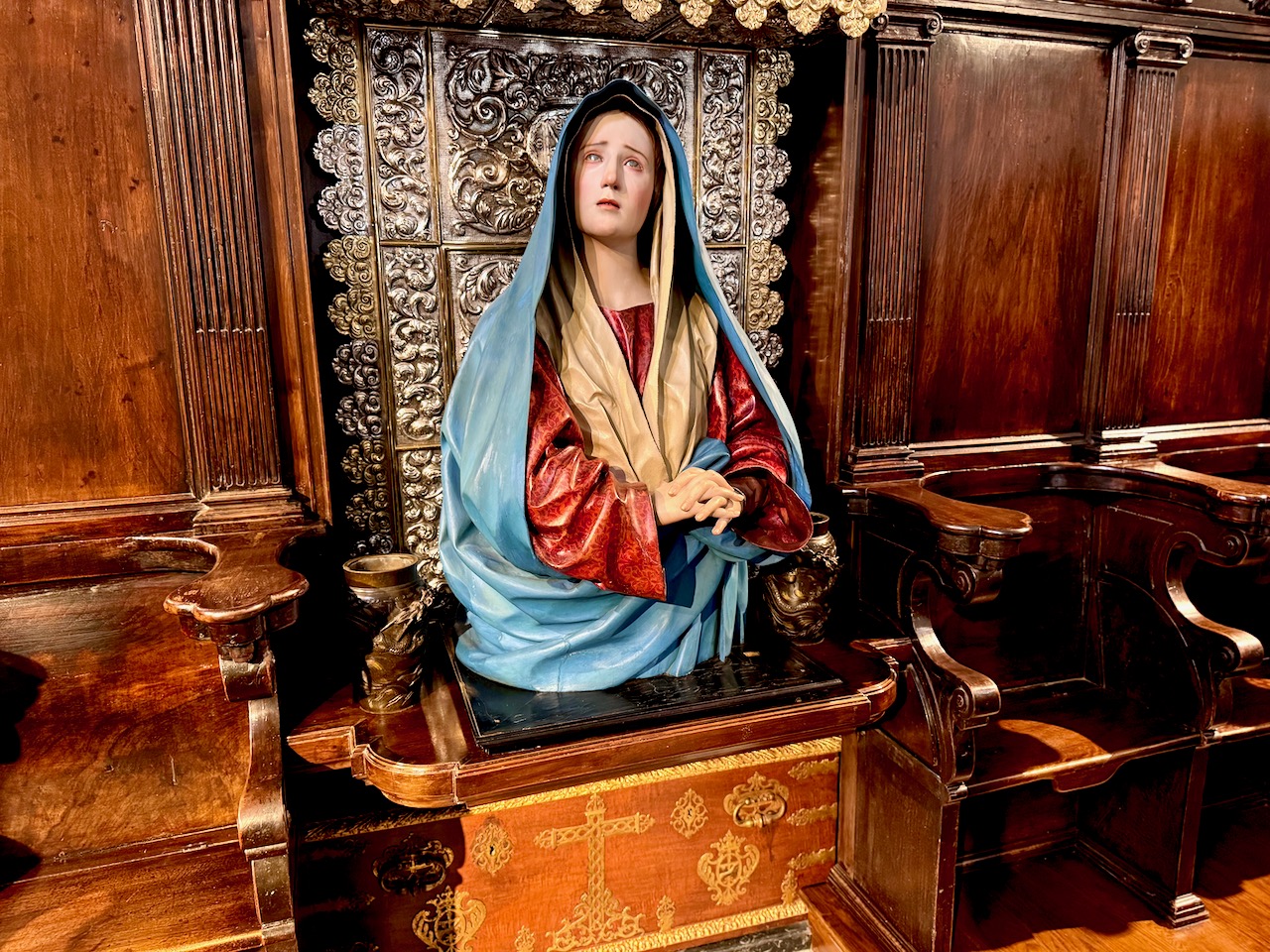
Lots of Marys in this room. Our friend Mary would have felt right at home.
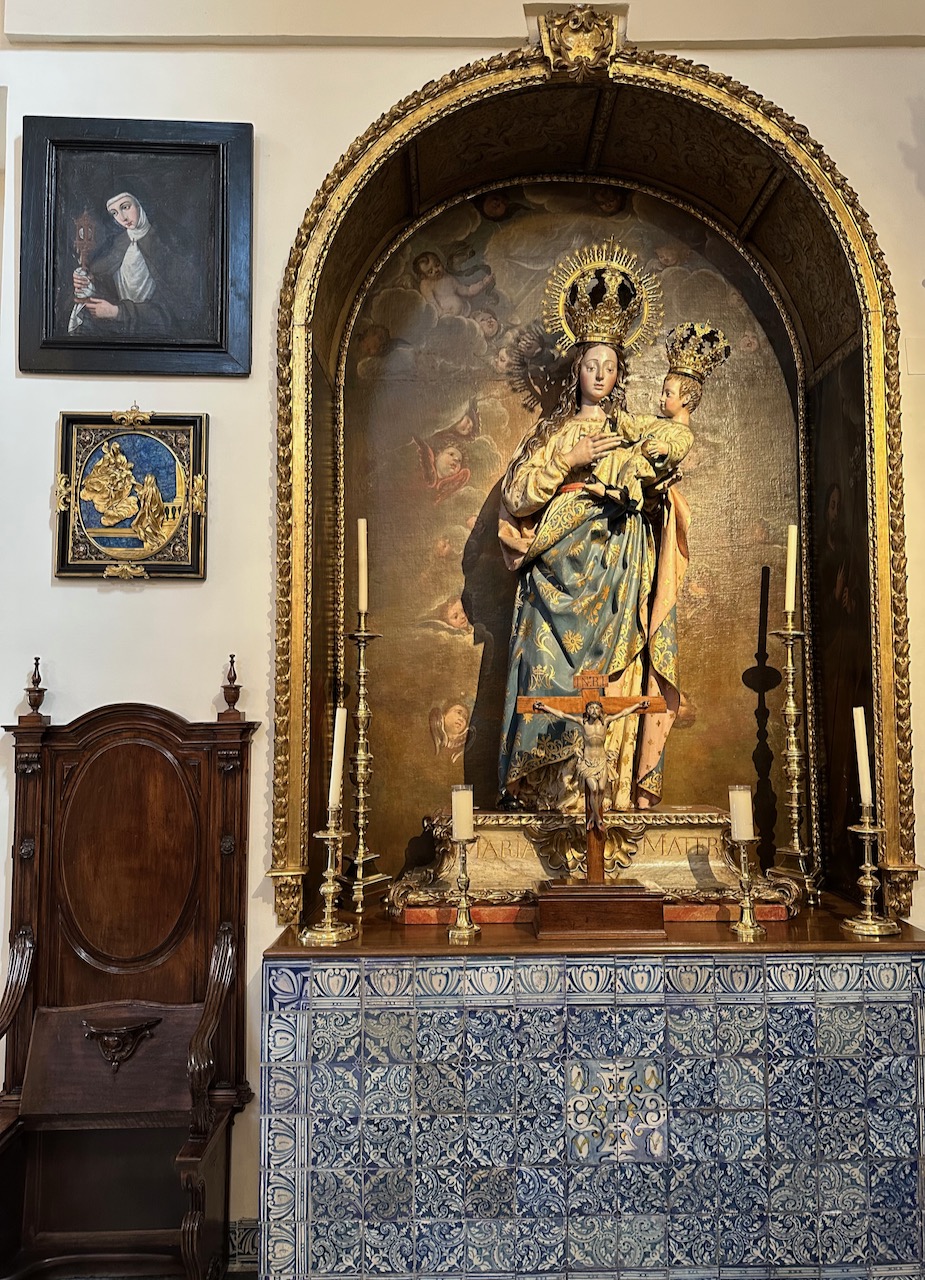
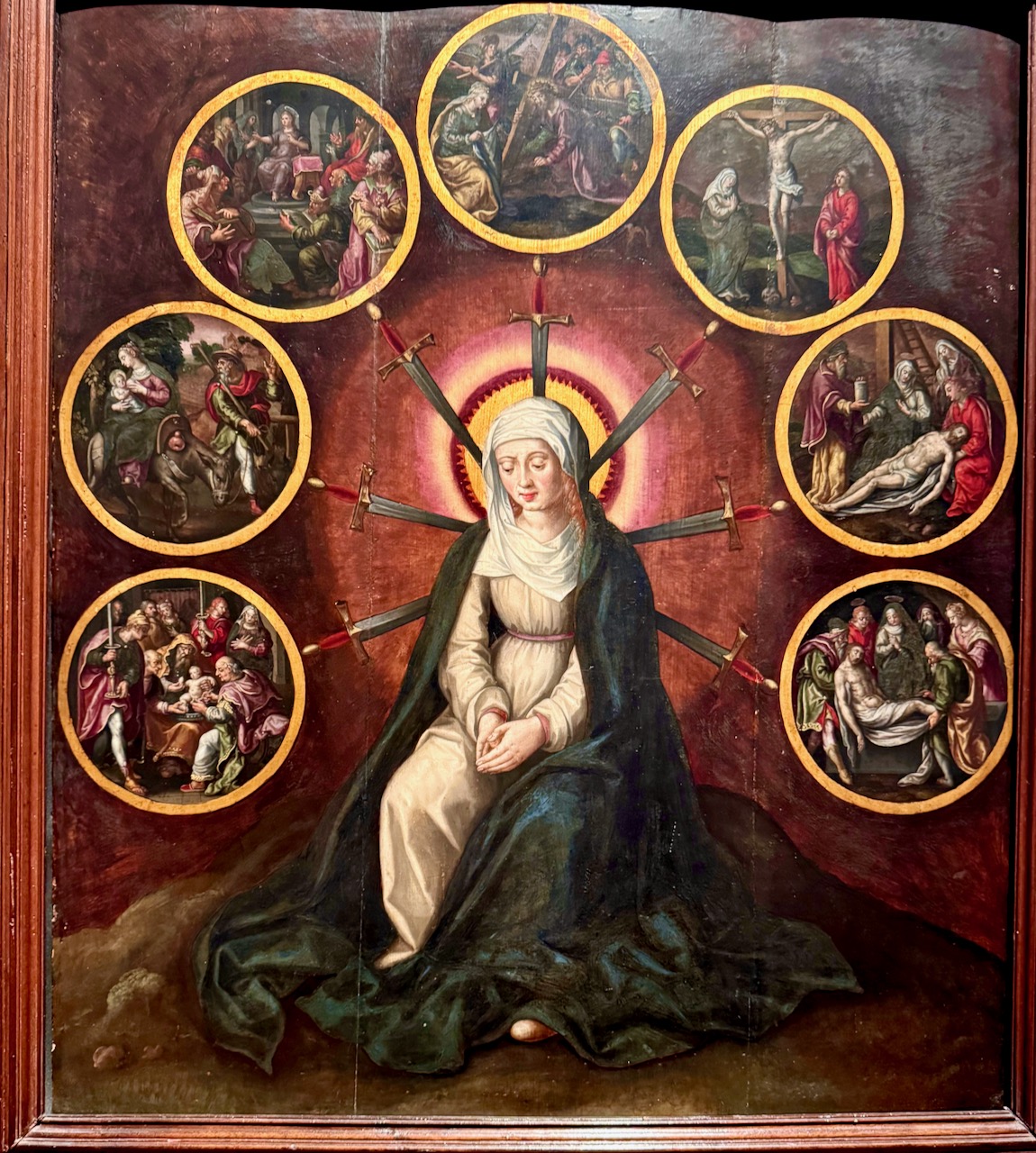
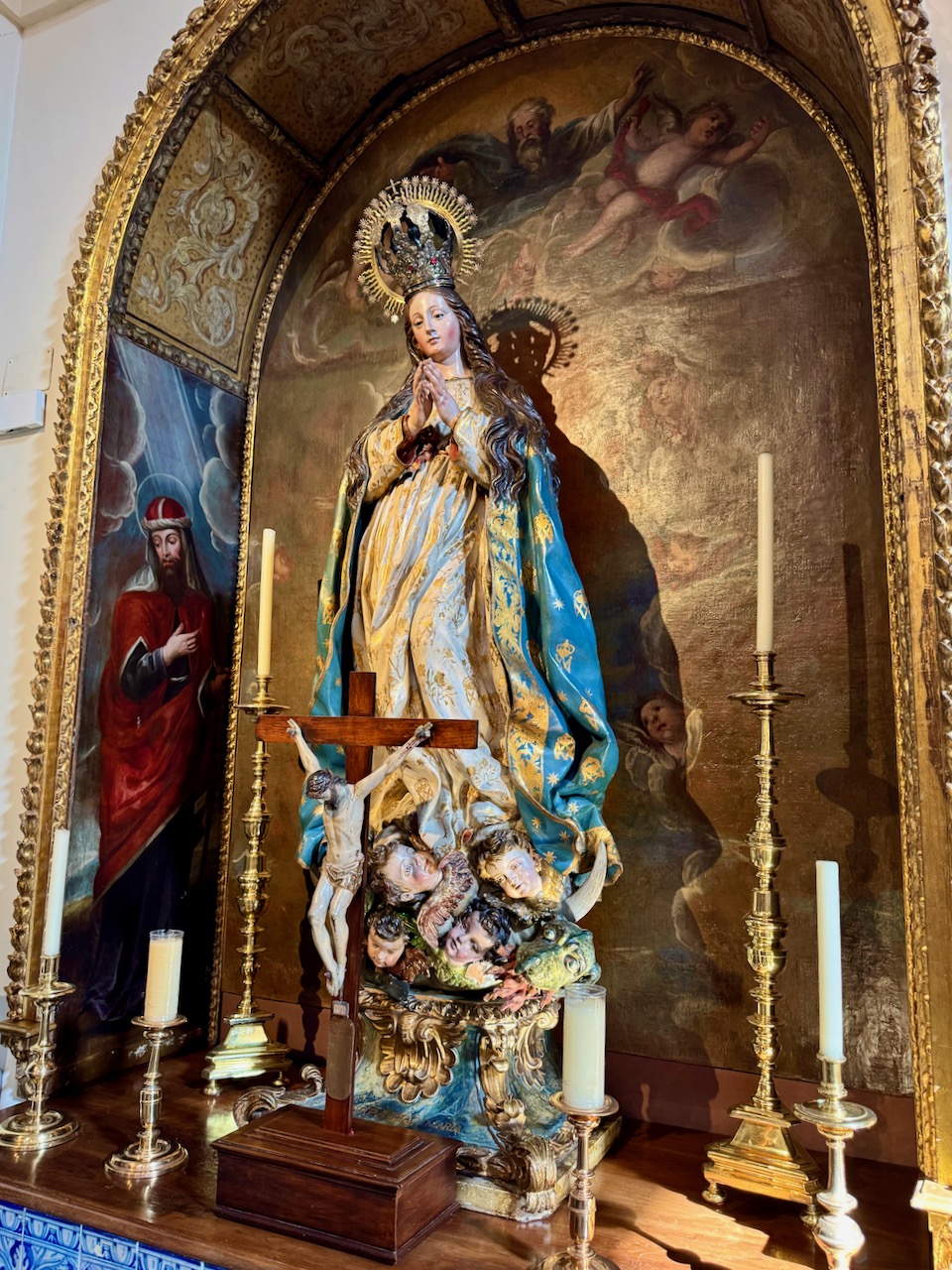
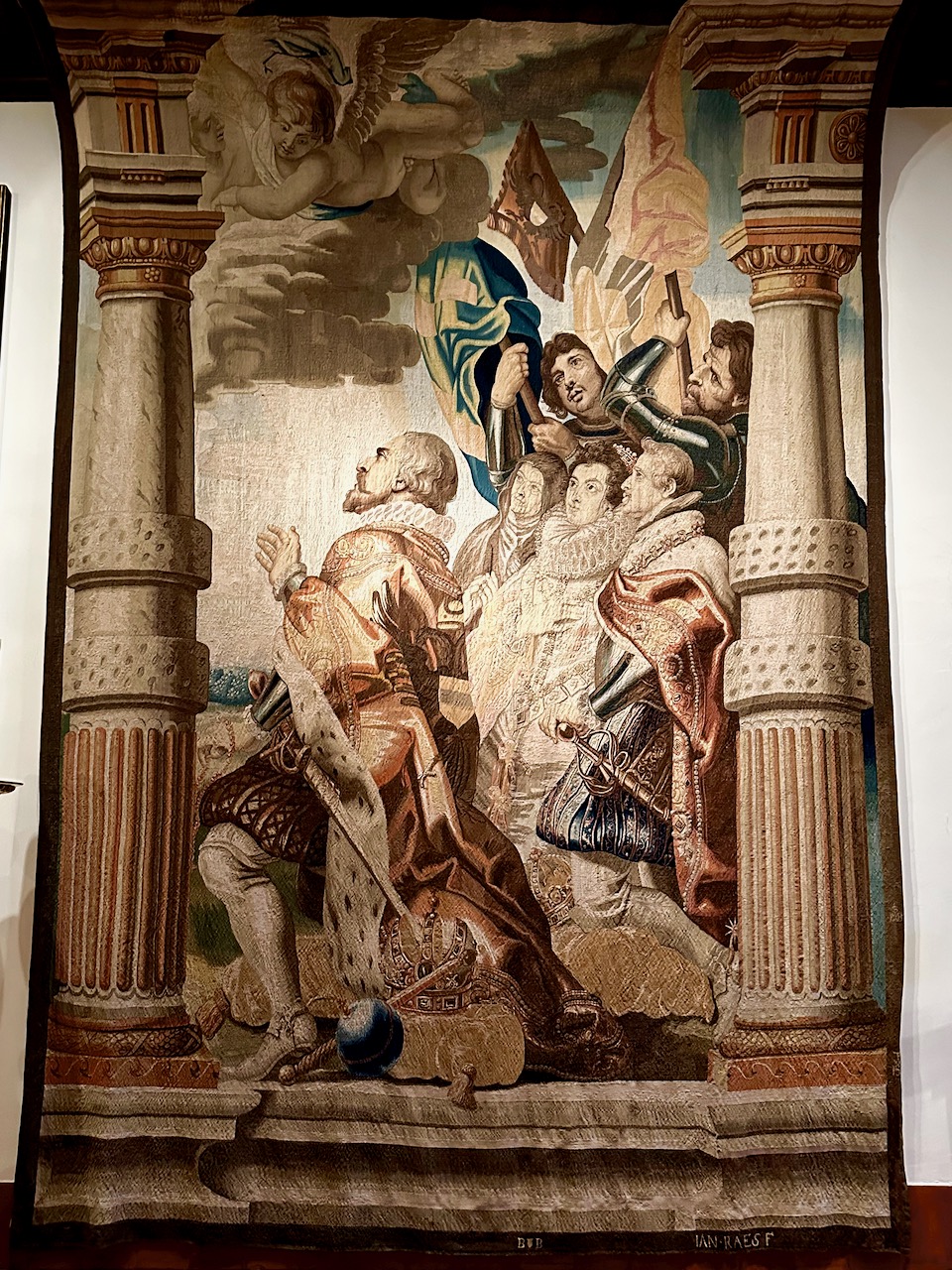
The Tapestry Room, which occupies the former dormitory of the nuns, is certainly one of the major highlights of the 60+-minute tour.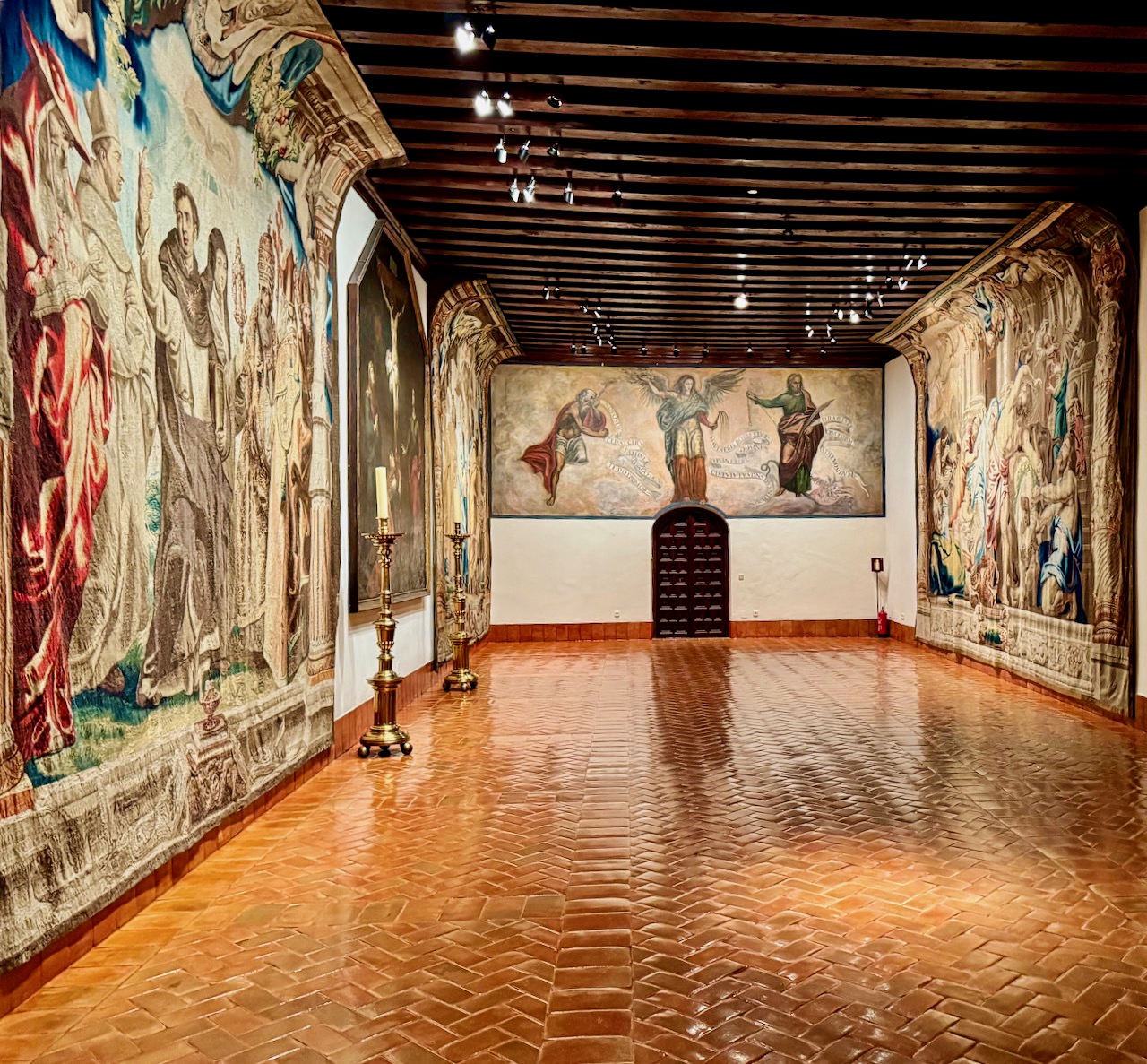
Brilliantly preserved (and I believe rather recently restored) tapestries include the Triumph of the Eucharist based upon the design of Rubens.
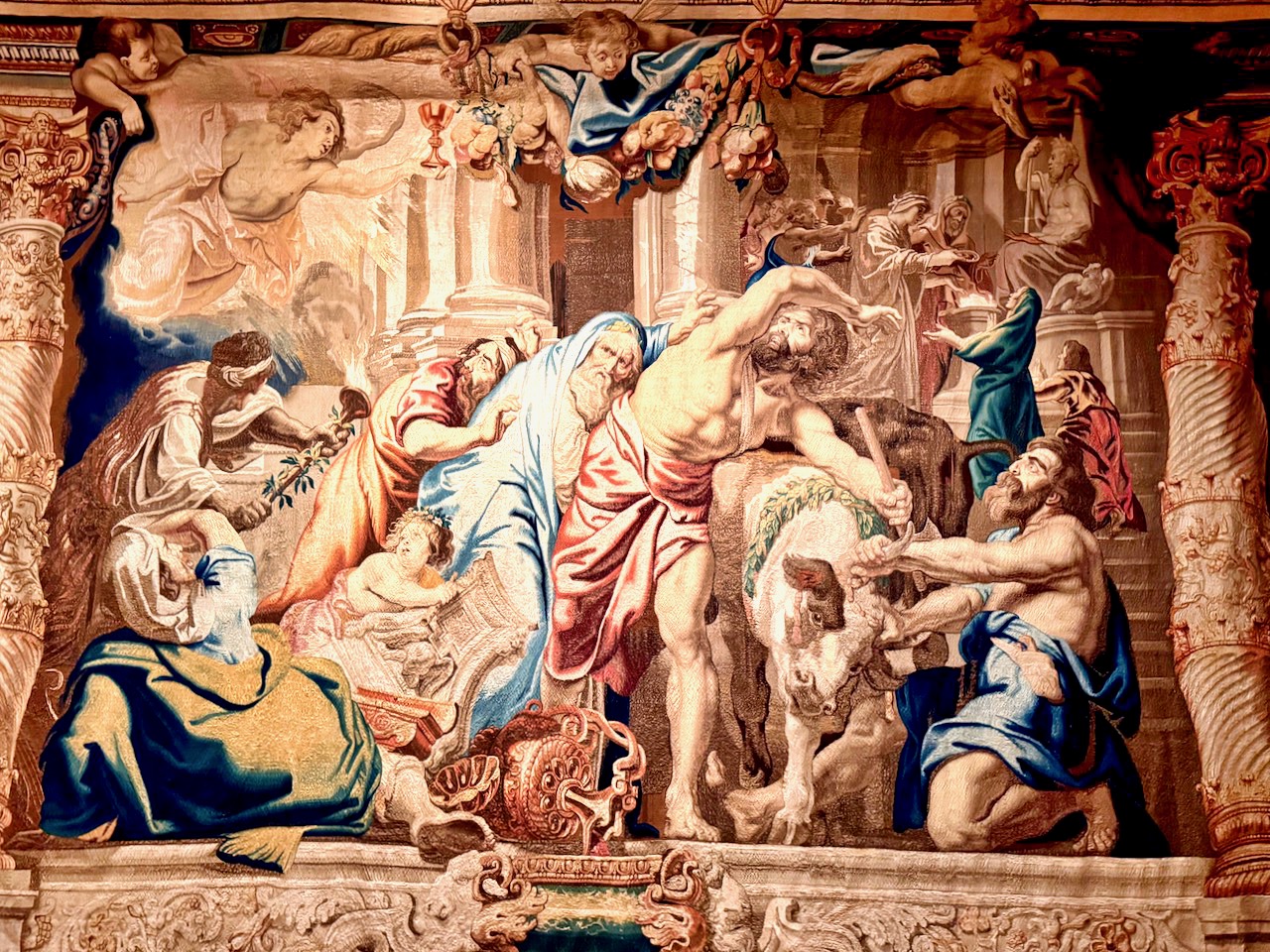
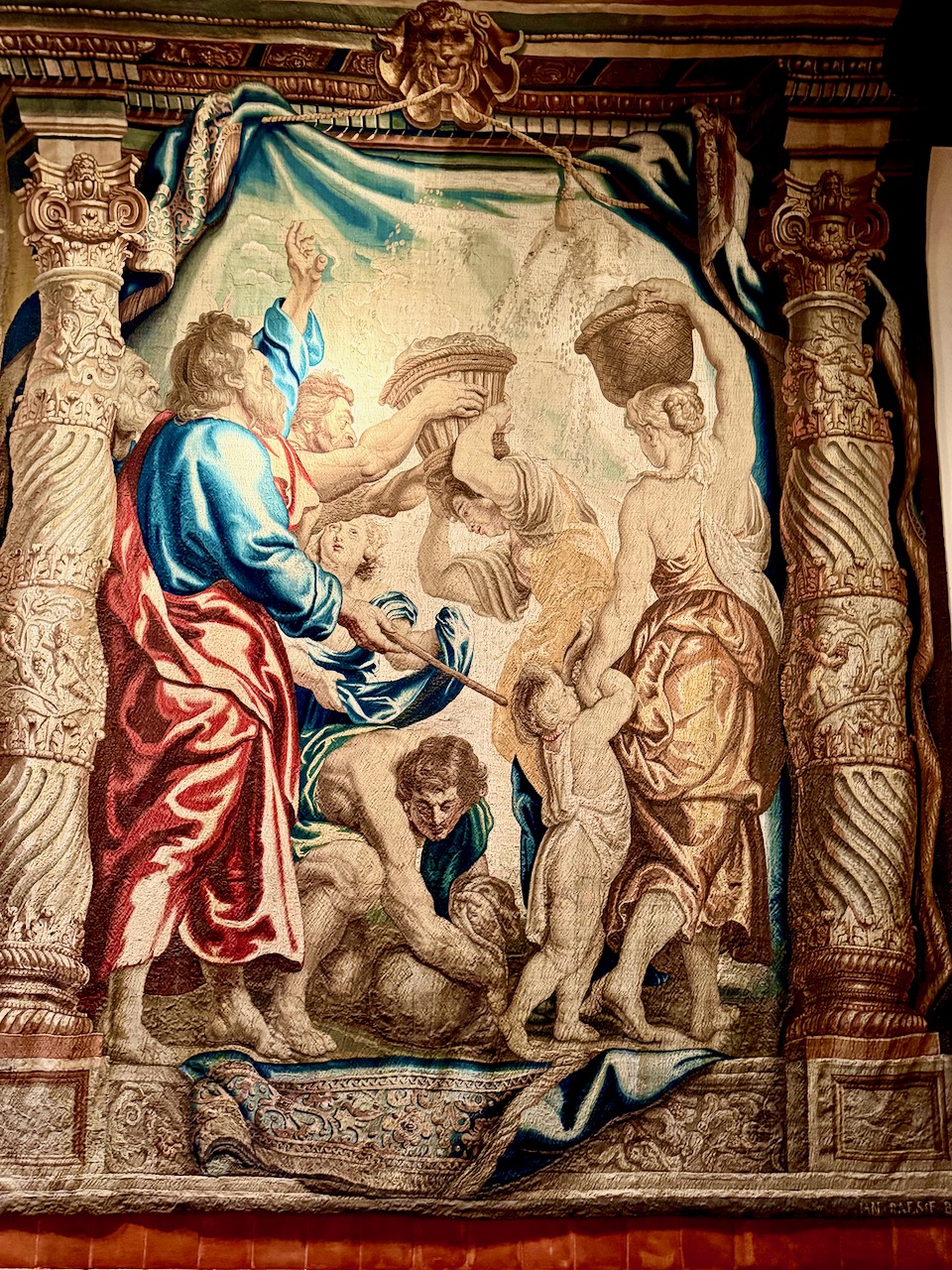
They are part of a set of 20 tapestries commissioned for the convent by the Infanta Isabel Clara Eugenia, the governor-general of the Spanish Netherlands.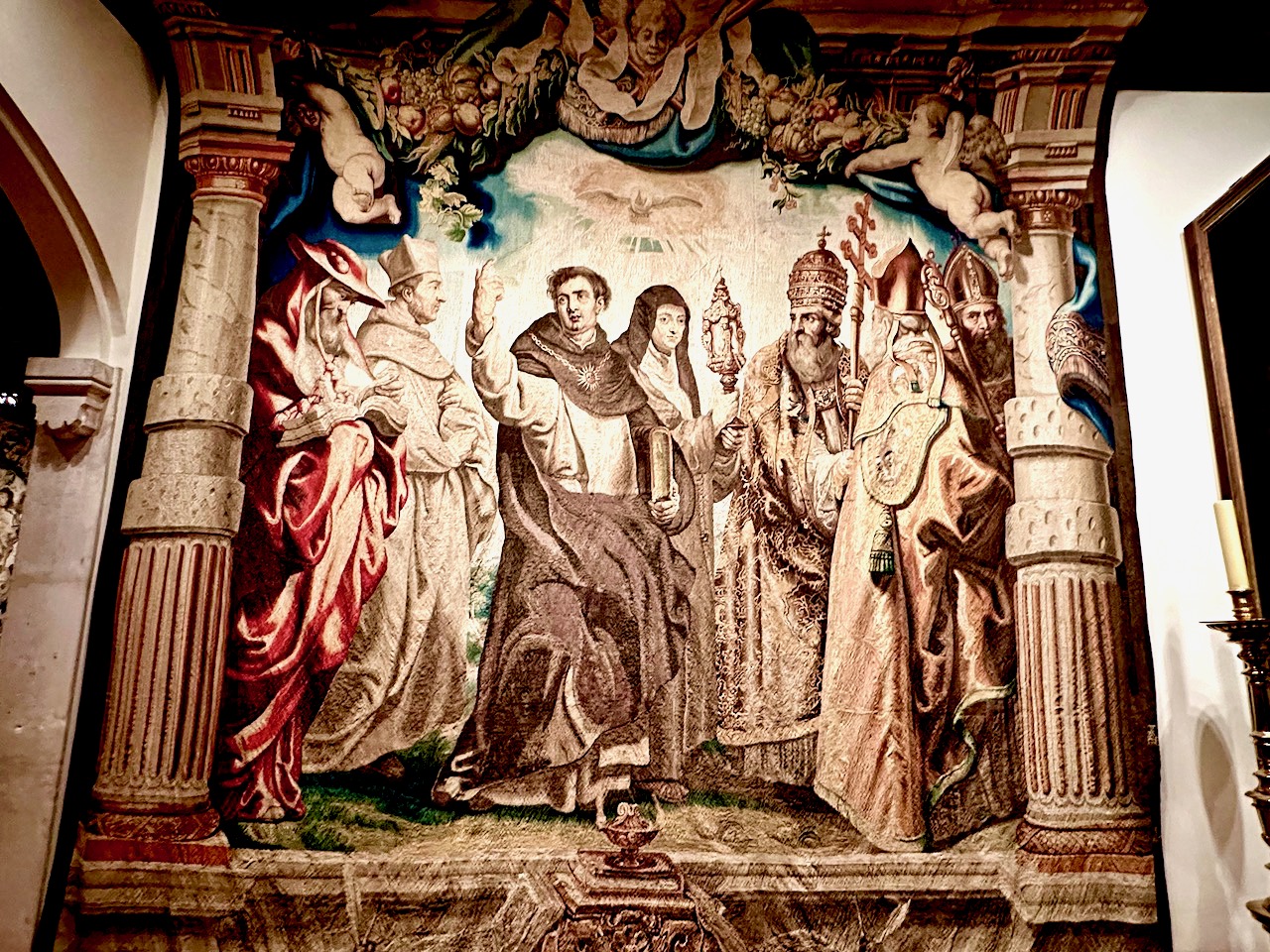
There was ample time in this area to admire these magnificent pieces.
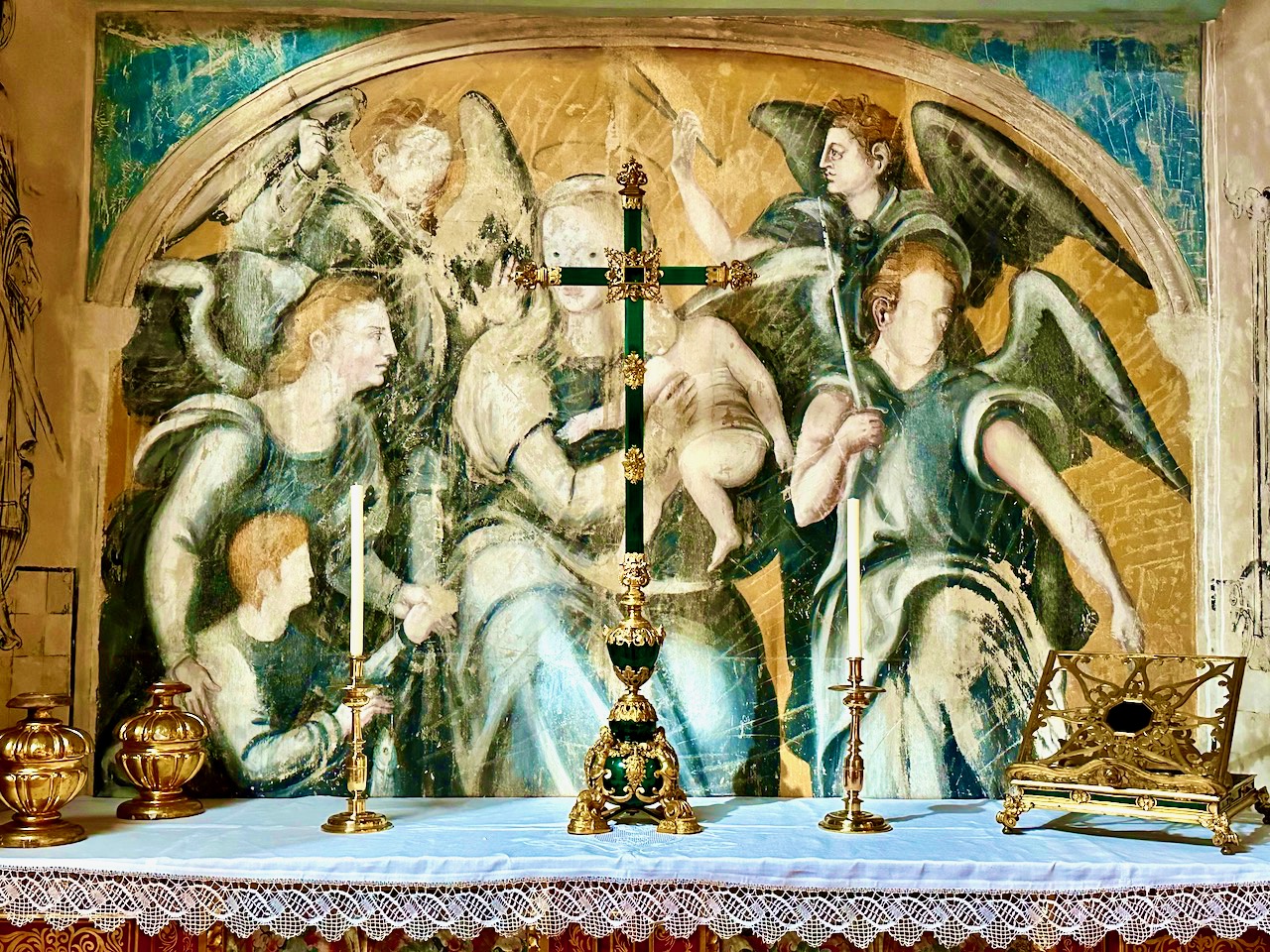
In another room, there were numerous paintings of nuns …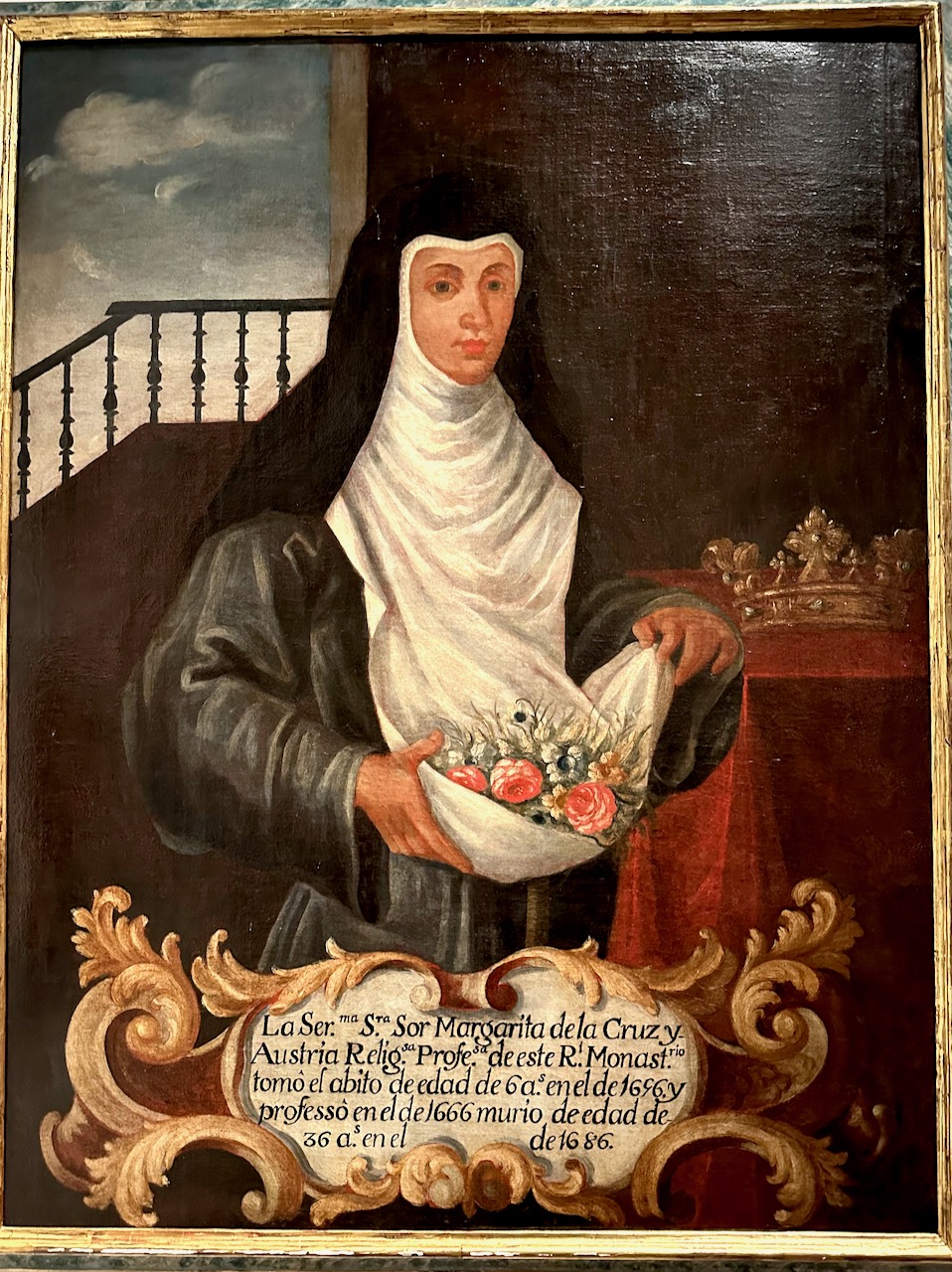
… but the tour guide had laser-focused the group on one particular painting, and after a little explanation, he pulled open the painting to reveal this skeleton-portrait. It sounded interesting, but my rudimentary, at best, Spanish was of no help. However, when I returned home I emailed Maribel, and she was able to provide insight into the painting.
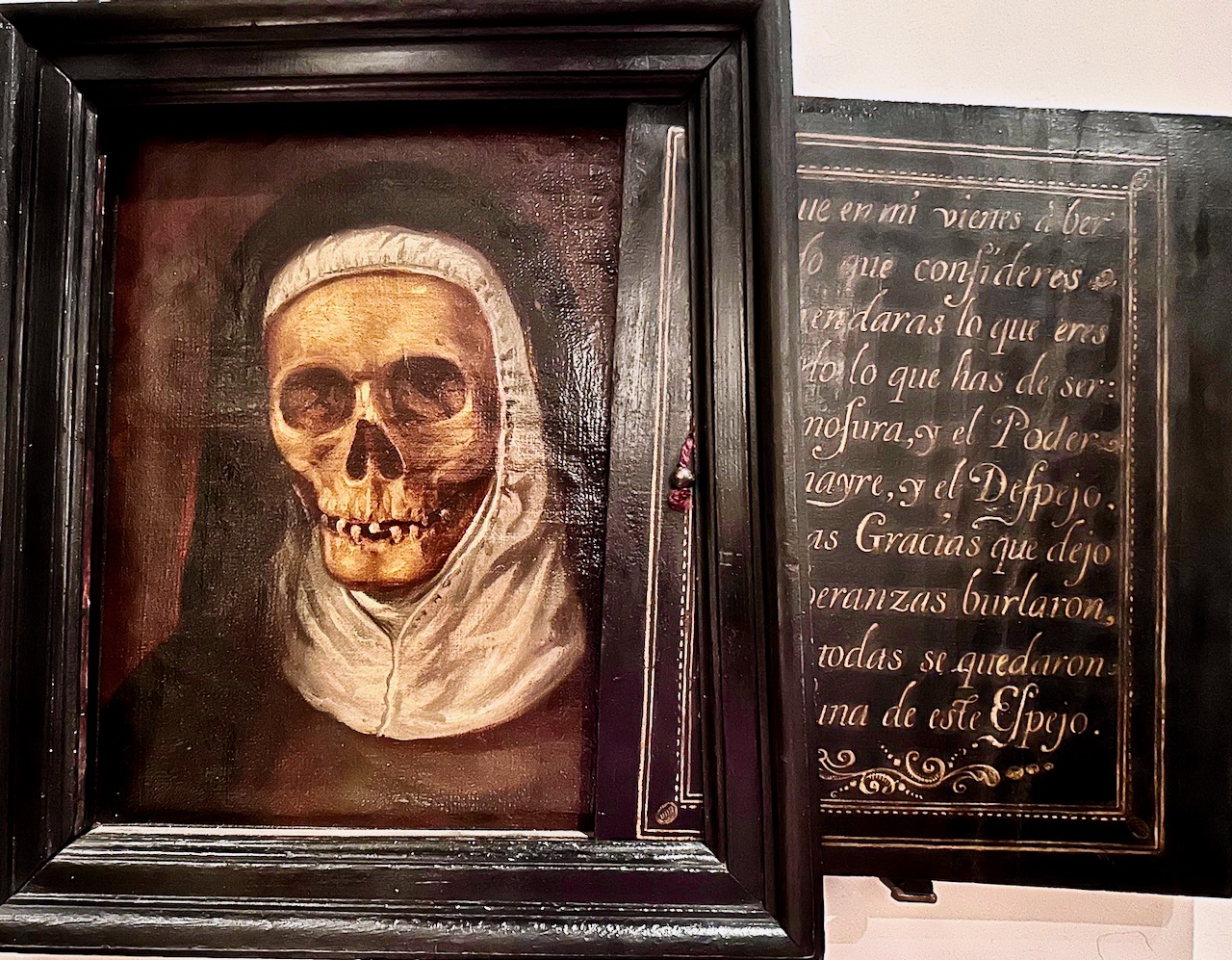
In her words, “It was an artistic movement called ‘Vanitas’ of producing death portraits to remind the viewer just how fleeting life is and how lasting death is. The most striking example of this is the skeleton portrait that you saw at Descalzas, where the aristocratic young nuns could not lose sight of death. The title is ‘The Mirror of the Clarisas’ (their religious order). On the black tablet covering this macabre portrait, the words inscribed are:
‘What you come to see in me,
I ask you to consider,
and you will amend what you are,
looking at what you must be:
beauty, and power,
grace and clarity,
with other graces that I leave behind,
your hopes mocked,
because they all remained
in the moon of this mirror’.”
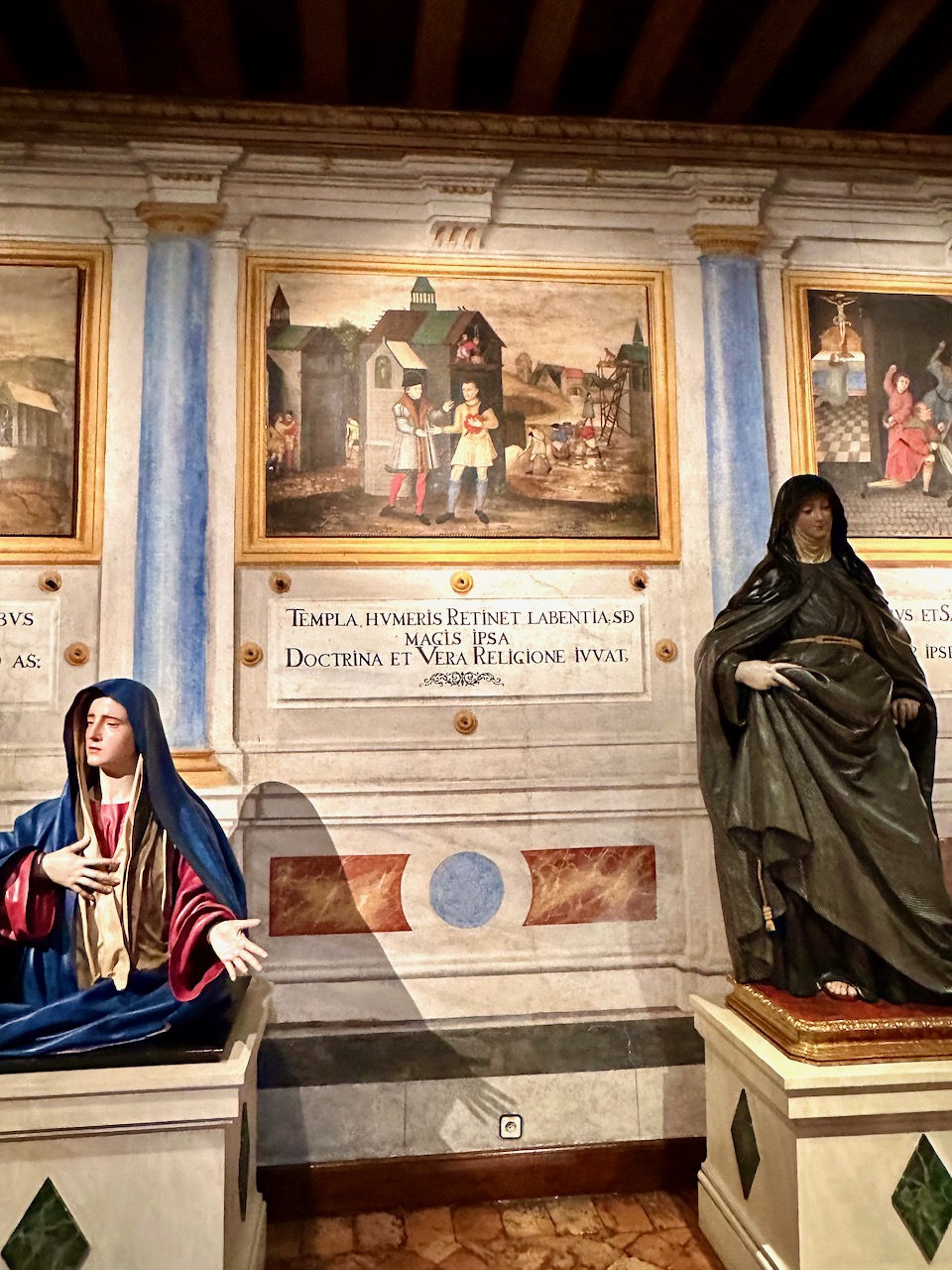
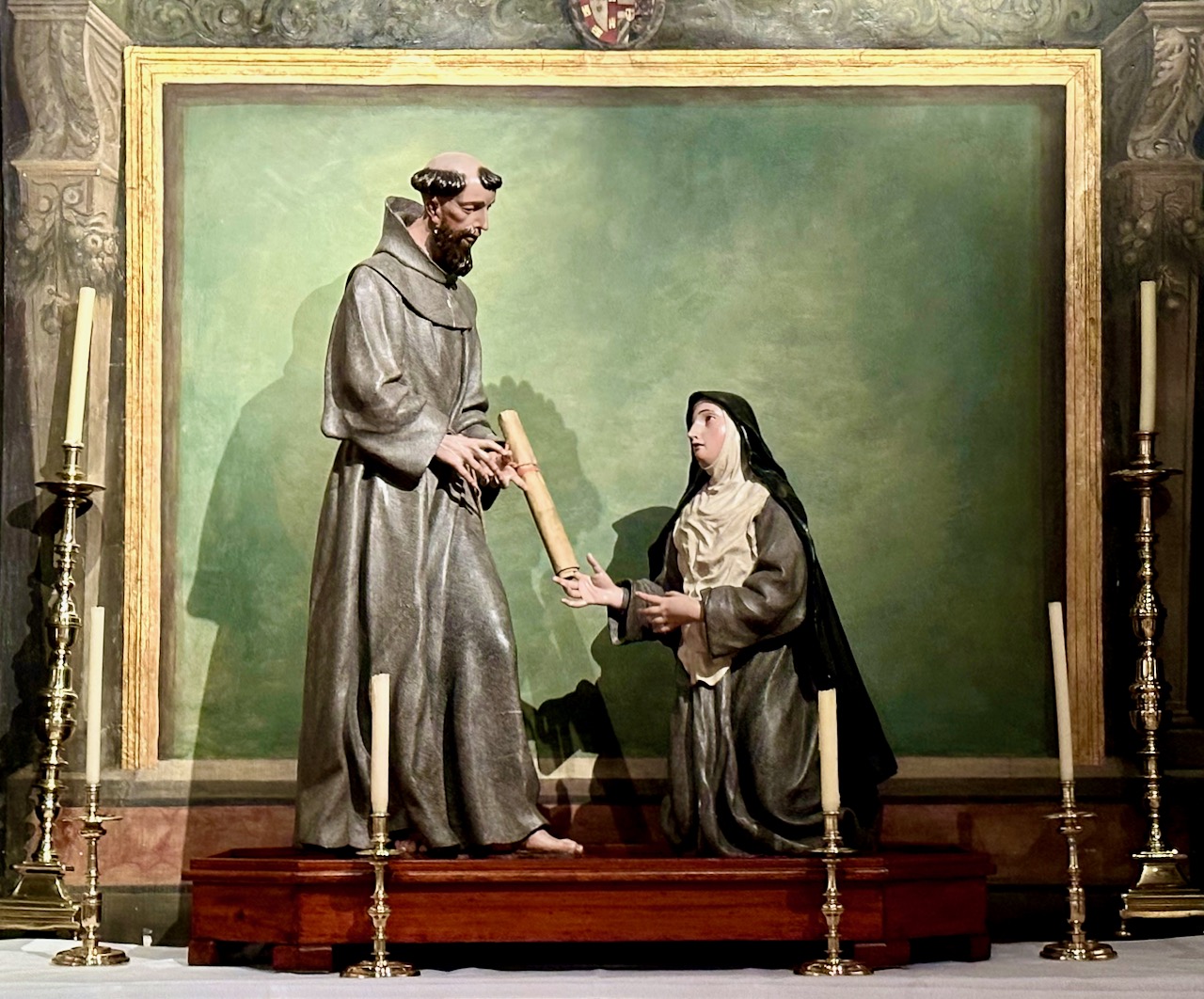
Nearing the end of the tour, we entered The Chapter House, where wooden sculptures are on display.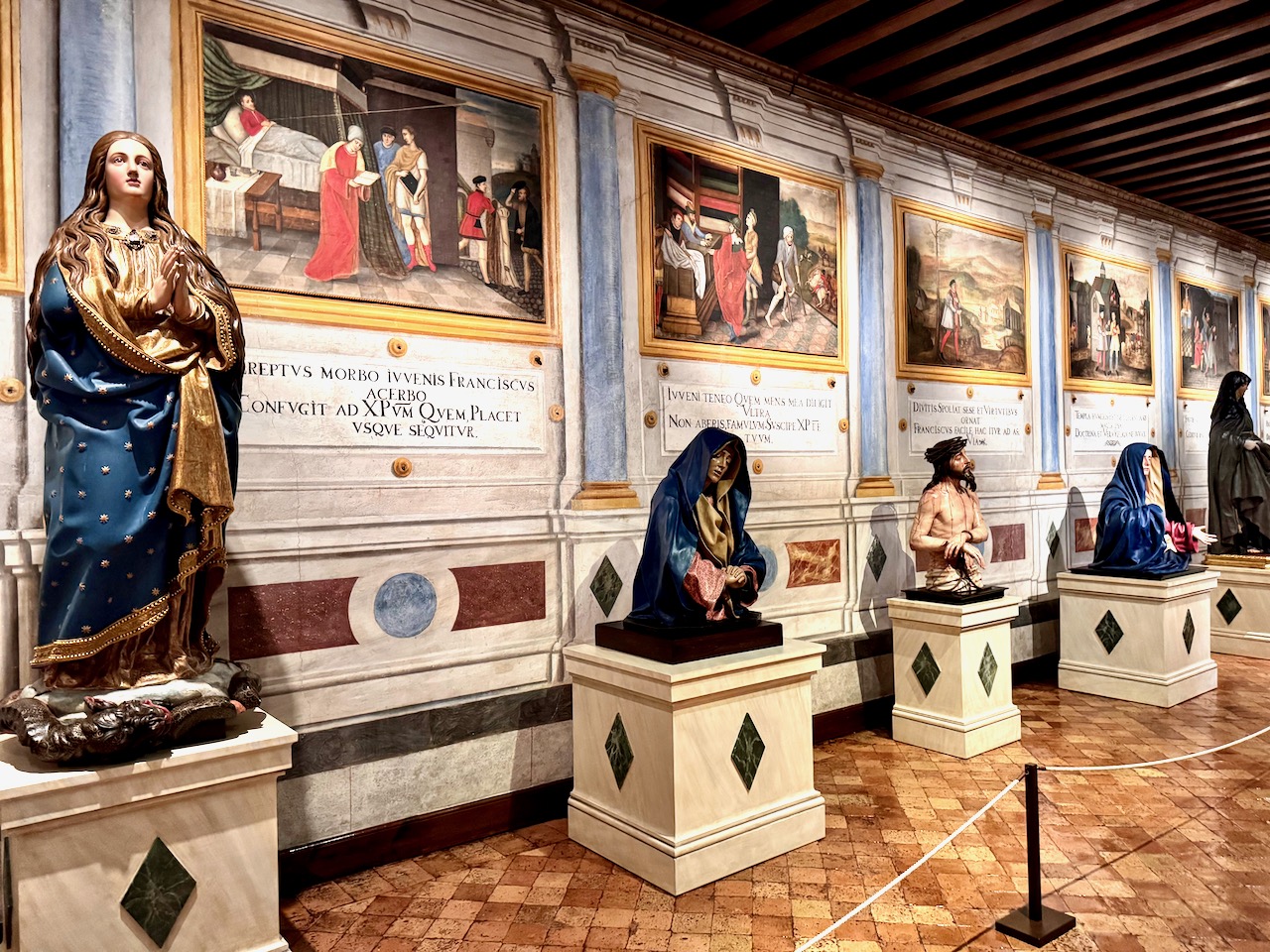
Scenes from the life of St. Francis of Assisi adorn the walls.

The guard was very accommodating in allowing us to linger in many of the rooms to take photos after the group had exited.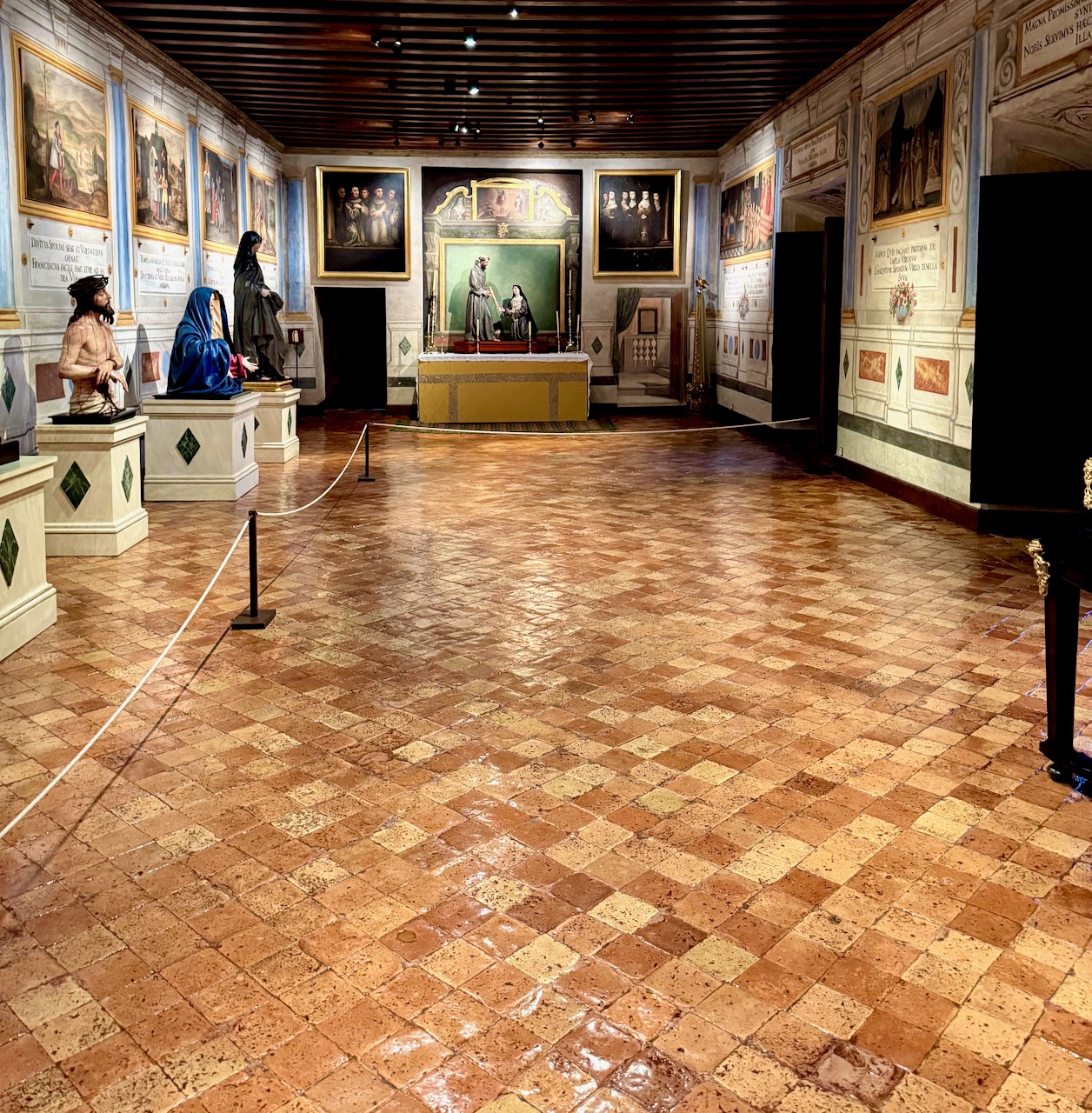
Finally, we visited the Painting Room (I believe that’s what it’s called) with portraits of, among others, members of the royal families.
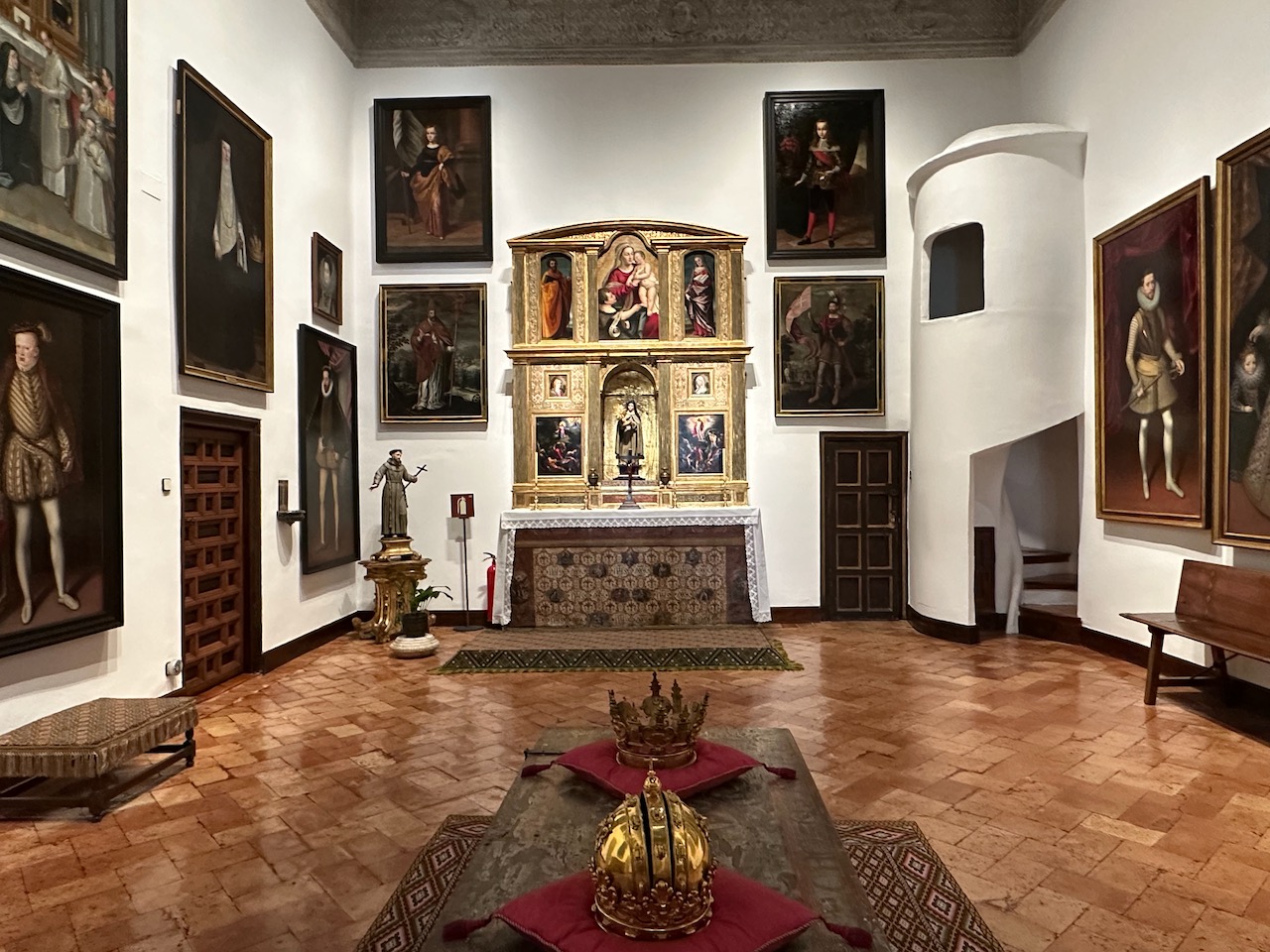
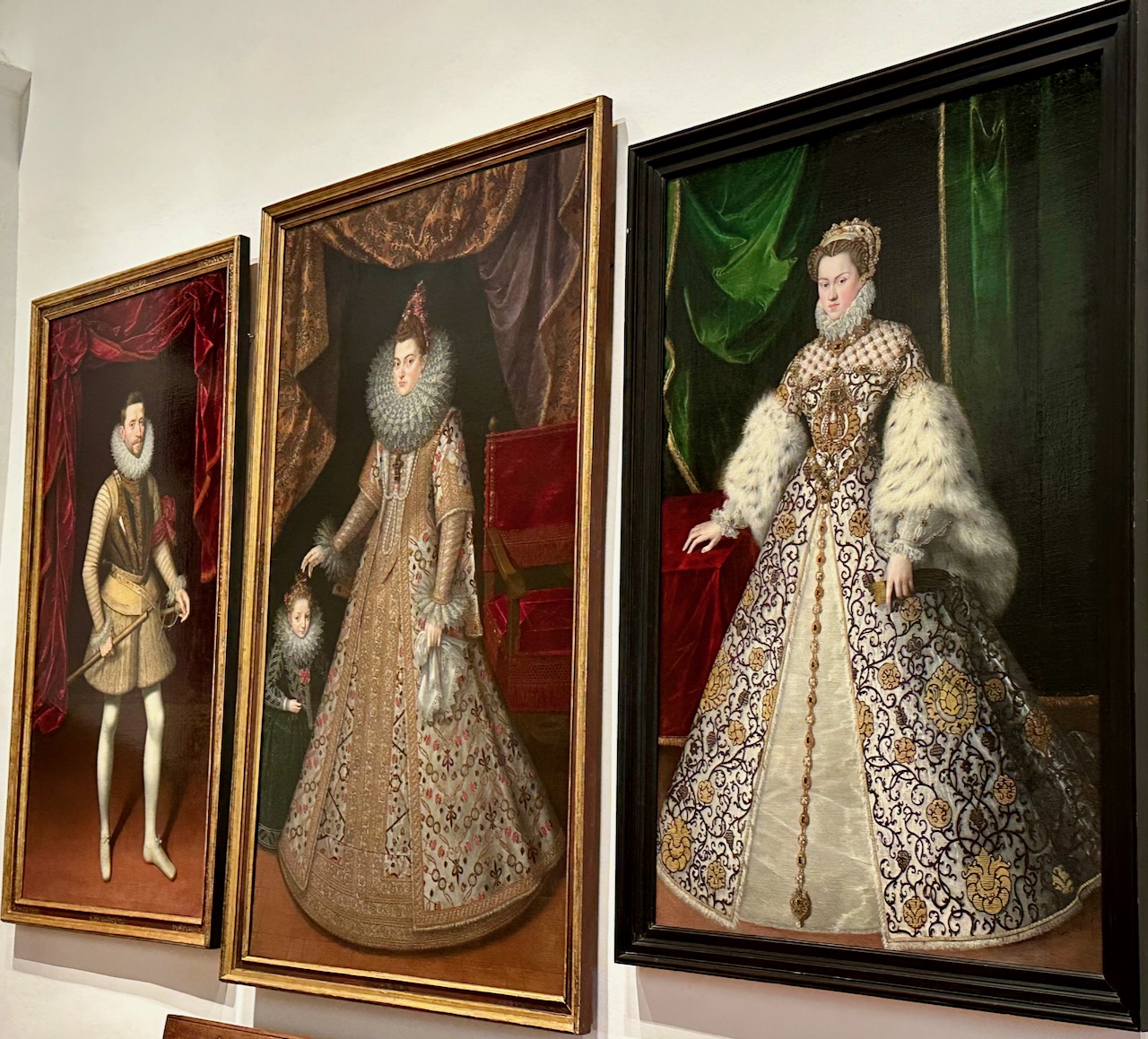
This is a Portrait of Joanna of Austria, Princess of Portugal. She seems to have the same “look” Tracy has when I do something stupid.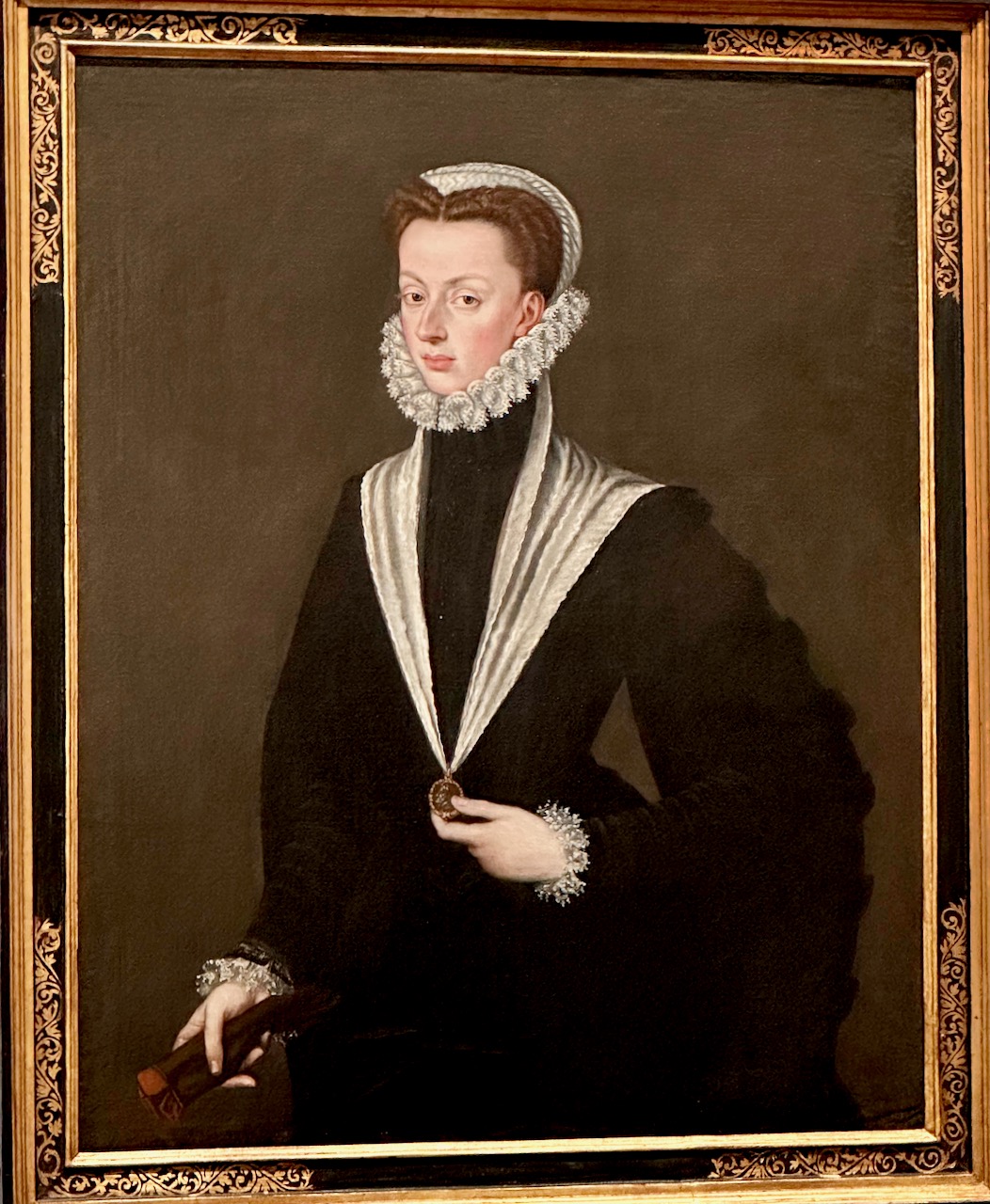
There was a mid-1500s painting of Santa Cecilia (patron saint of music) at the piano and Saint Michael and Saint Gabriel presenting the Child Jesus to the Virgin and Saint Joseph from the late 1600s.

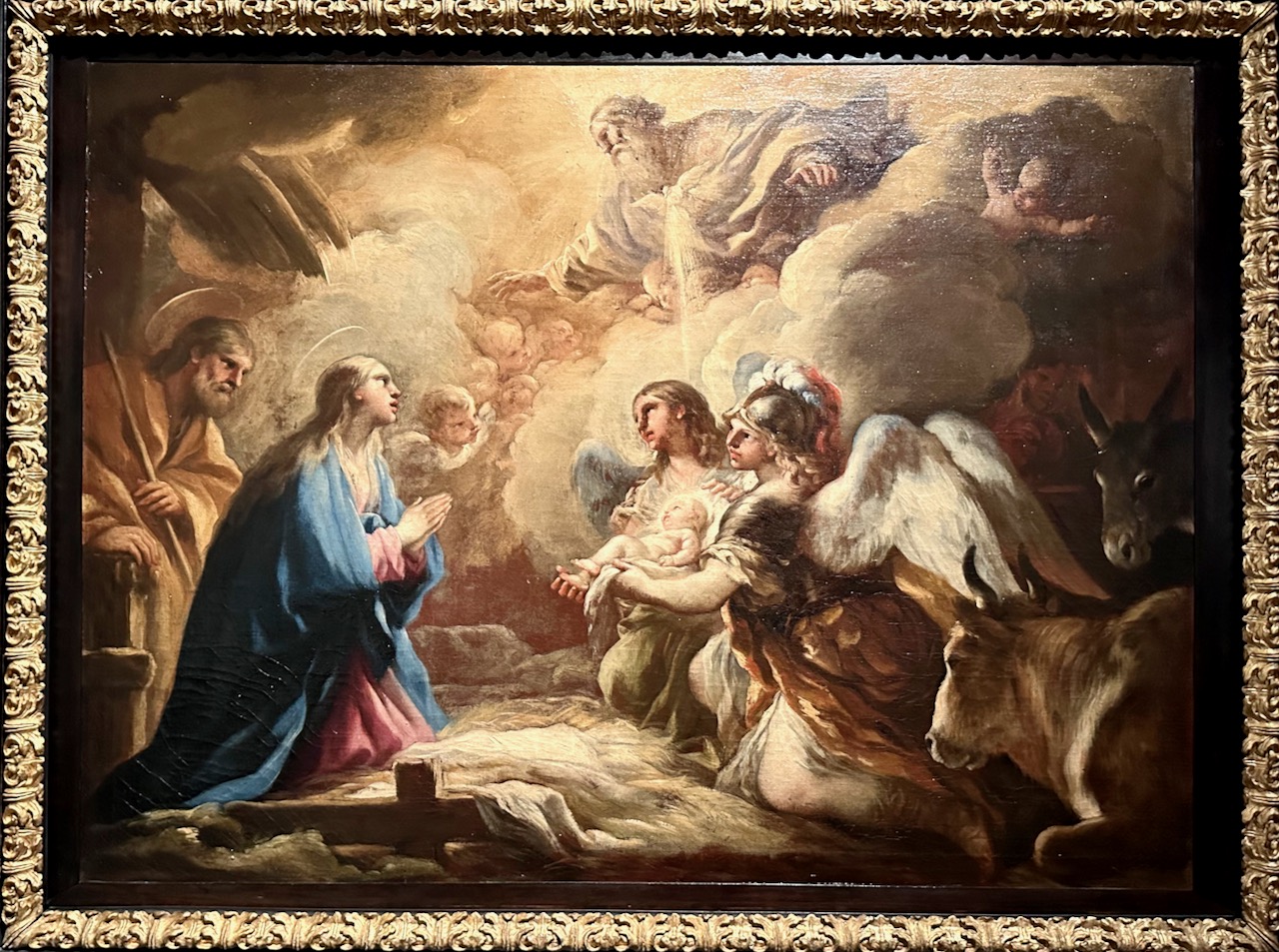
We viewed a few more paintings …

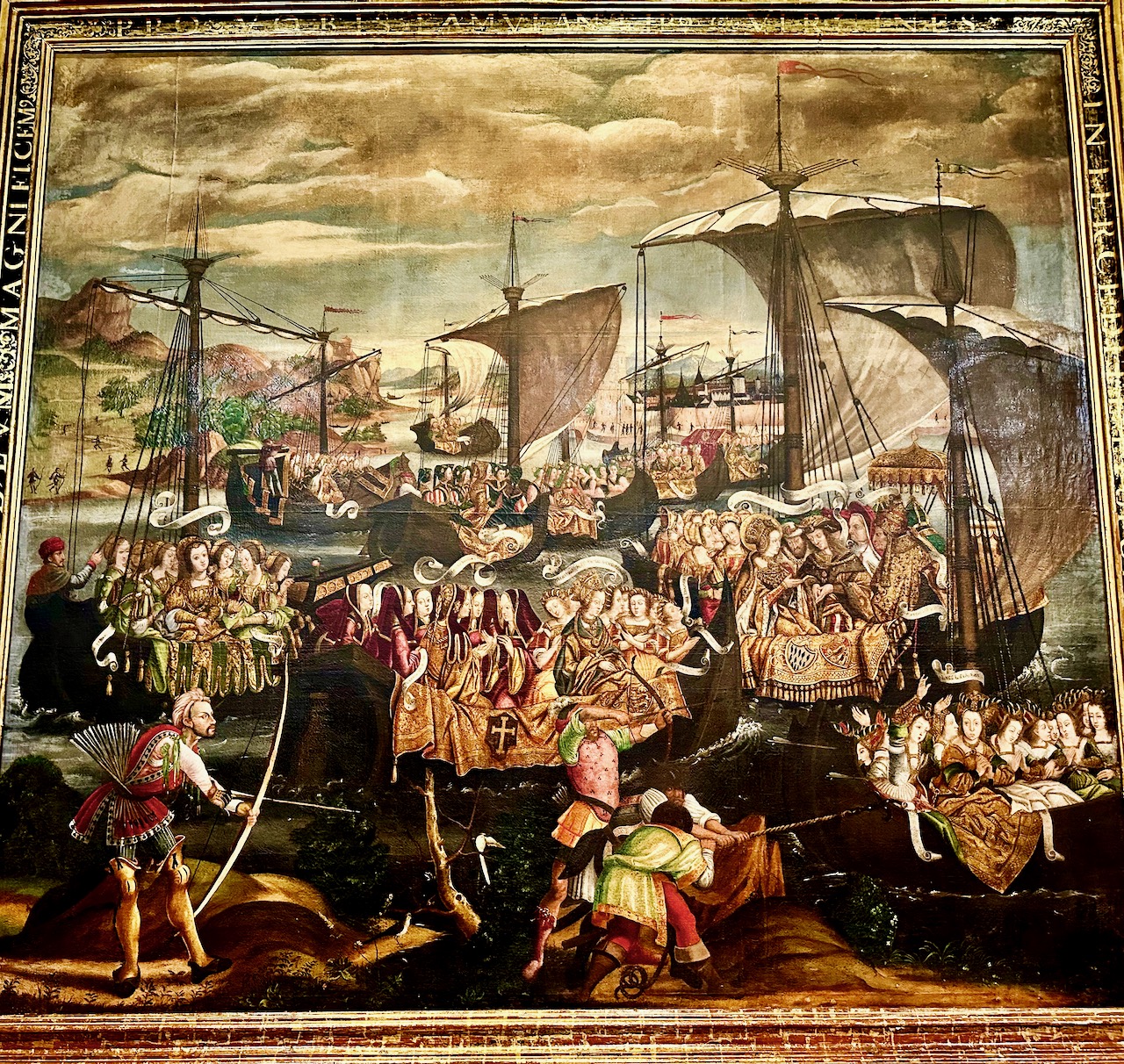
… and the tour was over. It’s an amazing incredible historical space and well worth your time even if you don’t speak Spanish.

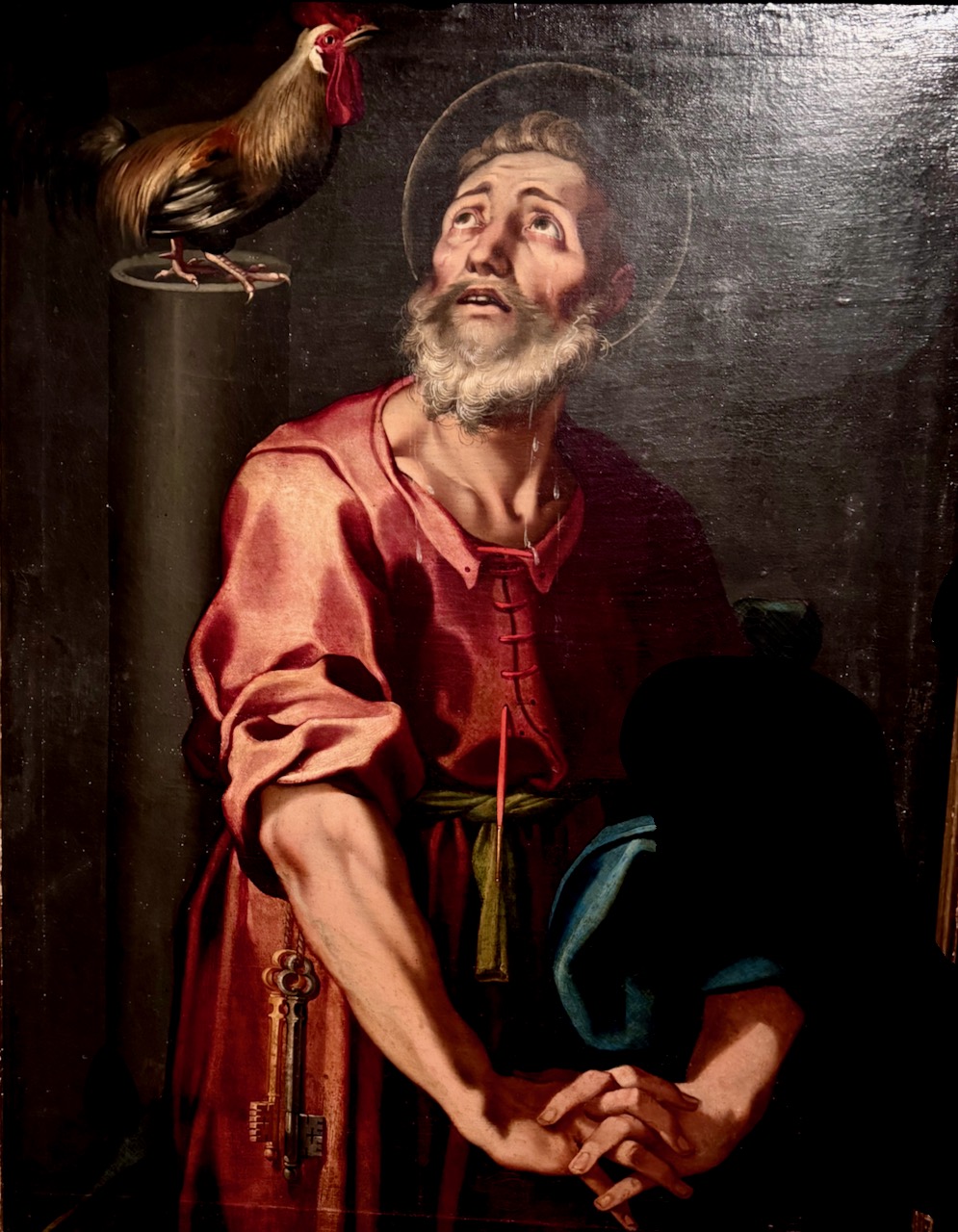
Three churches down. One to go. Our final monastery/church stop for the day had not been on my radar, however entry to the Iglesia de San Antonio de los Alemanes included a visit to the nearby 17th-century El Convento de San Plácido, so off we went. The backstory on El Convento de San Plácido is even more interesting than the Spanish Baroque style church. From the website Explory, “In 1628, the Spanish Inquisition investigated the supposed demonic possession of twenty-five nuns. Teresa Valle de la Cerda [the prioress] was among them. Their demons prophesied church reform.” Per the audioguide, the nuns were incarcerated for four years but eventually cleared. Considered a “jewel of the Madrid Baroque” the church has been rocked with additional issues recently and only reopened to the public in 2025.
The main altarpiece depicts The Annunciation by Claudio Coello who also created the sacristy of El Escorial.
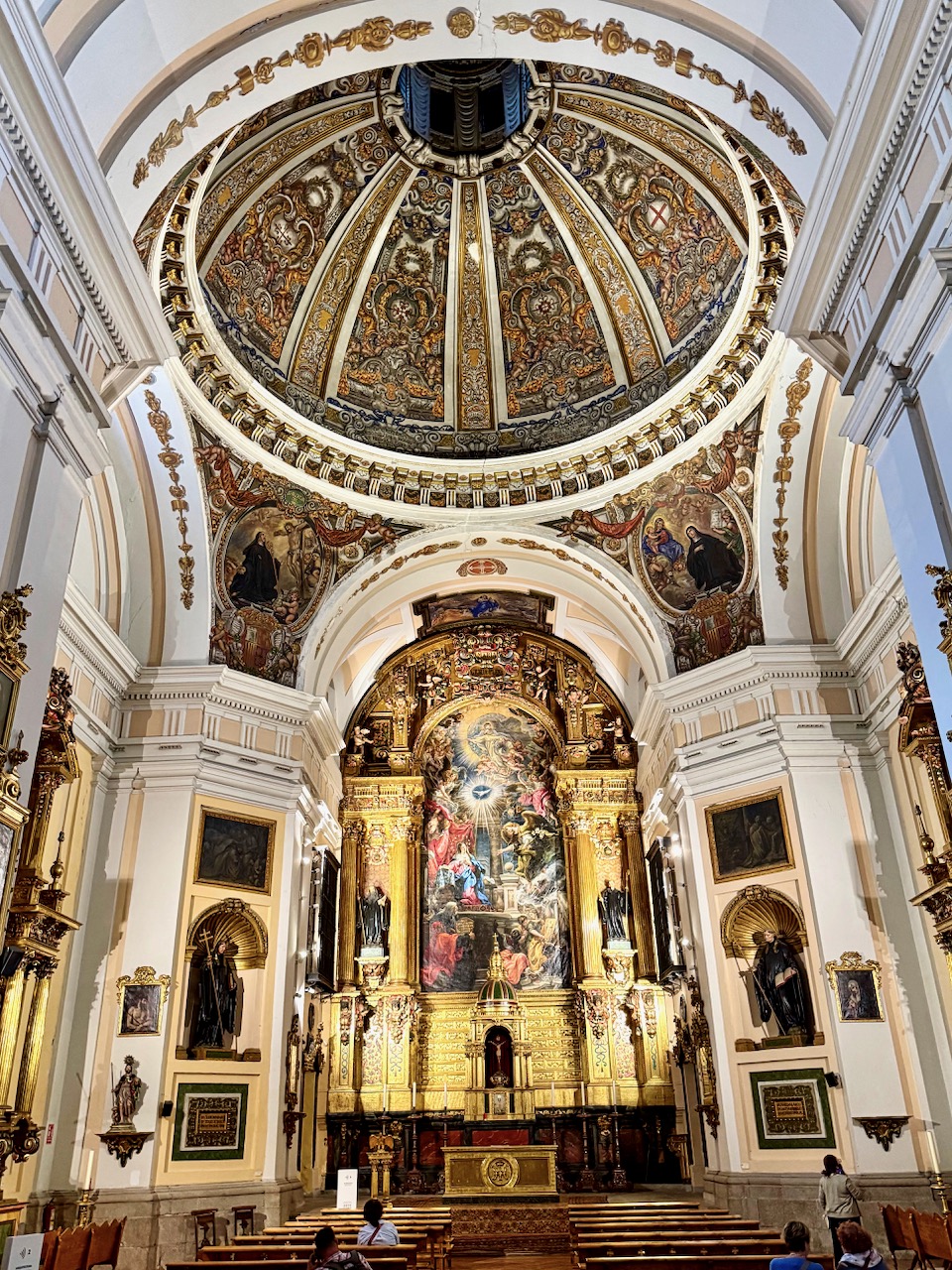

Frescoes by Francisco Rizi and Juan Martin Cabezalero are seen the ceiling.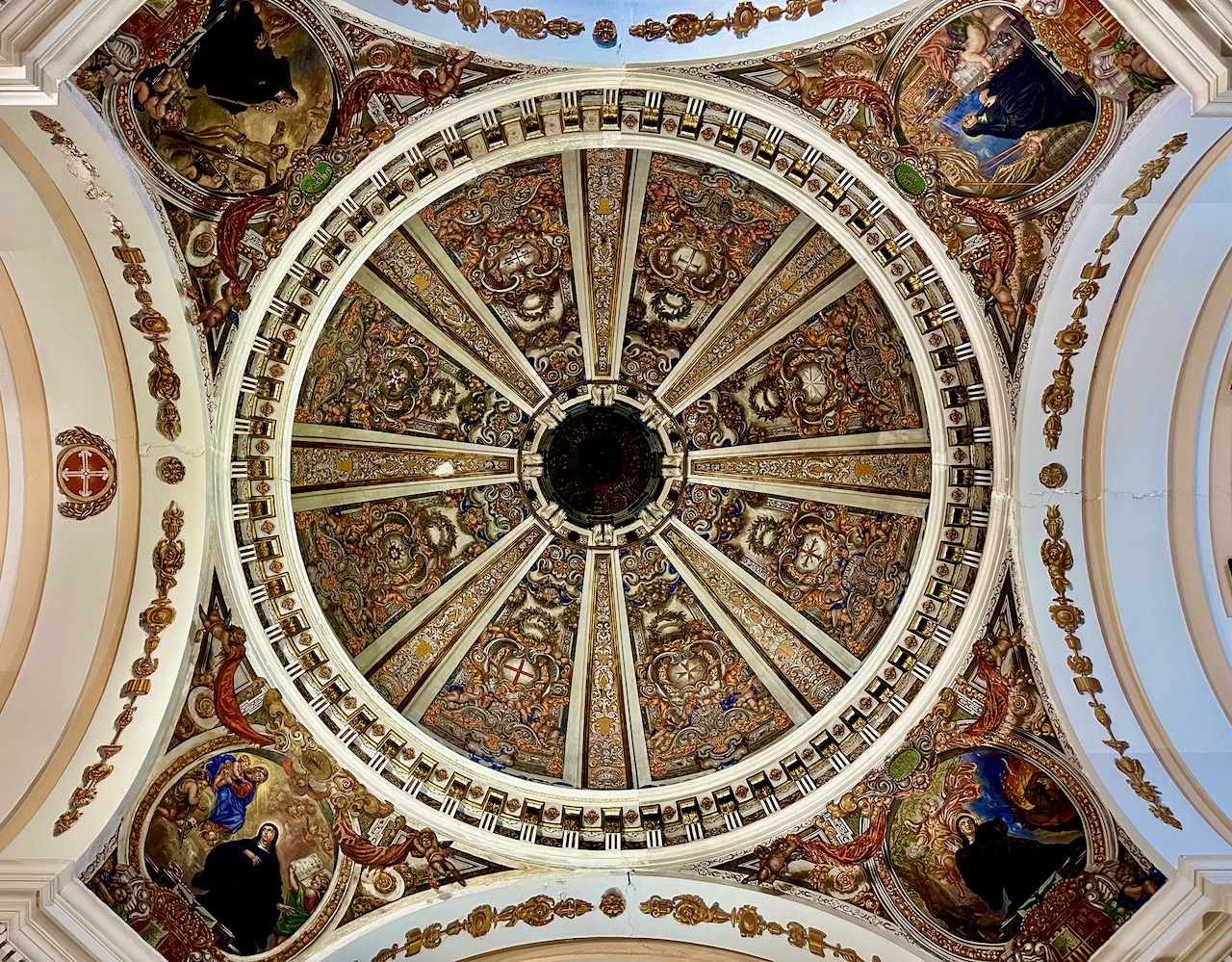
By now, we were officially “churched out.”

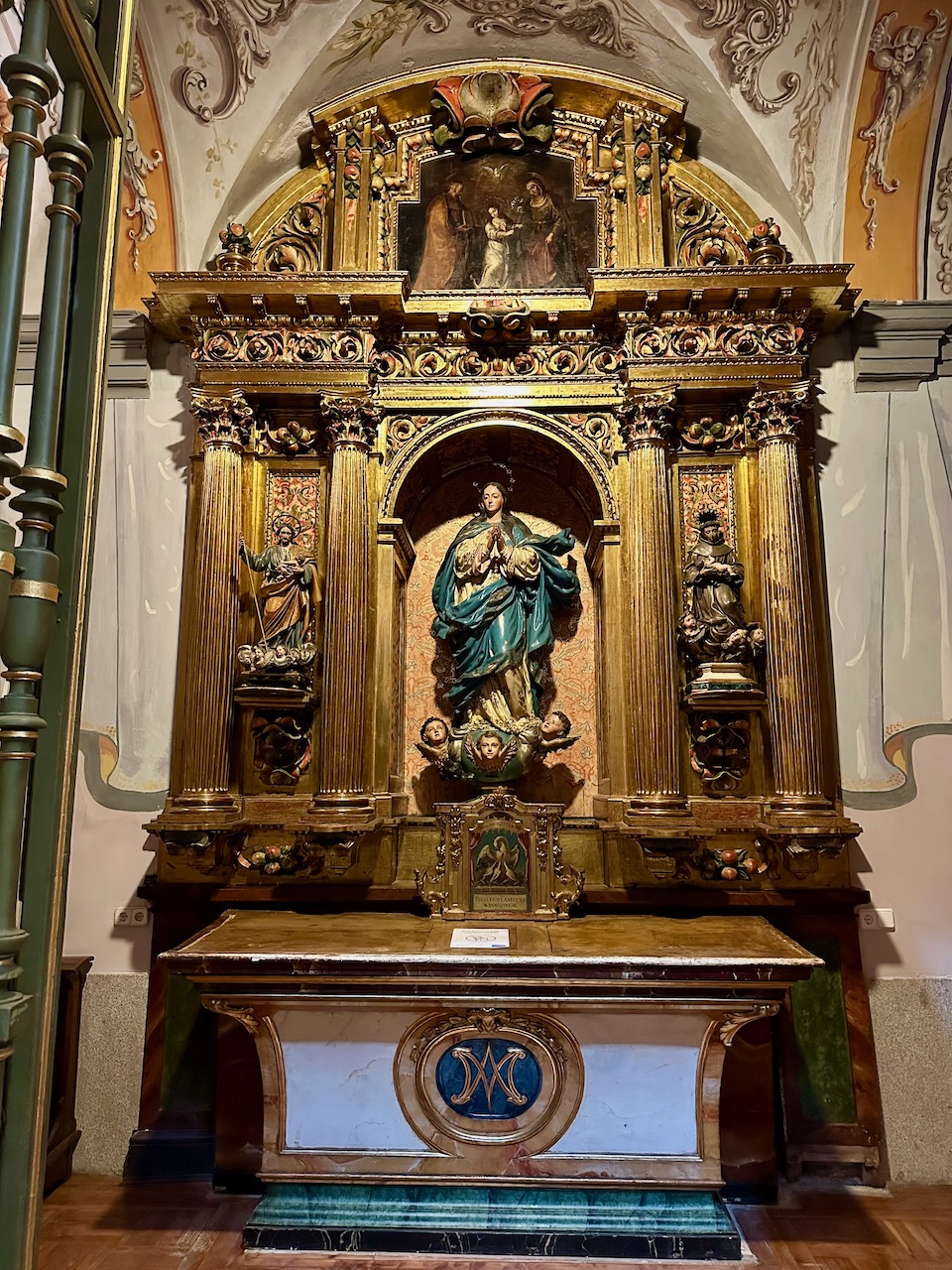

It was now nearing 2 pm, and we were very hungry. Unfortunately, we had forgotten Sebastian’s list of suggested places to eat, so we wandered … and wandered. The Monument to Federico García Lorca is located in the Plaza de Santa Ana. Lorcas was a famed Spanish poet and playwright. Lorca is holding a lark.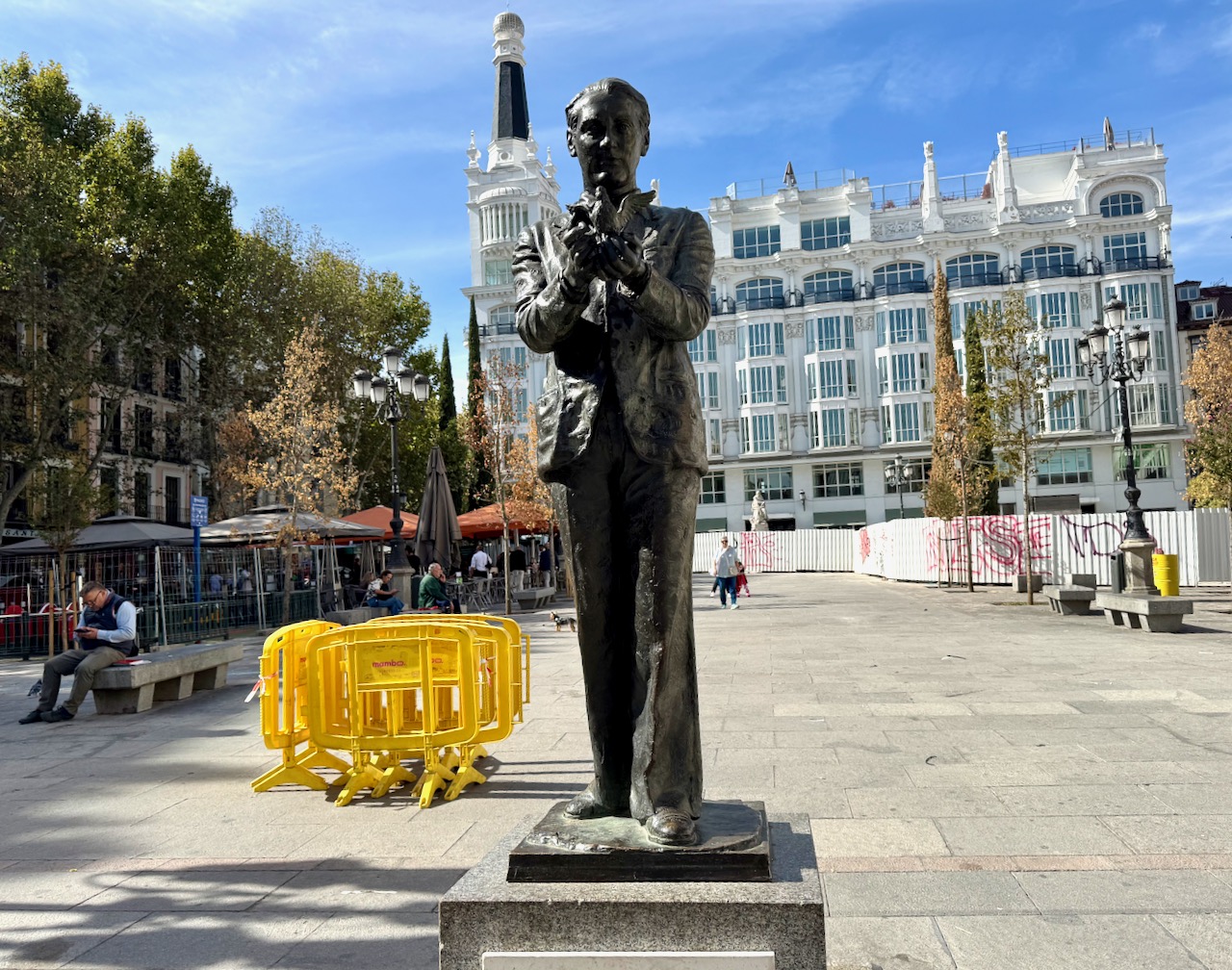
Unfortunately, we also chose our luncheon spot on a lark. Wandering aimlessly (which will be inscribed on my tombstone), we finally settled at an outdoor spot where we had eaten our final dinner in 2015. It was a mistake, and our lunch at Ginger was mediocre. Now I know why I always liked Mary Ann better.
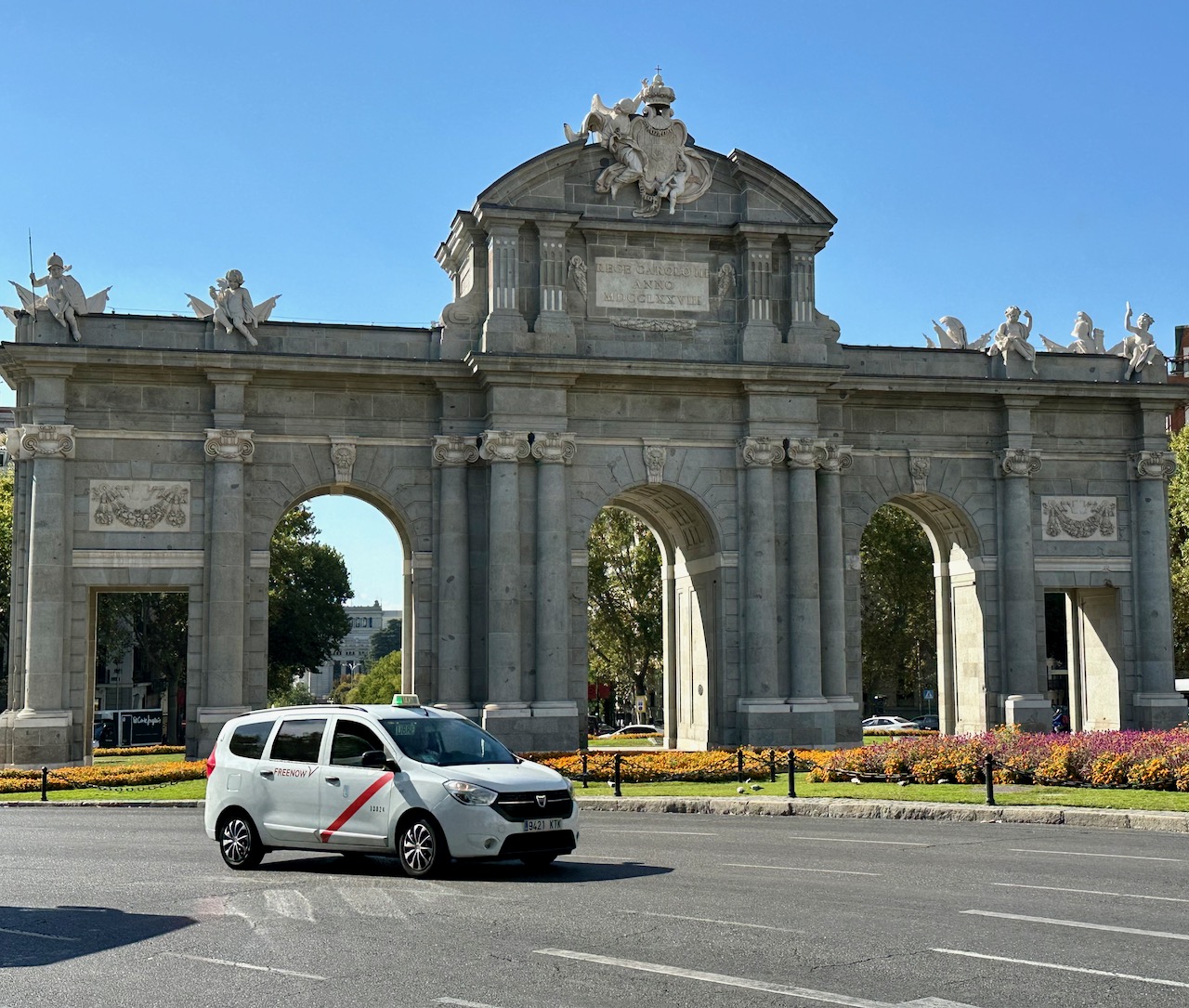
Since our walk the previous day at Parque del Buen Retiro had been abbreviated, we returned to stroll around part of this 350-acre park. Fortunately, the day was cooler so we spent about an hour doing some “ambiancing.” We walked in the Puerta de Alcalá entrance. The granite triumphal arch at the confluence of three streets was erected in 1778 and commissioned by King Charles III.
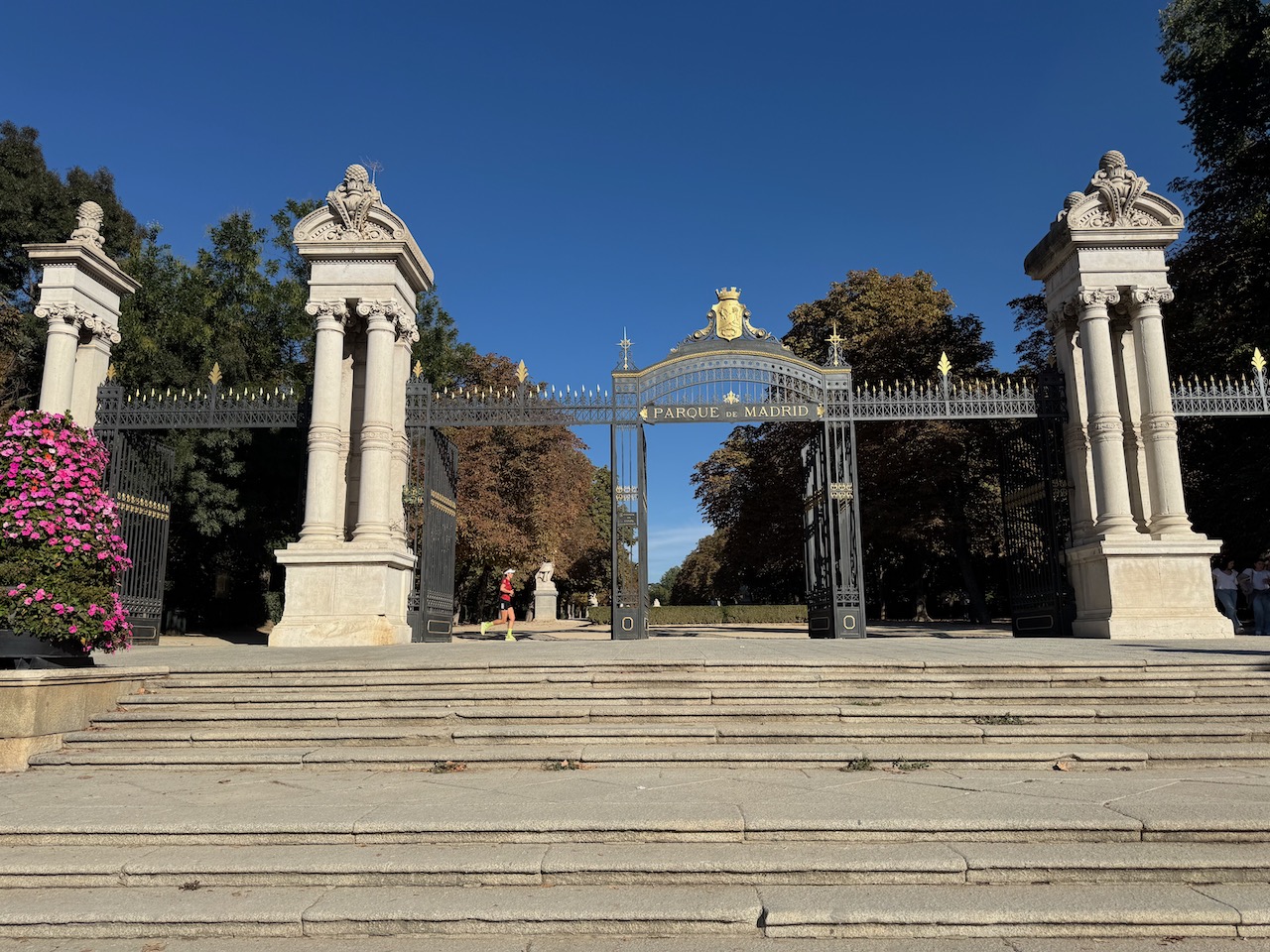
We had visited in 2015, so we checked out some things we missed on that walk. Once inside we passed by Fuente de los Galápagos (no sign of the HMS Beagle)), also known as the Fountain of Isabella II, because it was erected in 1832 to commemorate the birth of Queen Isabella.
Estanque Grande del Retiro was full of families and friends rowing on a perfect afternoon. The Great Pond dates back to the 1630s and once held water shows that included mock battles. The gigantic Monument to King Alfonso XII, dedicated in 1922, towers above the pond.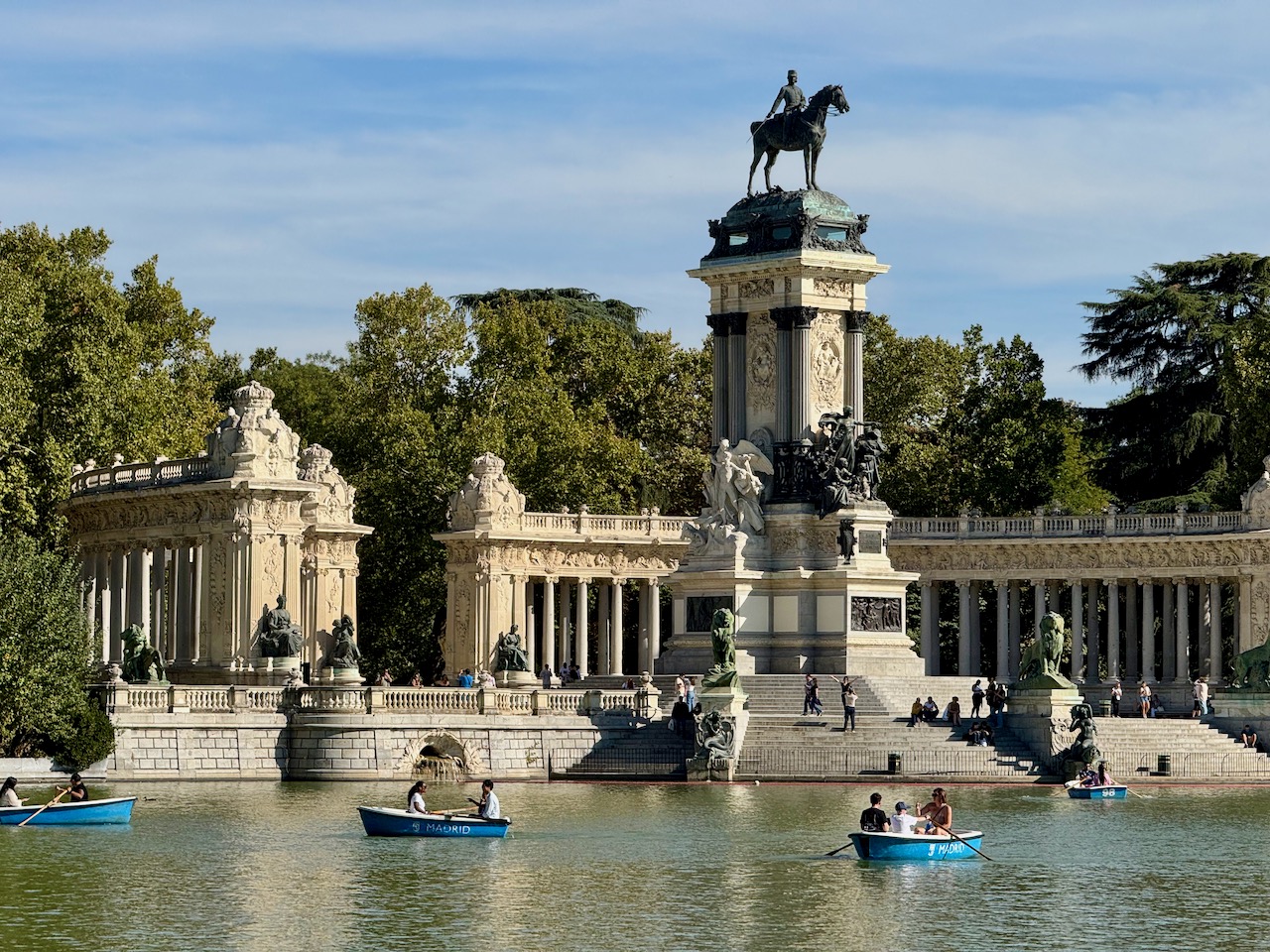
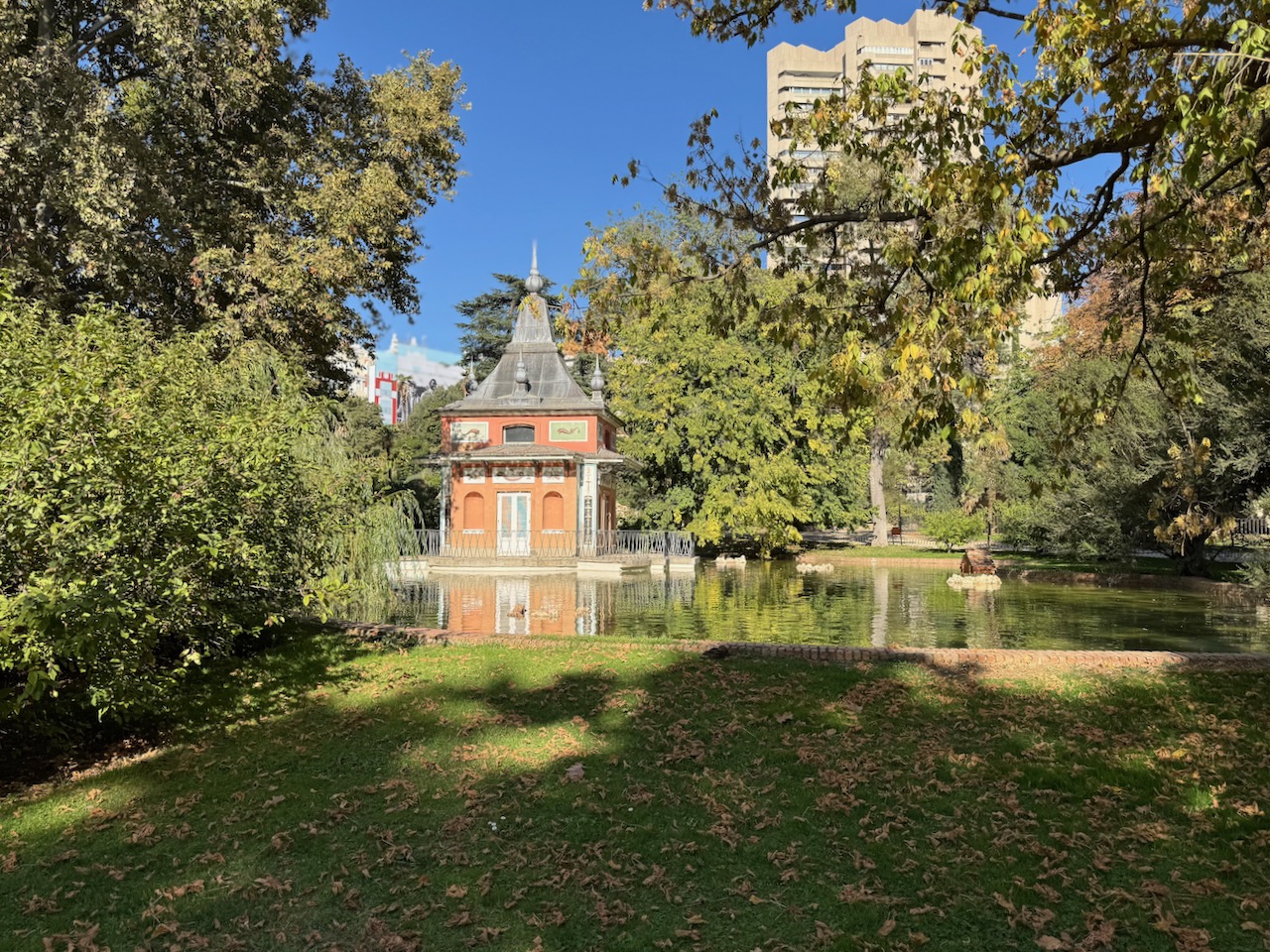
Deeper into the northern part of the park we came upon Casita del Pescador (Fisherman’s House). Situated on a smaller pond in the park, it was built by King Ferdinand VII just for the halibut as a “private hideaway for relaxation and fishing” in the 19th century.

The Monument to Cuba from 1930 features Cuba (in the form of a woman), Christopher Columbus, Queen Isabella …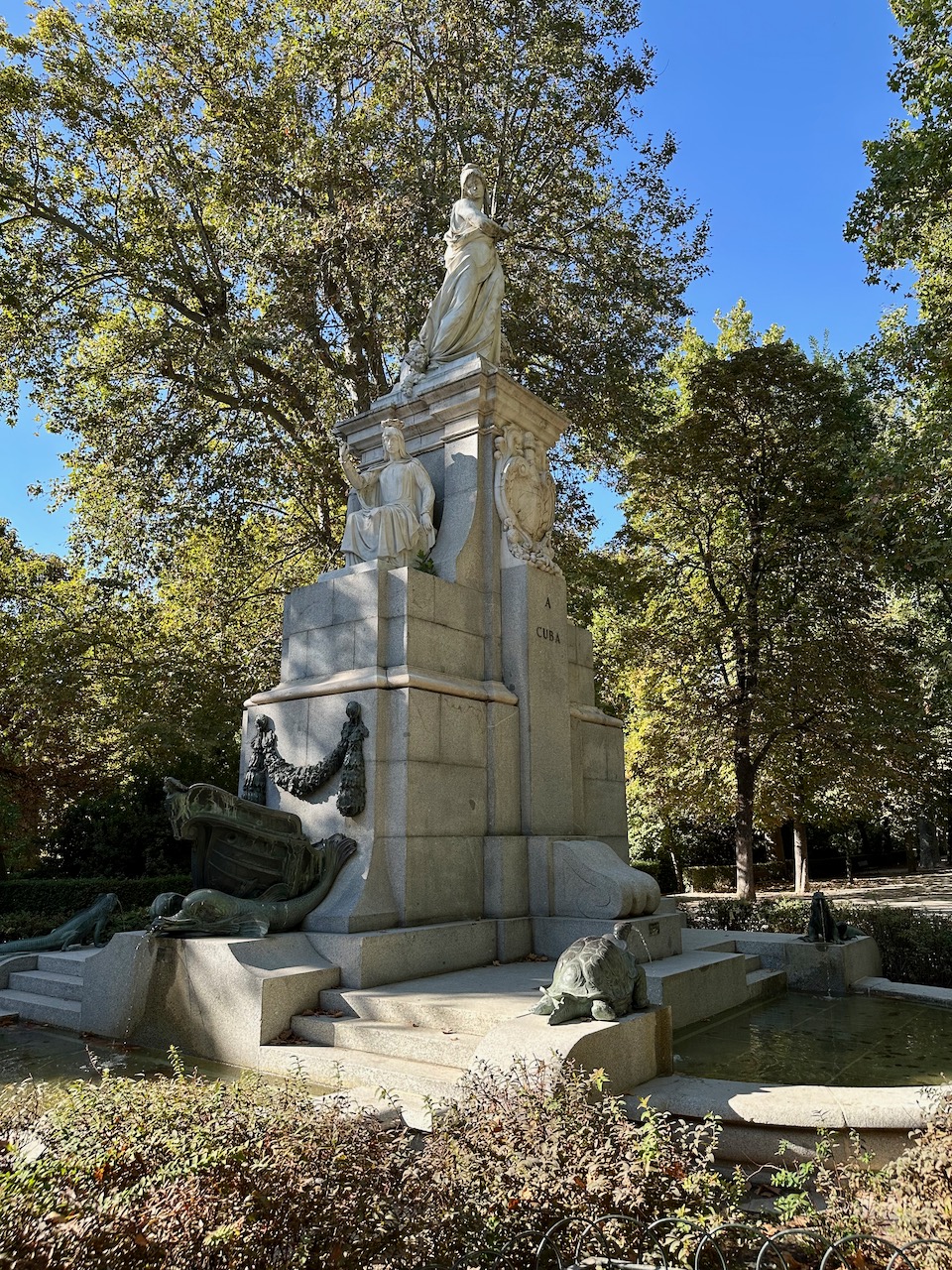
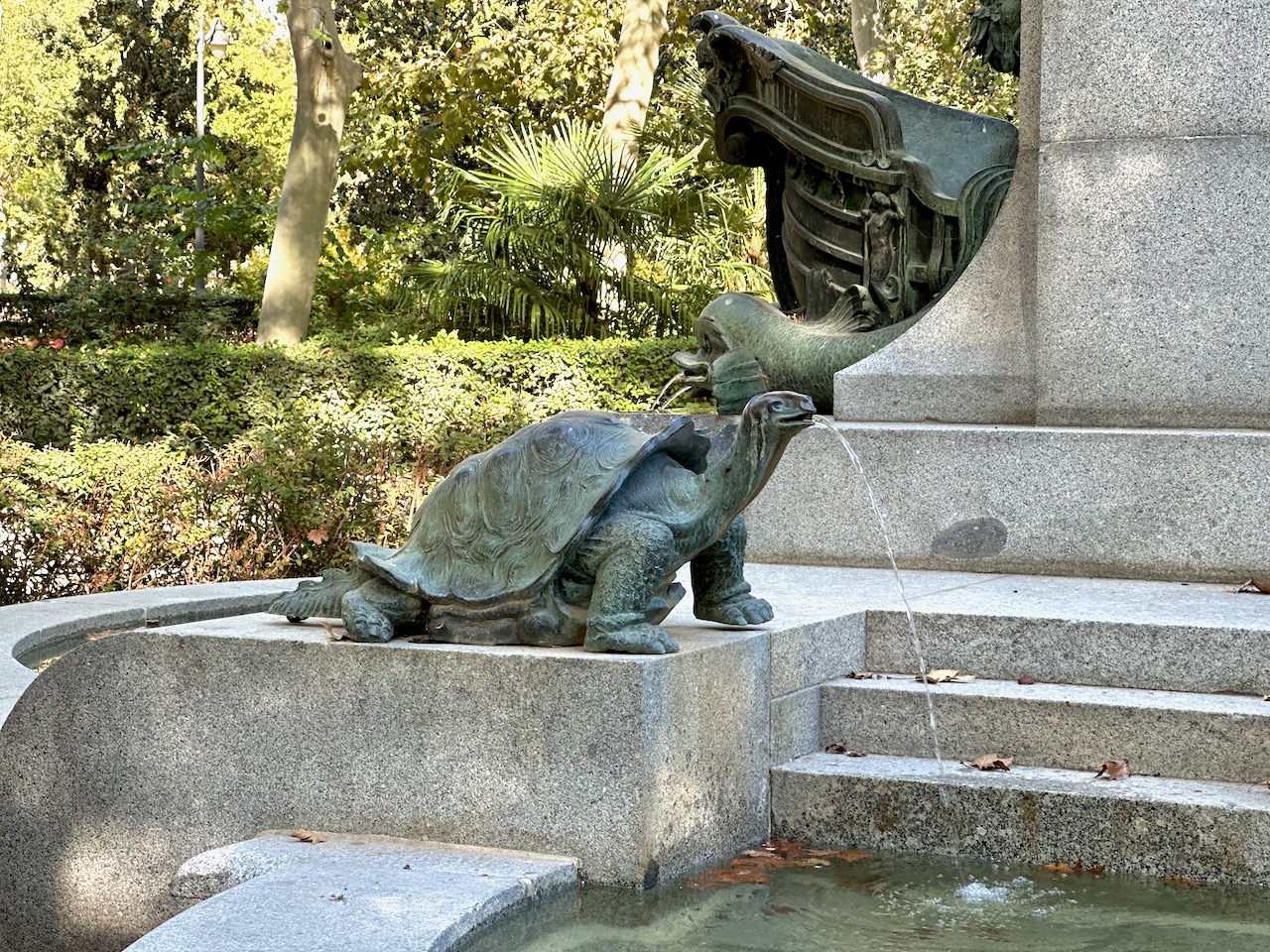
… plus exotic animals like turtles and iguanas.
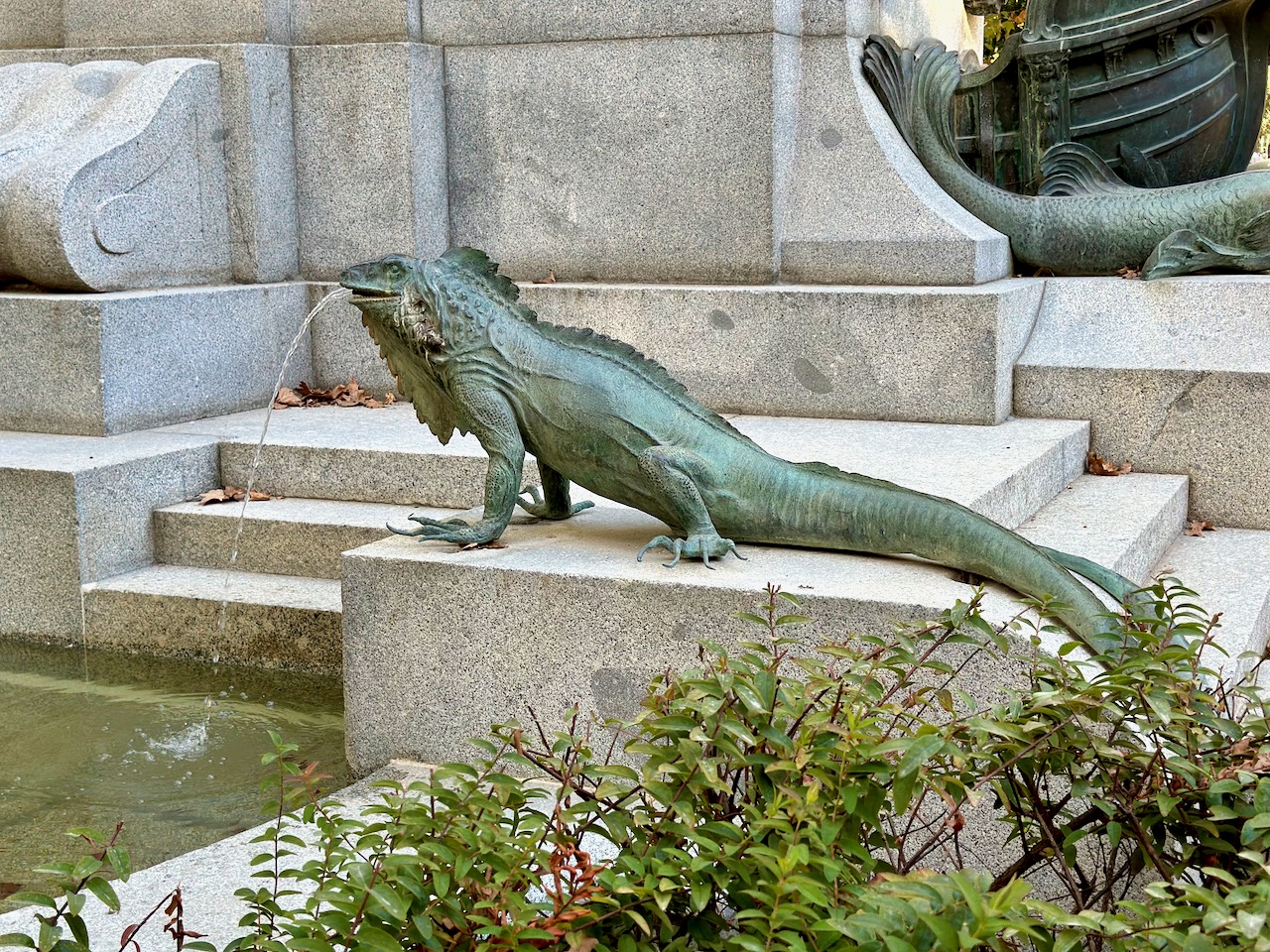
We were walking through a part of the park less traveled, and I thought if I ever returned it would be fun to get a detailed map and scope out all the monuments, sculptures and other attractions hidden everywhere. I might have to talk Tracy into that, however.
Next we found a monument to Serafín and Joaquín Álvarez Quintero, who were Spanish playwrights.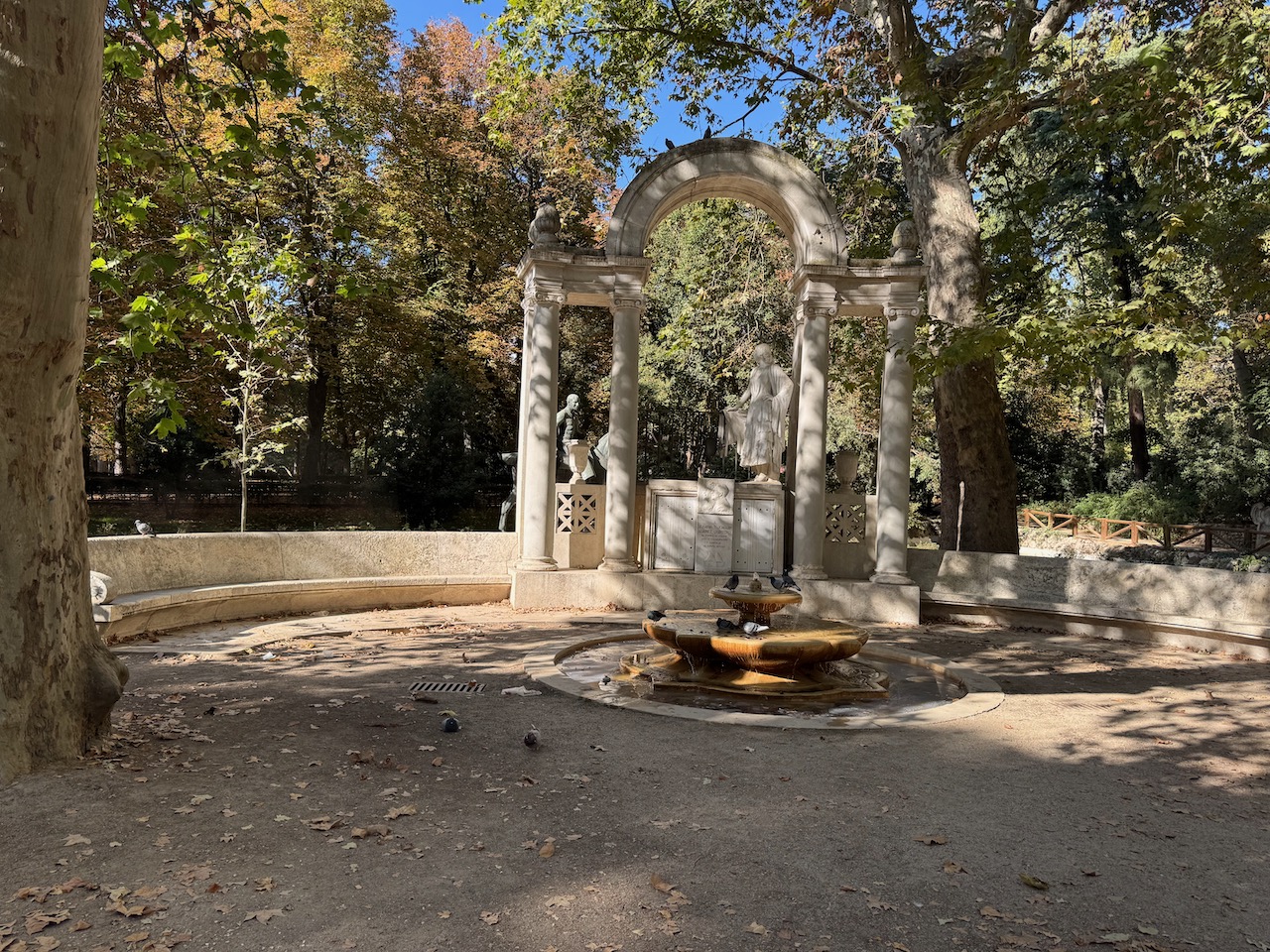
Antonio Mingote was a noted Spanish journalist, cartoonist and writer.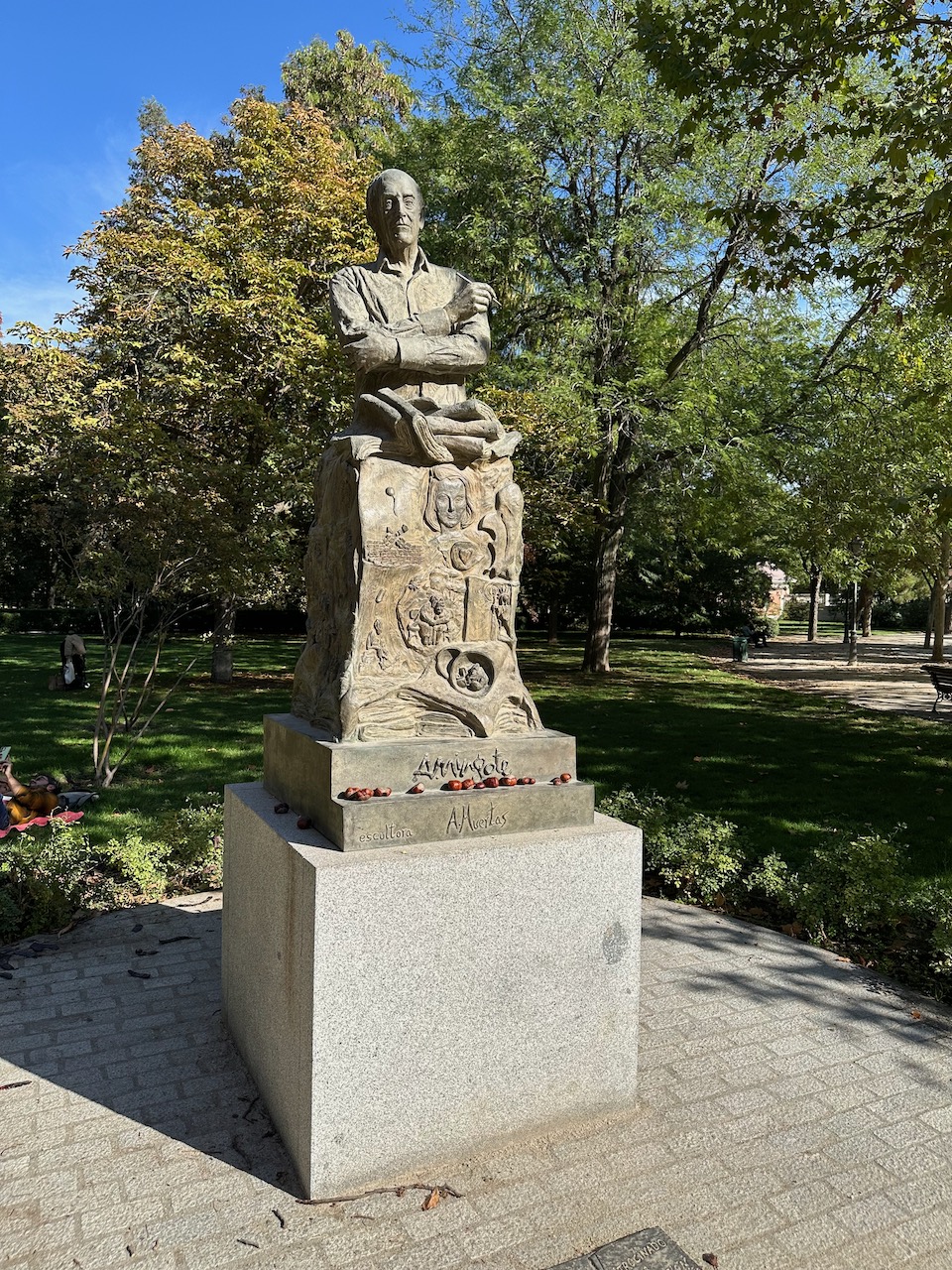
When I ran into a monument for Ponce de León, I thought I had found the Fountain of Youth, however this Ponce de León named Pedro was a Spanish Benedictine monk credited as the first teacher for the deaf.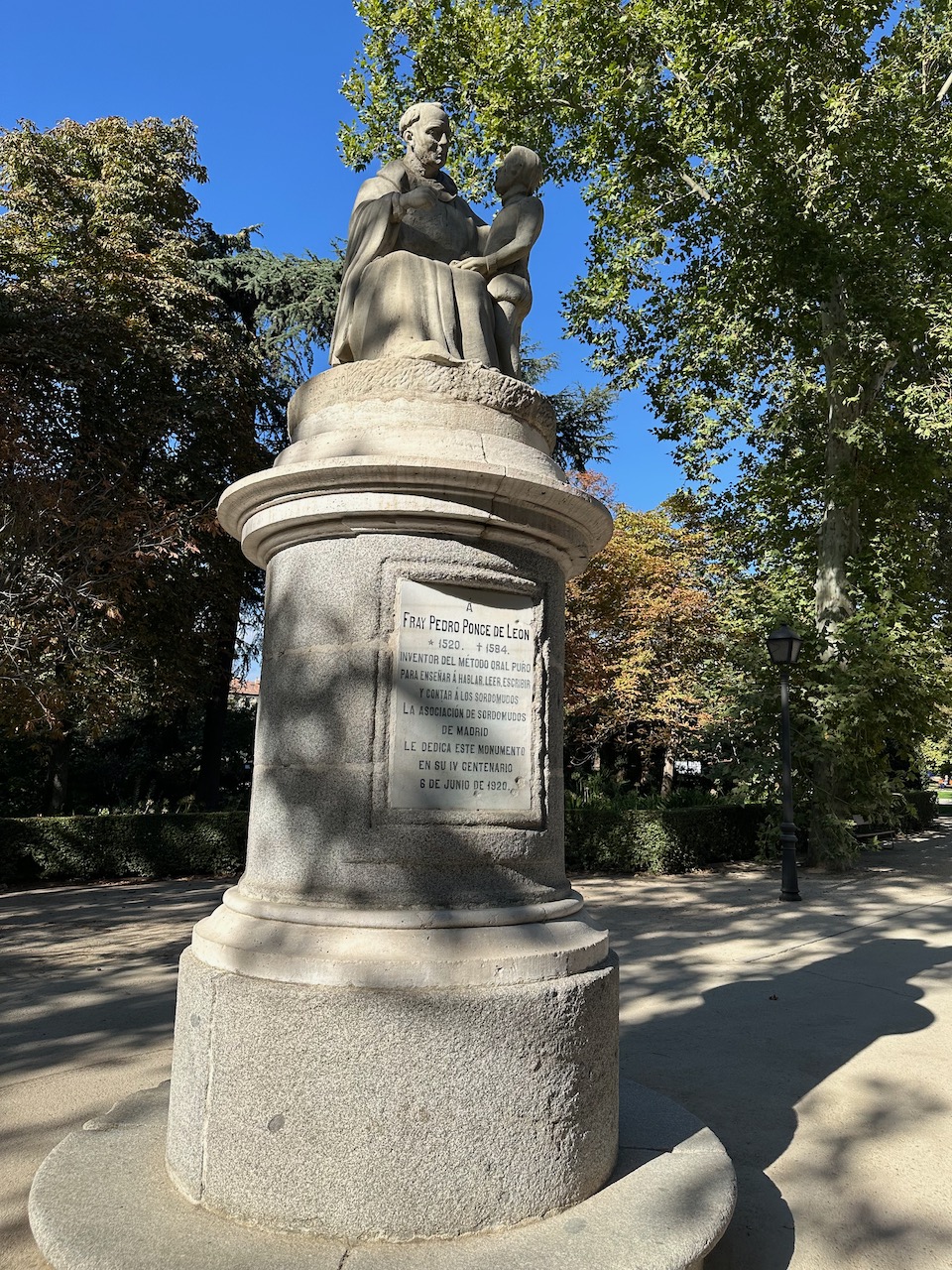
Back at the Estanque Grande del Retiro, Tracy and I attempted to take a selfie of ourselves with King Alfonso’s monument in the background. Because we are both selfie-impaired (aka old), after looking at the photo our heads were even larger than the monument. Fortunately, a lovely young lady took pity on her elders, and took this for us. Muchas gracias!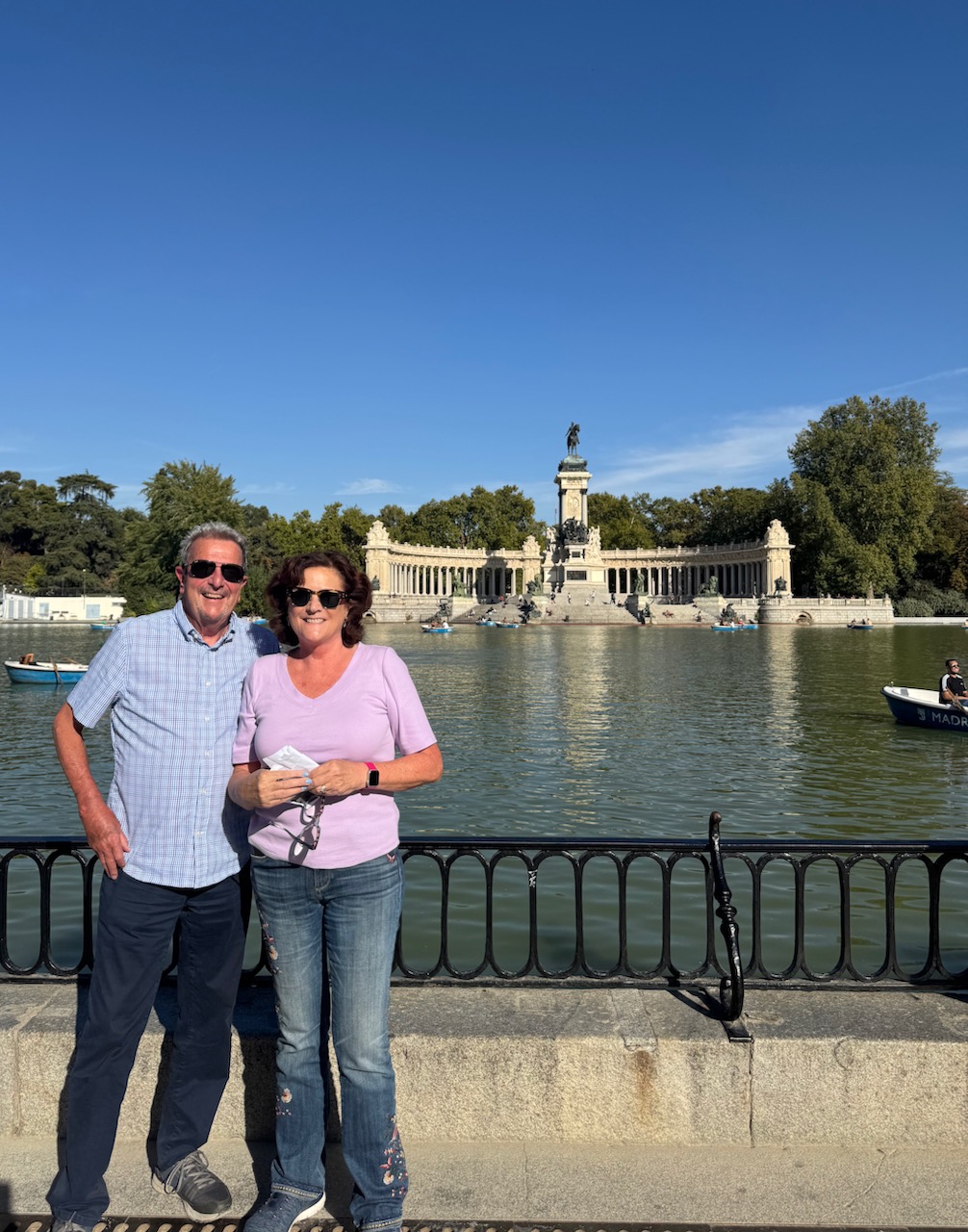
On an increasingly gorgeous autumn afternoon, we walked through Paseo de la Argentina, also known as the Paseo de las Estatuas. It is filled with statues of ancient Spanish kings and queens that were originally created for the cornice of the Royal Palace but, because of how much they weighed, were placed in various public spaces in the mid-19th century.
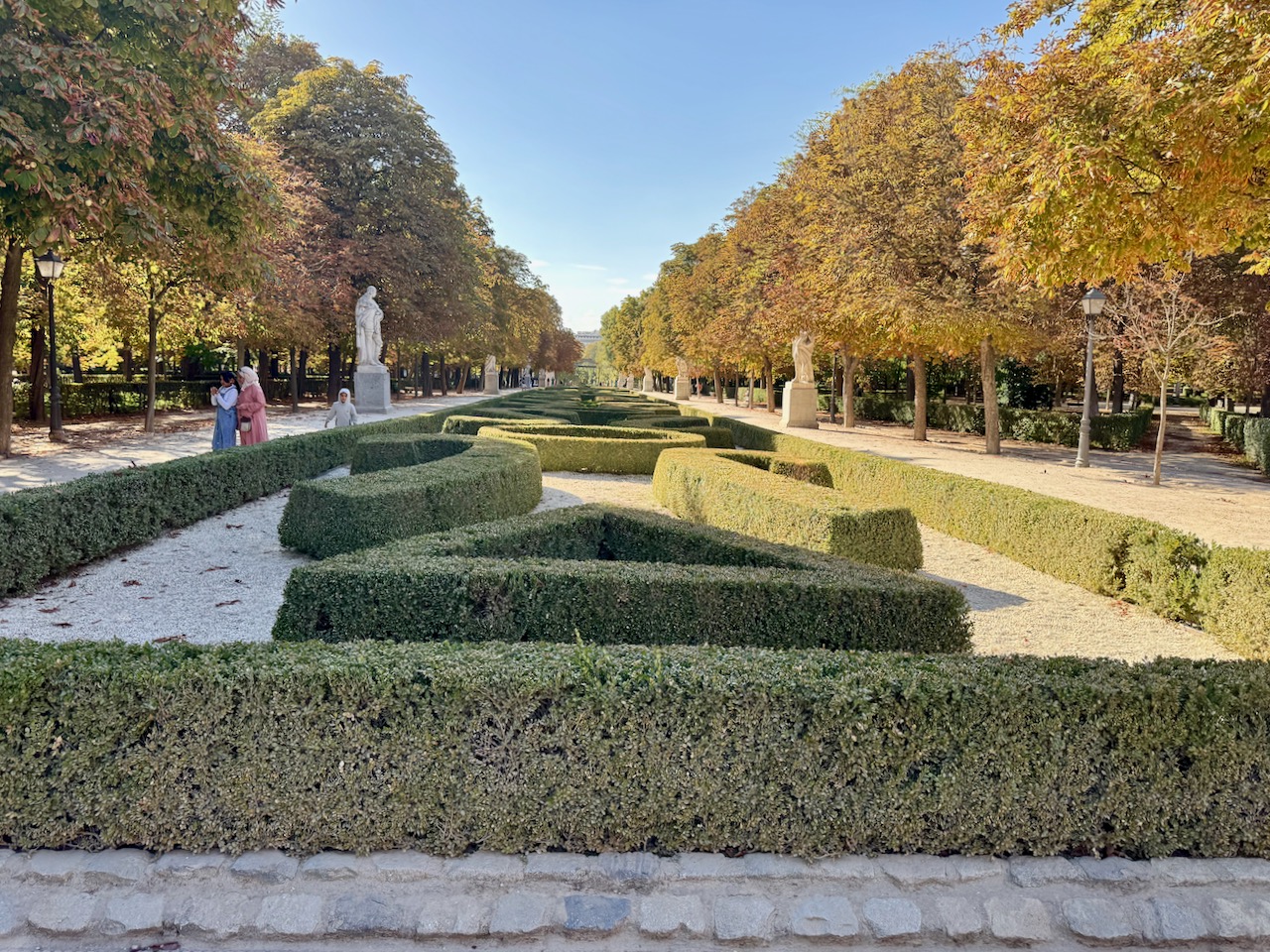

We stopped at the statue of Juana I, Queen of Castile and Aragon …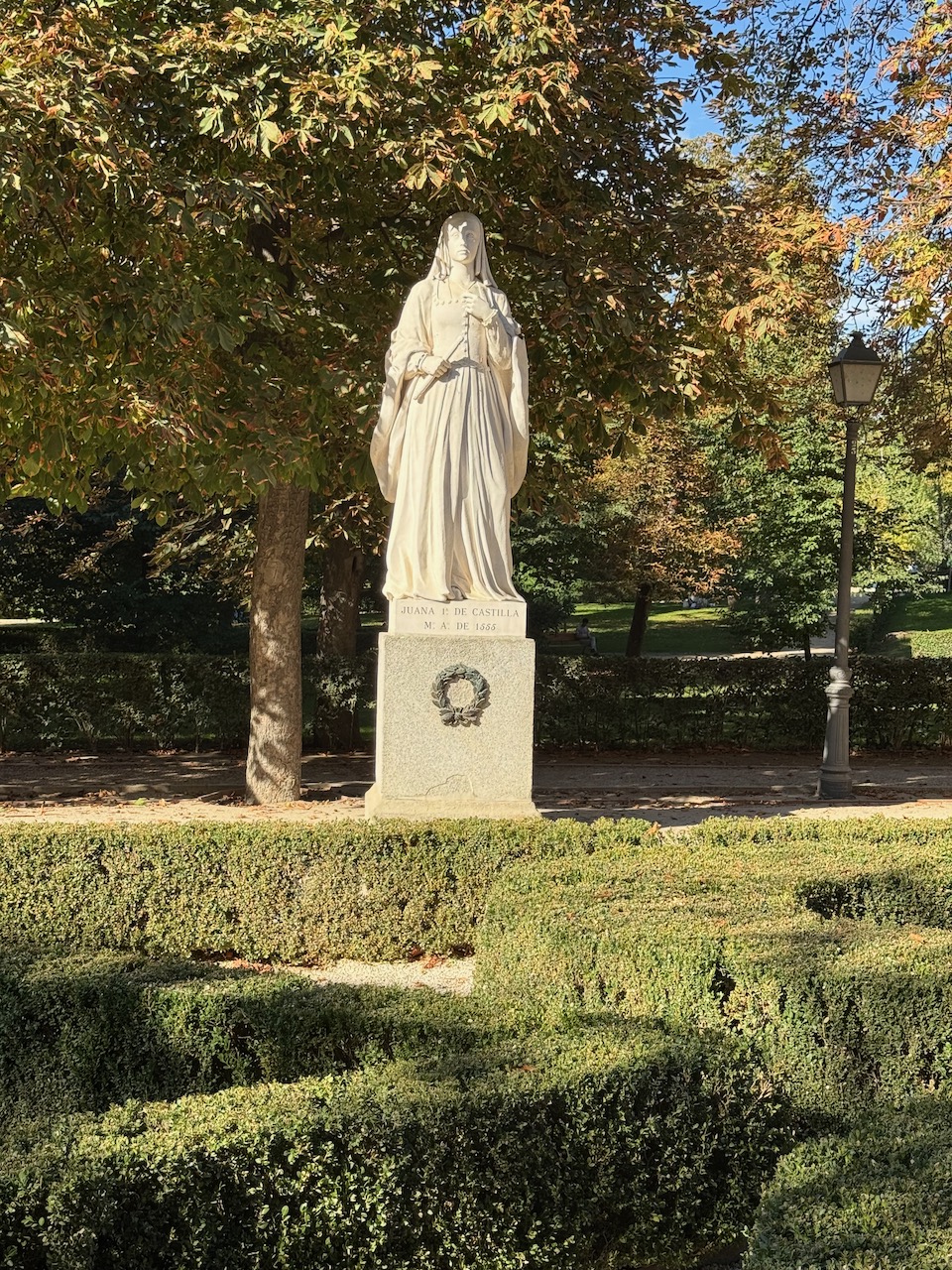
… then headed (pun intended) to Alfonso I of Aragon, who was nicknamed “The Battler,” standing on what’s left of his foe.
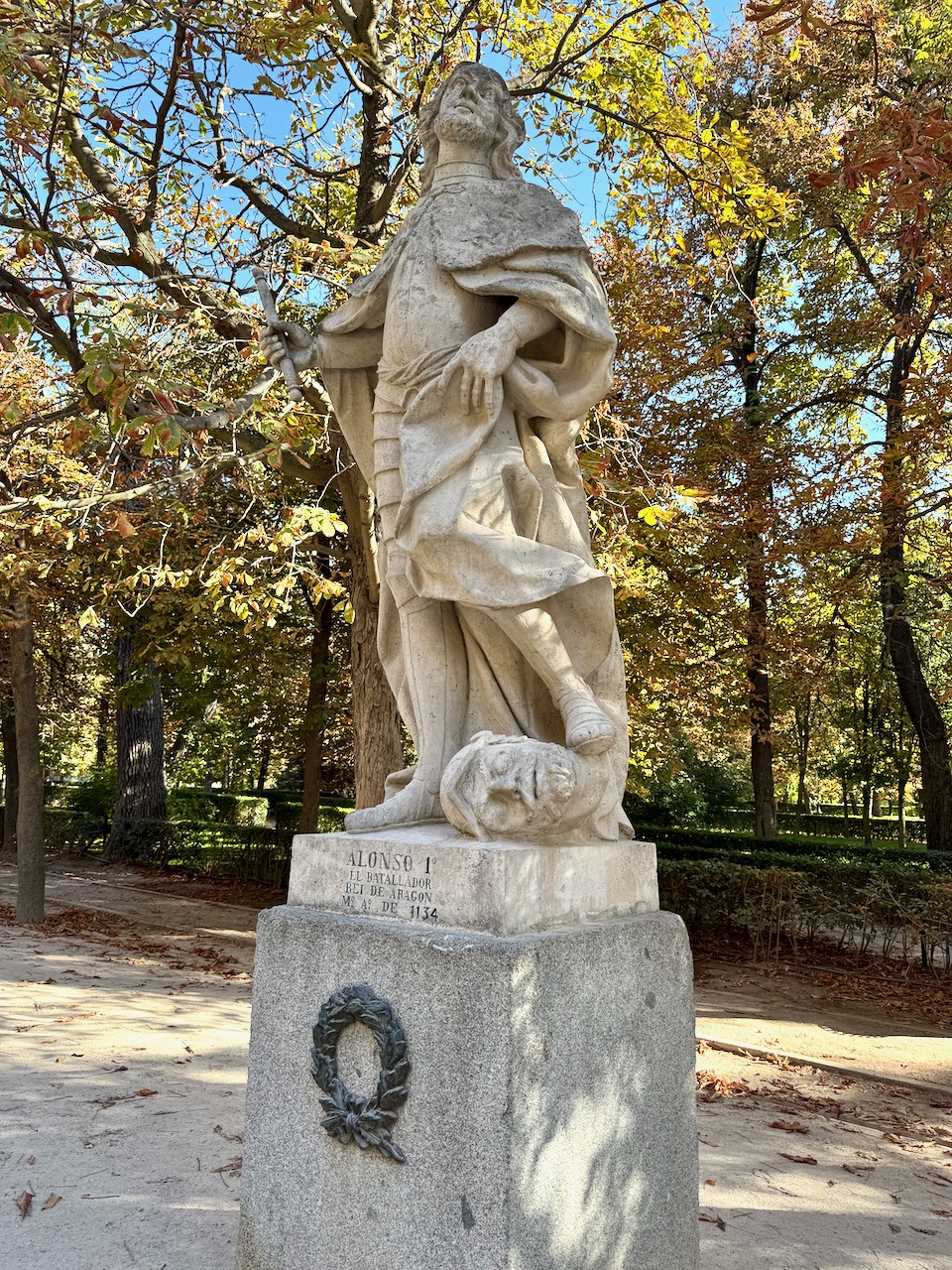
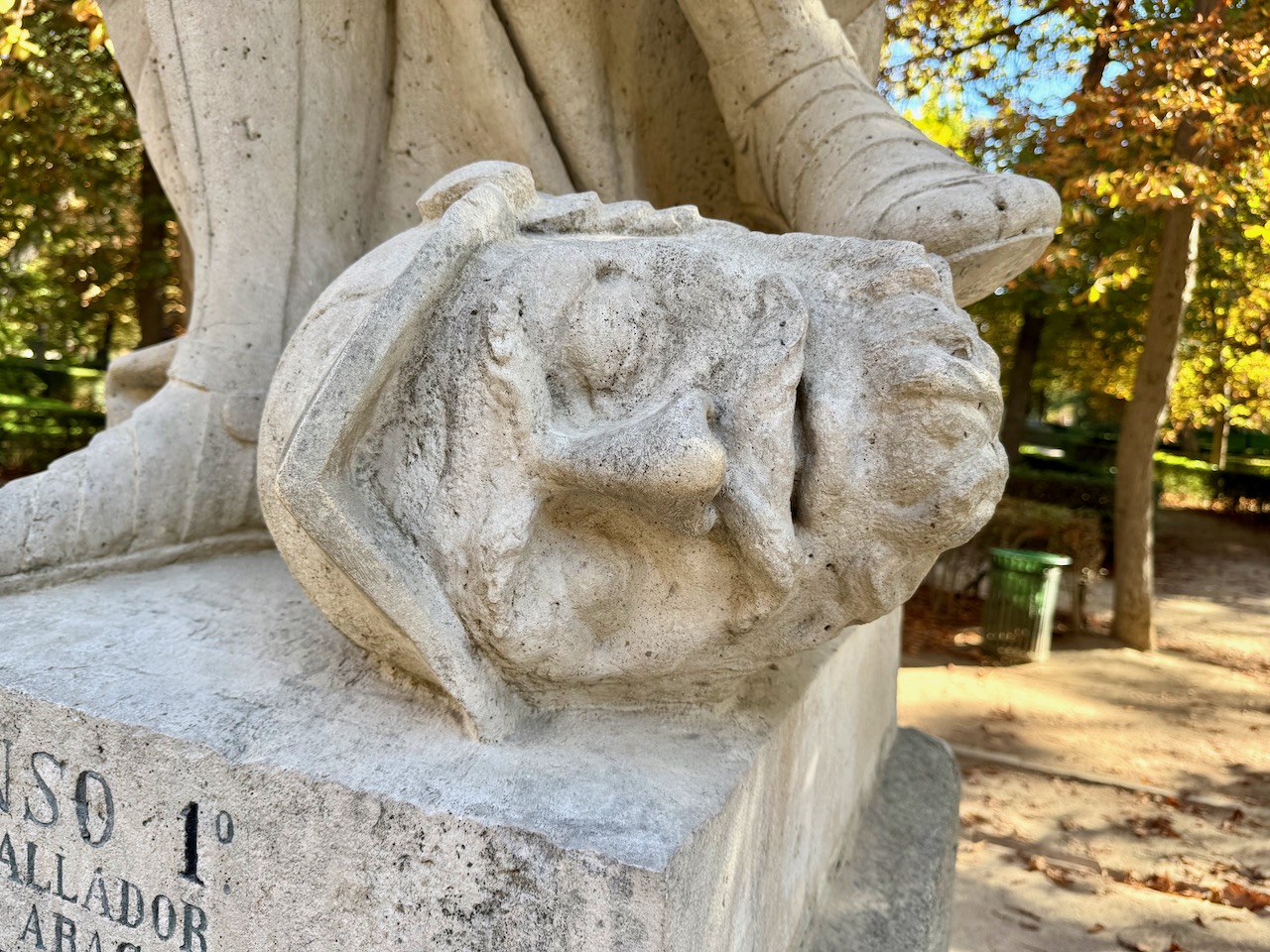
And who is this? “Only the Shadow Knows.”
Leaving the park …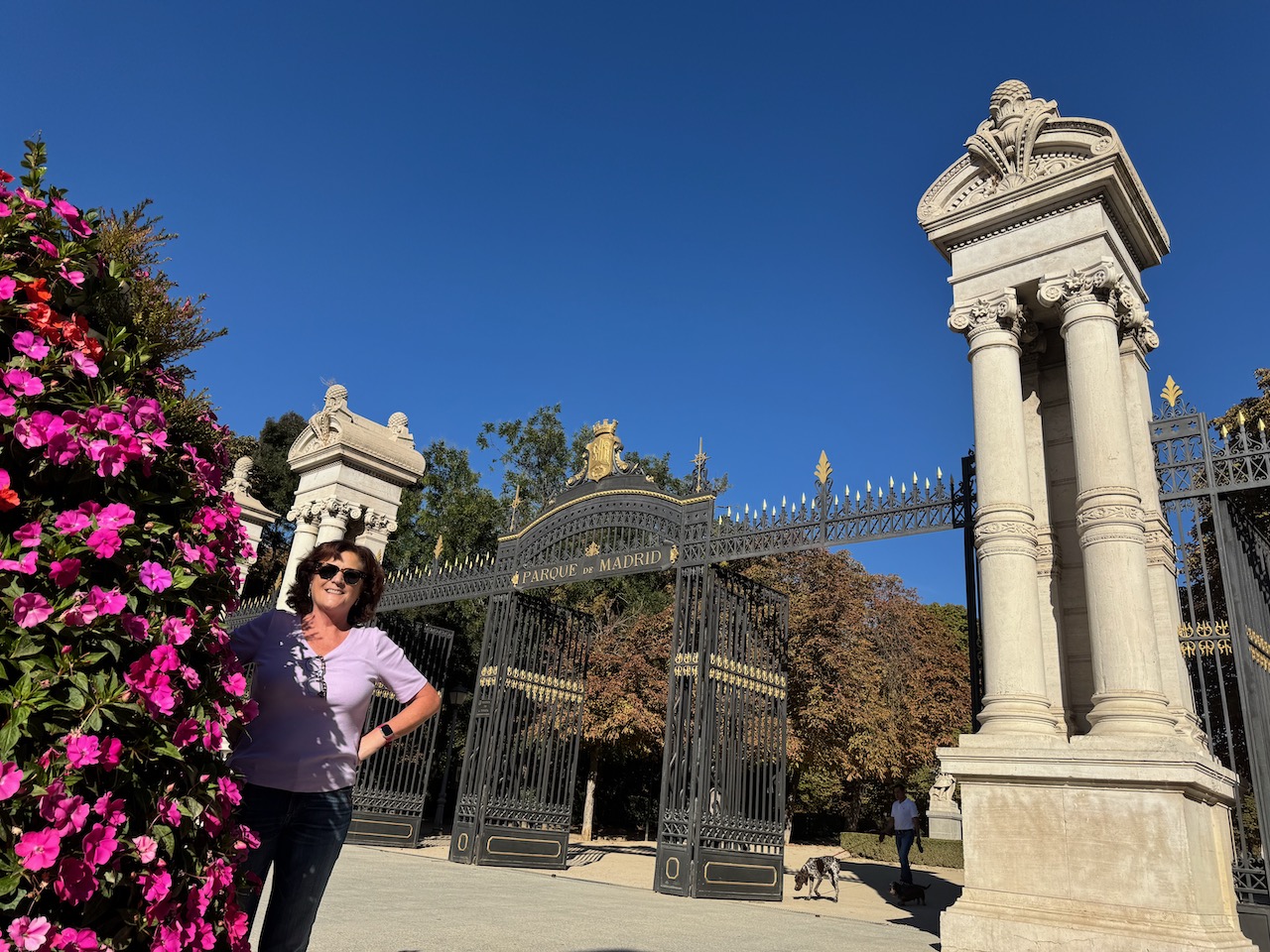
… and after walking seemingly 100 miles for the day, I decided to order a taxi for the short (but uphill) journey back to our hotel. We had been on our feet for the better part of eight hours. The taxi picked us up, drove about a block, stopped and asked us to please exit the vehicle. I wondered if he’d seen our terrible selfie and thought our heads might be too heavy for his car, but out we went. We surmised he got himself a more lucrative fare.
Then we ordered an Uber, but when our driver arrived and dropped off someone else, he said he could not take us but did not provide any further explanation. We were beginning to get a complex, so we decided to walk.
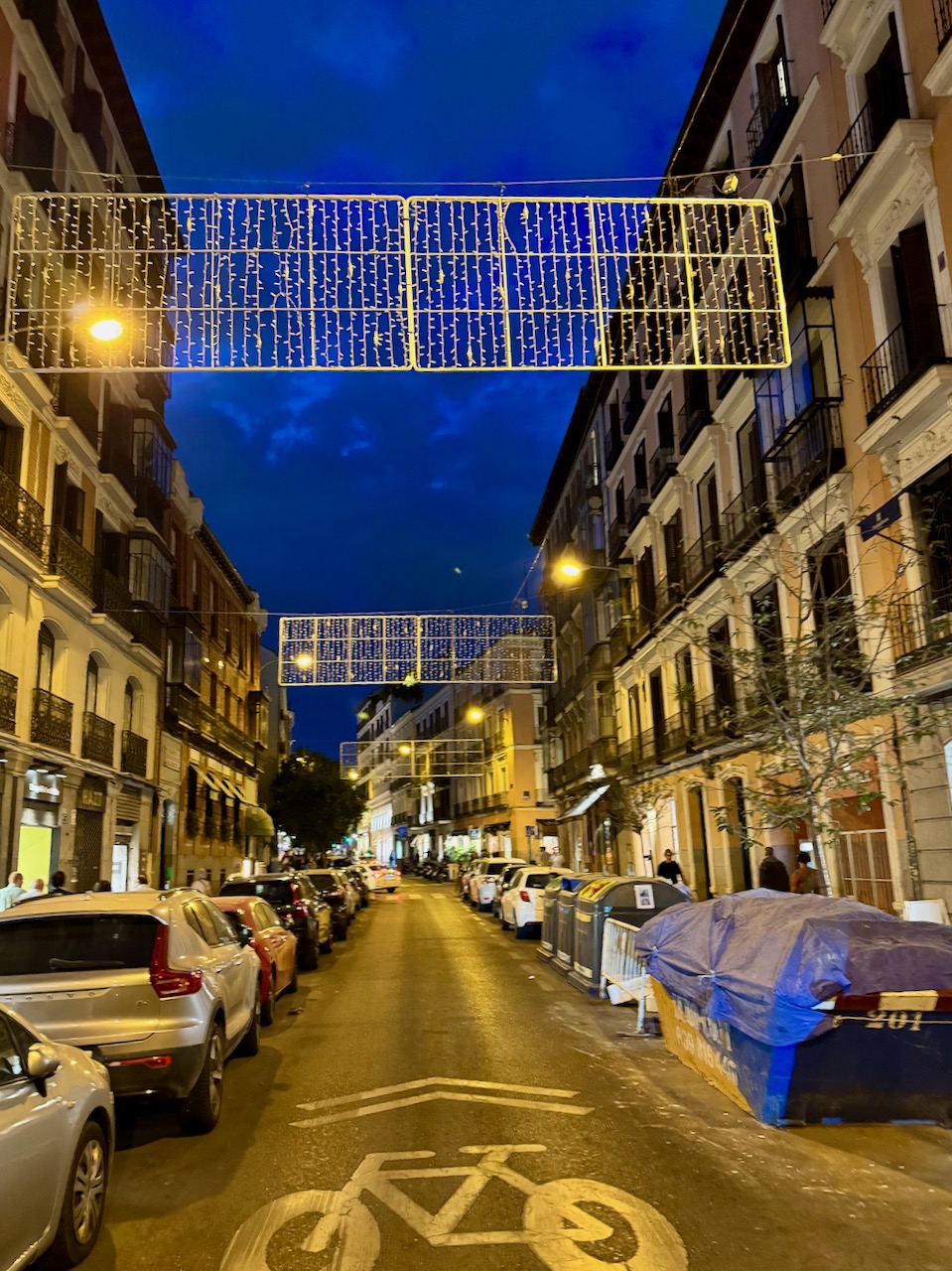
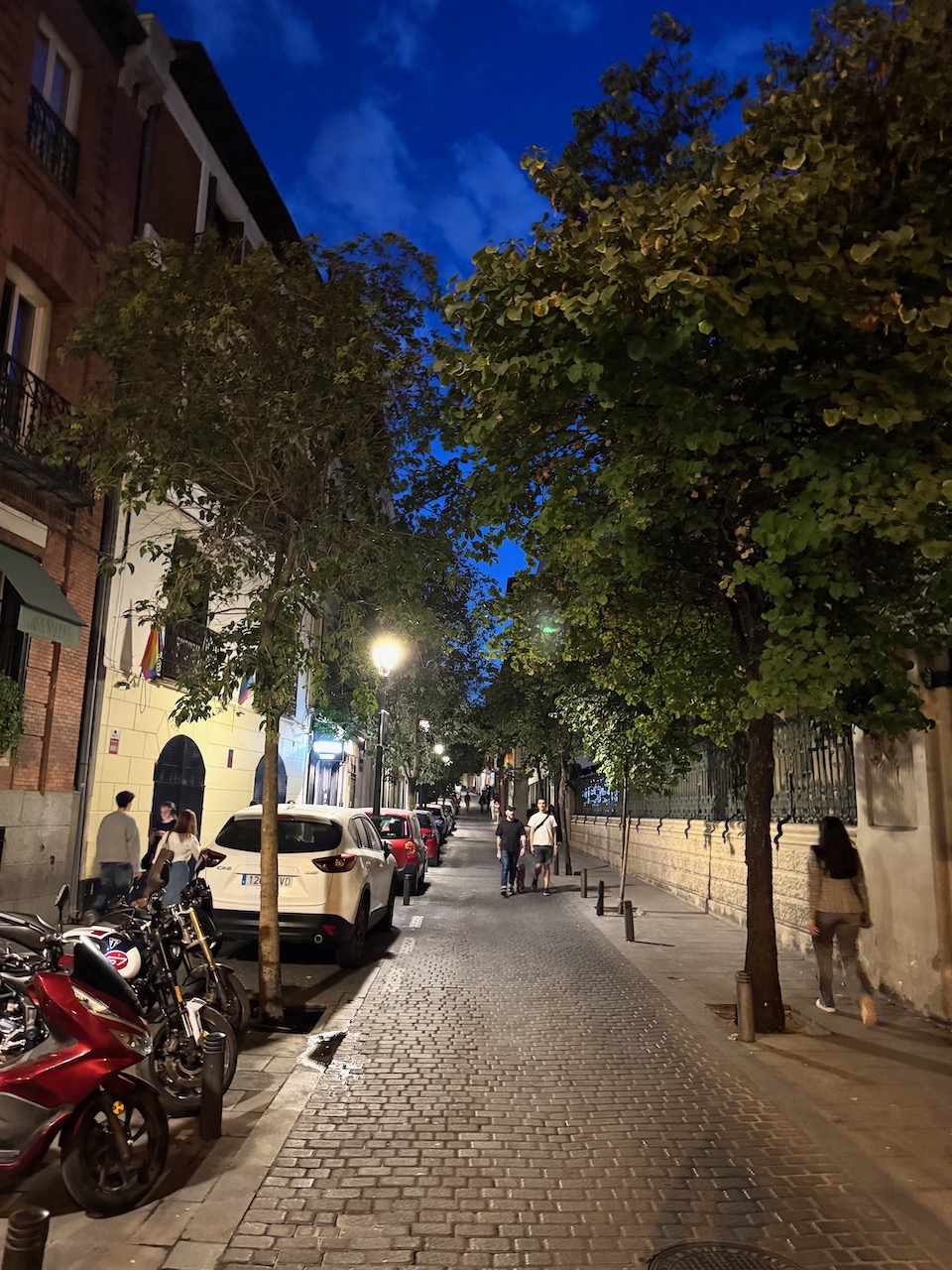
Our late afternoon siesta was a short one, because by 7:30 we were headed for the Chueca district. A friend had told us it’s “the hip area of Madrid,” so we hoped we didn’t diminish the vibe of the area too much. It was a busy Wednesday evening as we walked around the neighborhood.
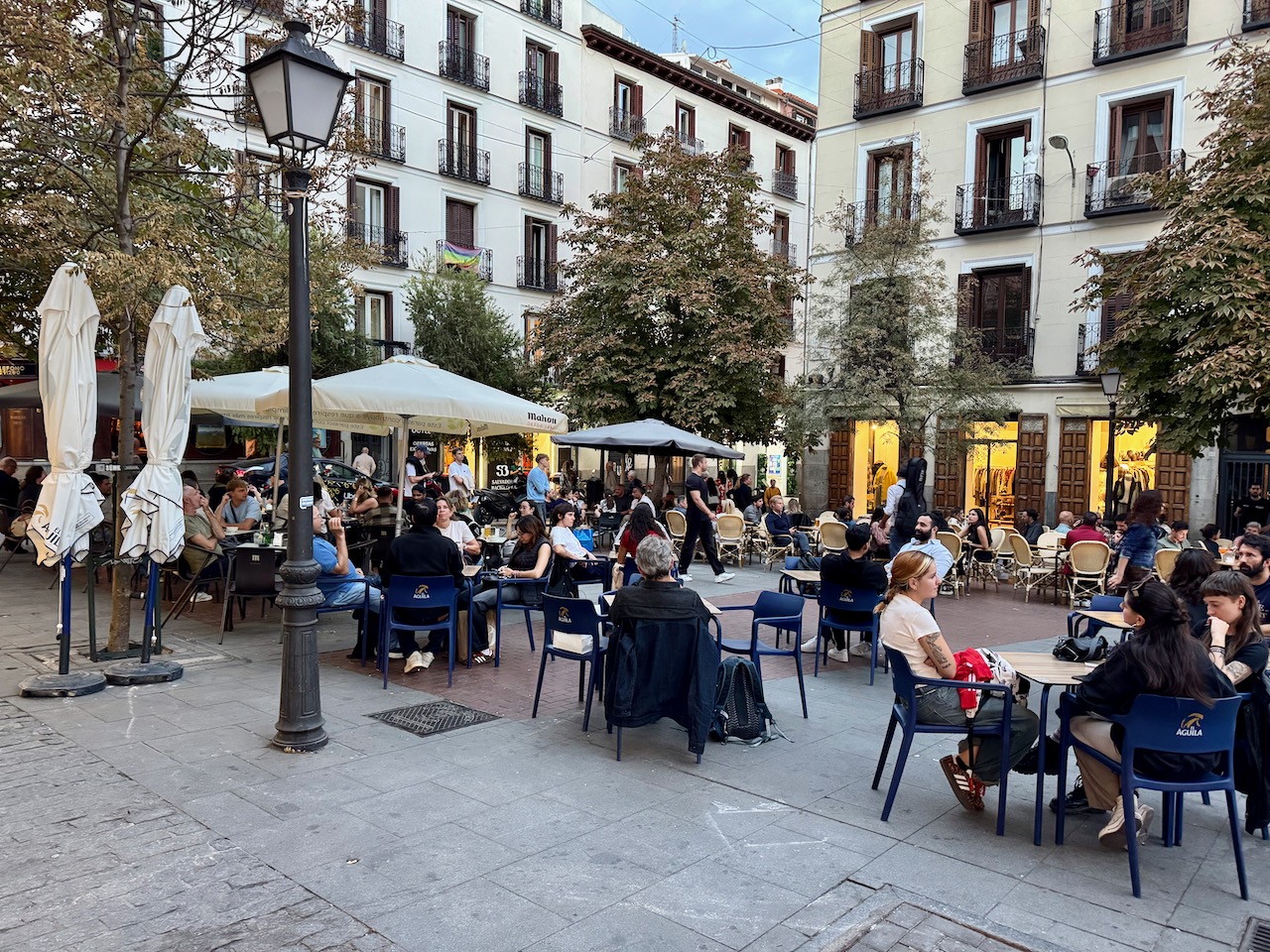
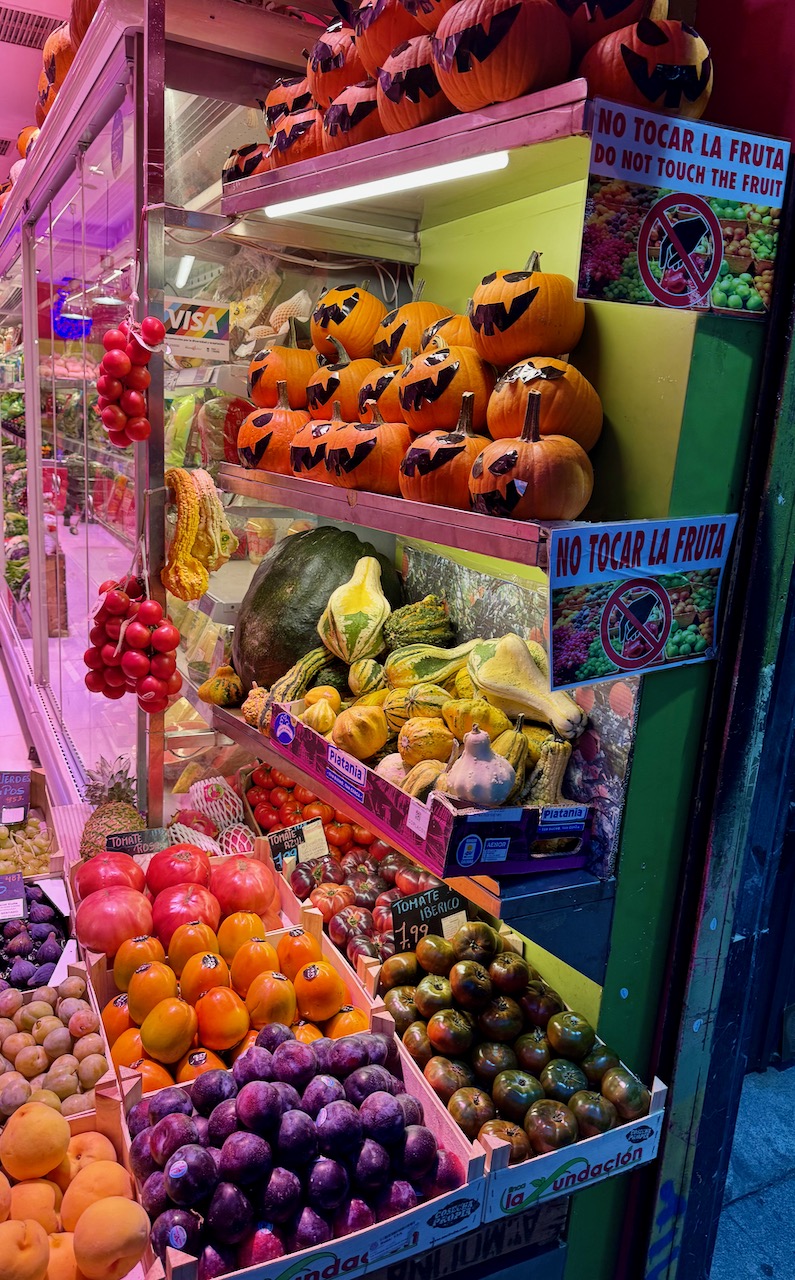
After seeing the sign for the Mercado San Antón, Tracy reminded me we had eaten dinner at one its restaurants on our 2015 visit. Obviously, my increasing senility had once again taken over, because it did not ring a bell. (Of course, when I checked our 2015 trip report, Tracy was correct once again.)

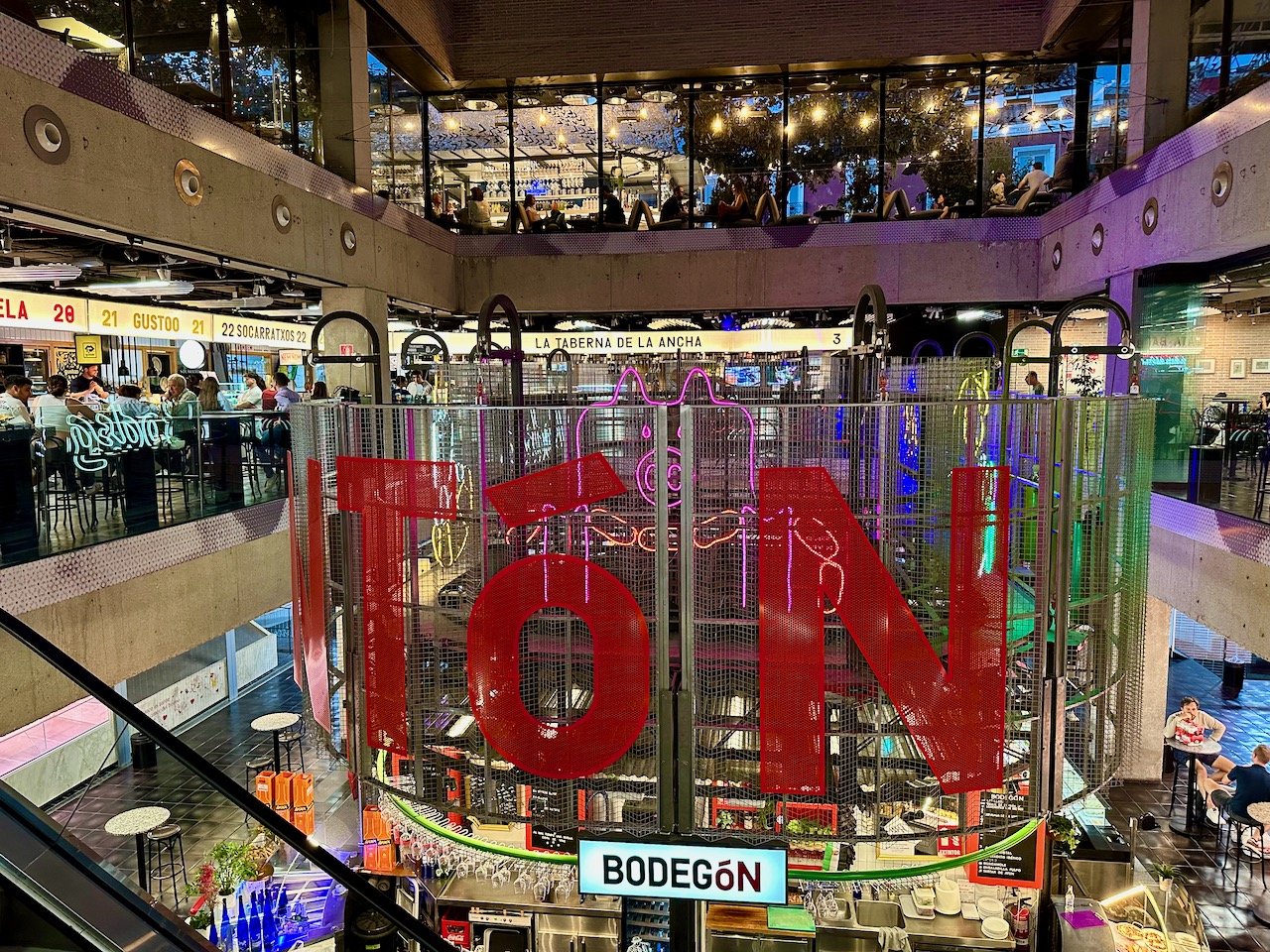
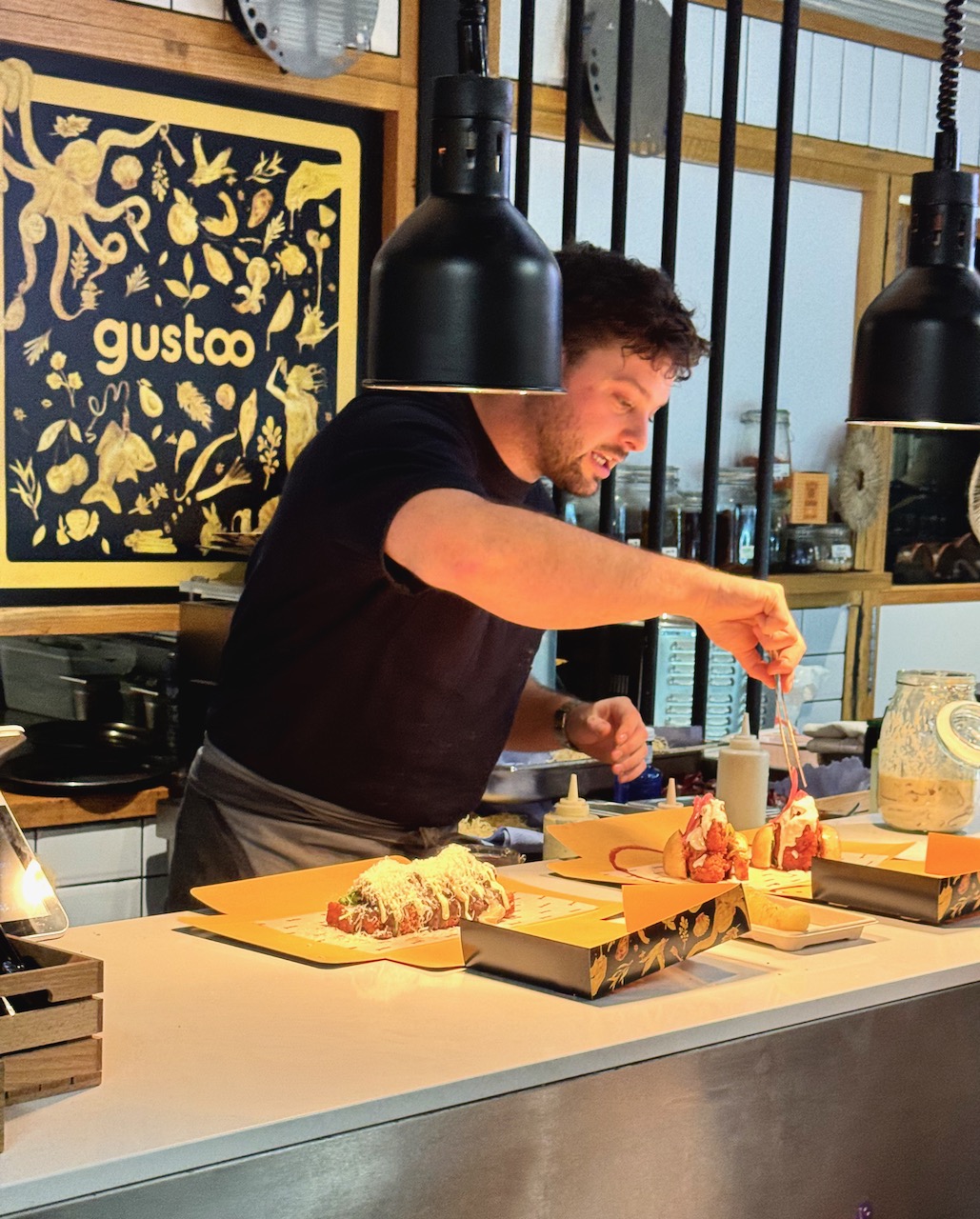
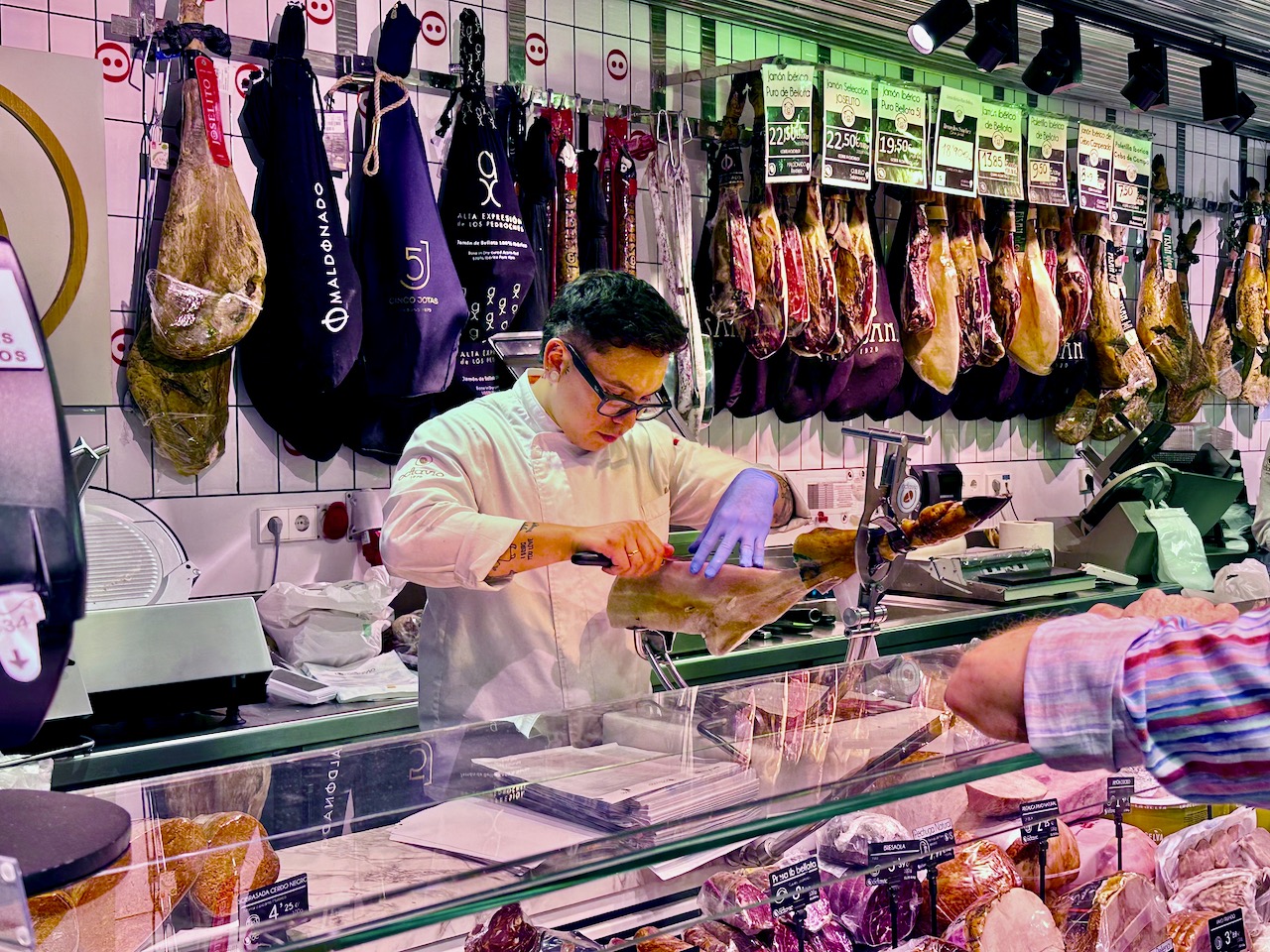
We walked around the market, taking in all the delicious looking food people were ordering.

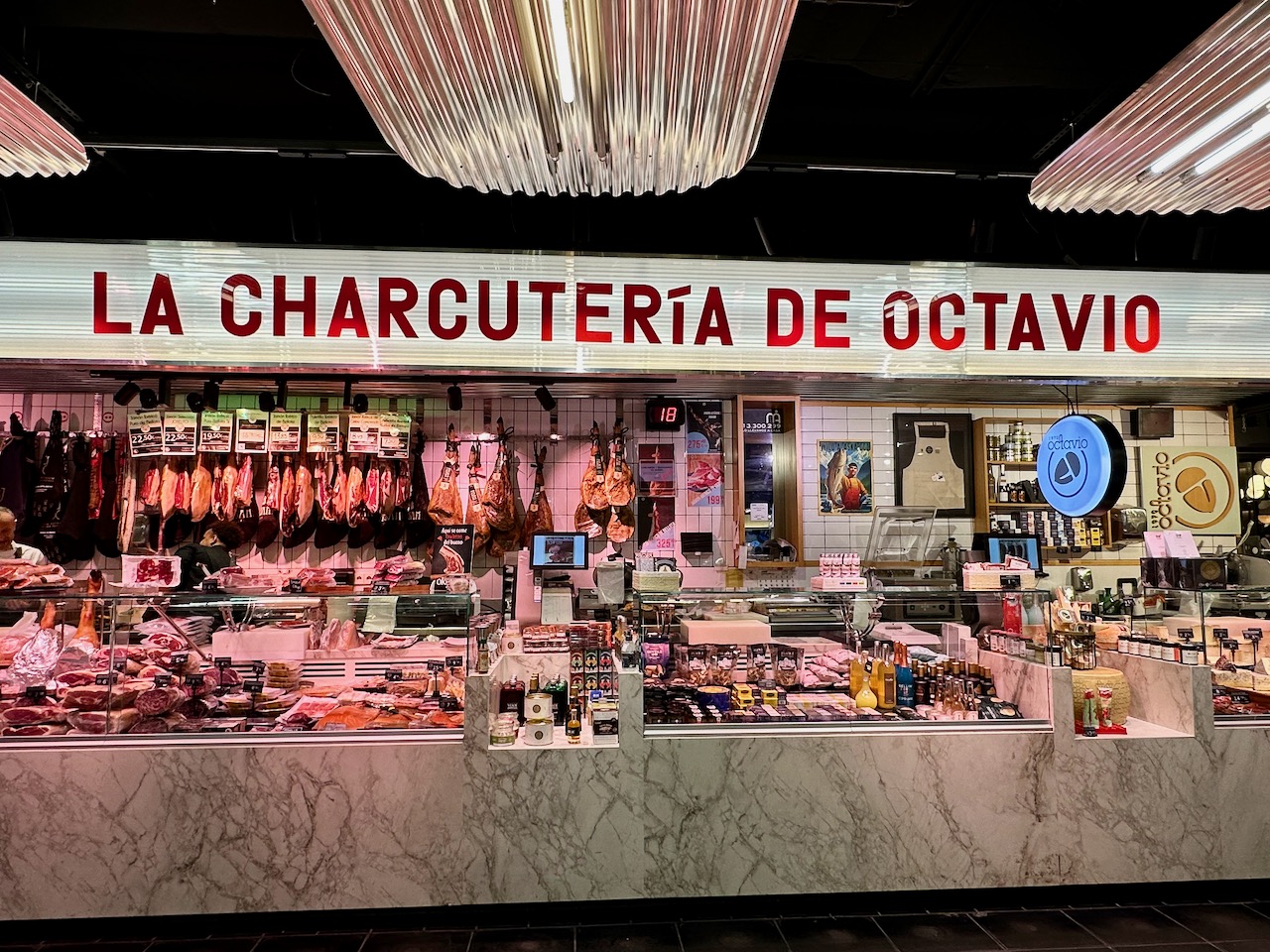
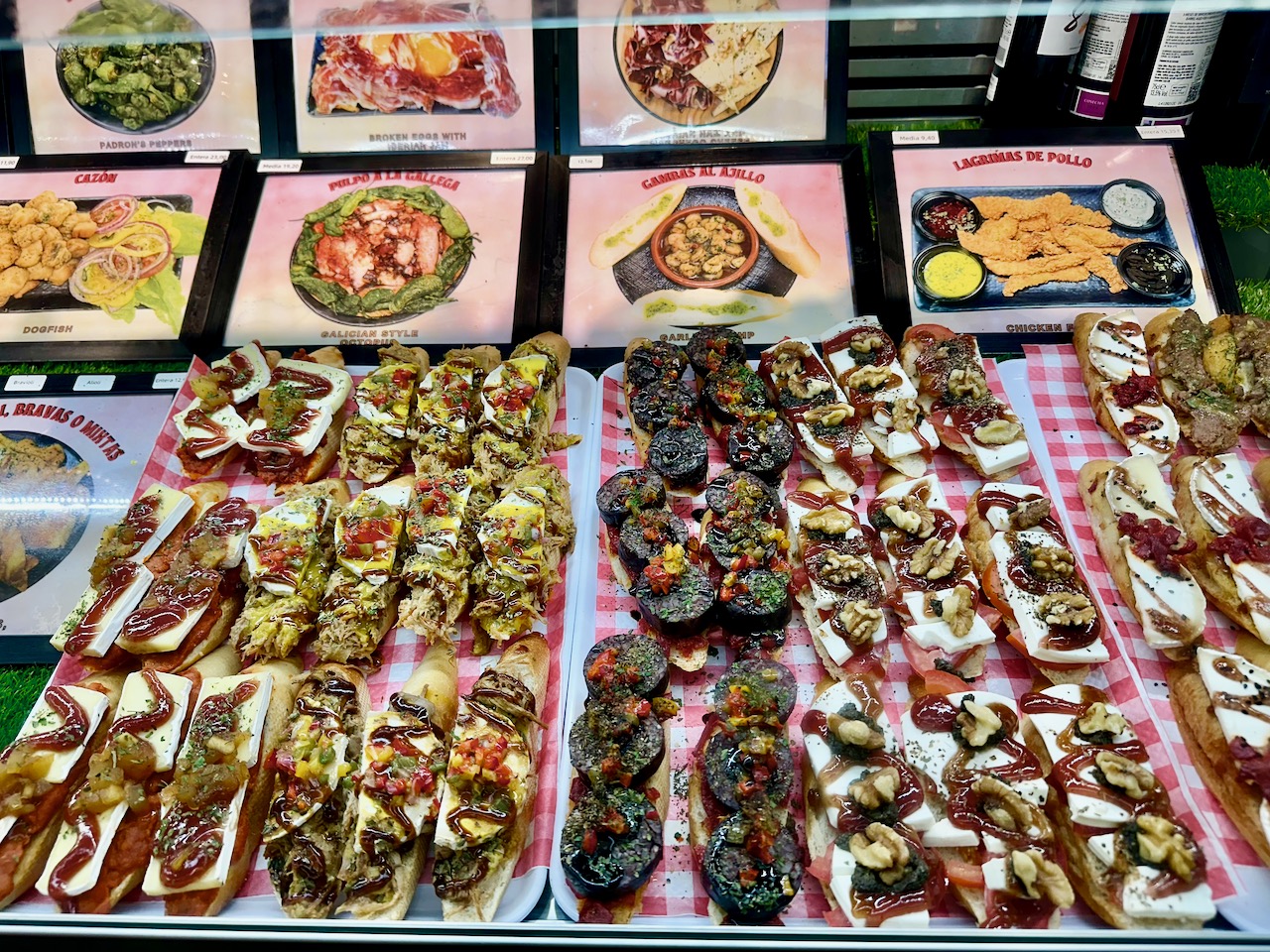
The vendors were hard at work.
We then walked part of the neighborhood on a very lovely evening.

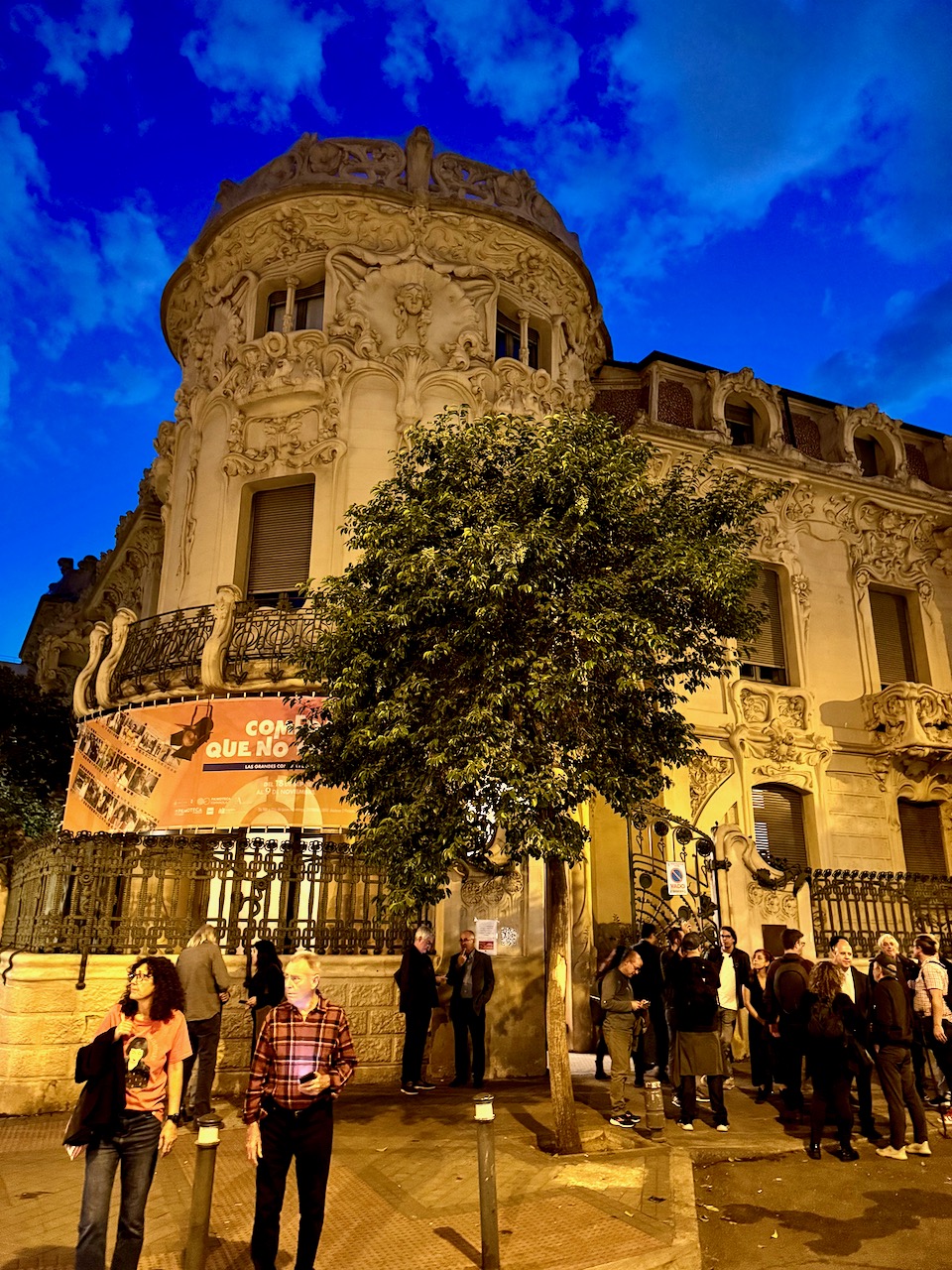
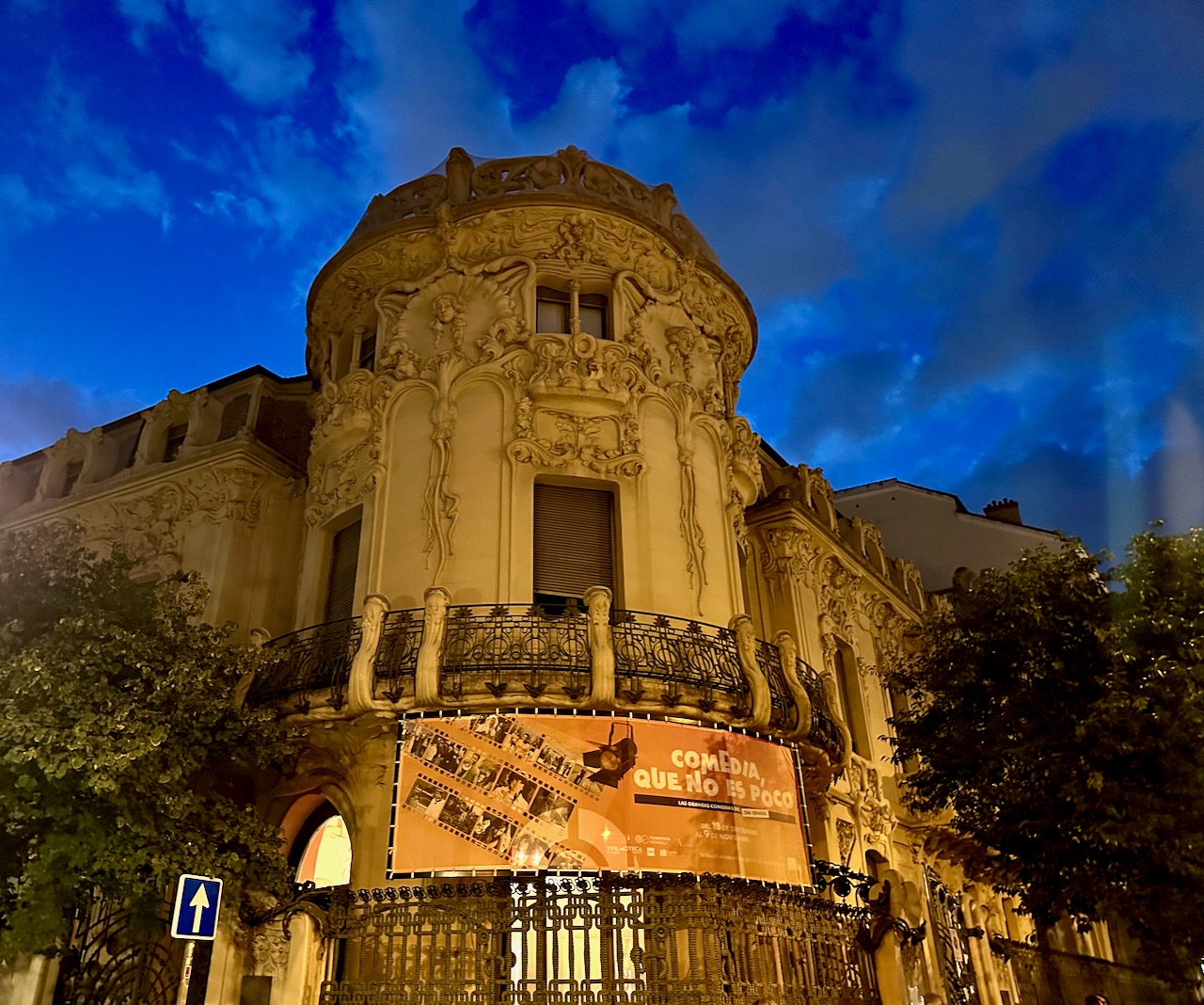
There seemed to be some sort of exhibition going on at the early 20th century Art Nouveau building called the (Don’t Call Me Eva) Longoria Palace (Palacio de Longoria).
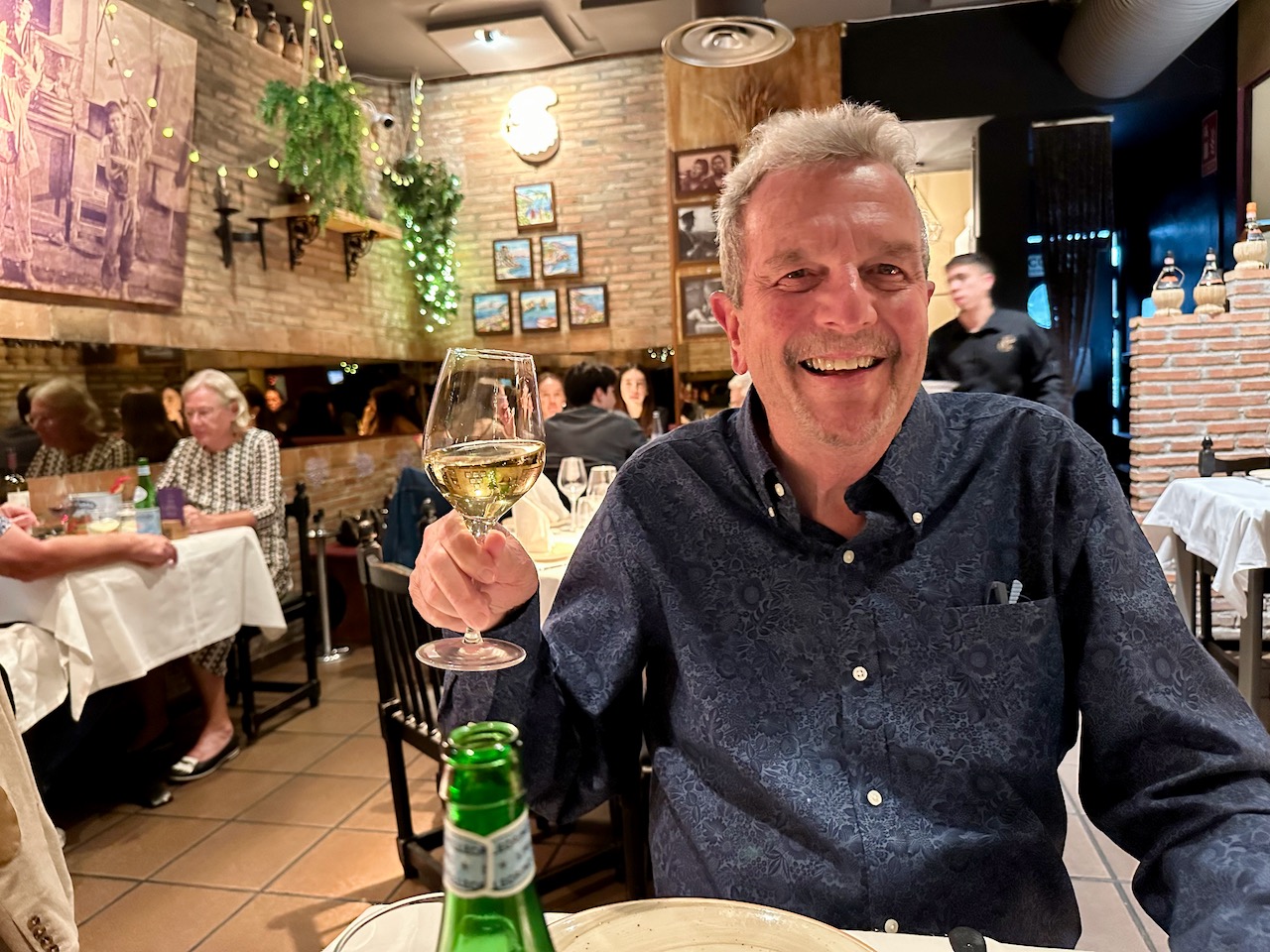
For dinner on this particular evening, I had made reservations at an Italian restaurant thinking that we might want a change of cuisine by this point. Trattoria Pulcinella, located just down the street from the Mercado San Antón, was jam-packed which made me happy that I had made reservations.

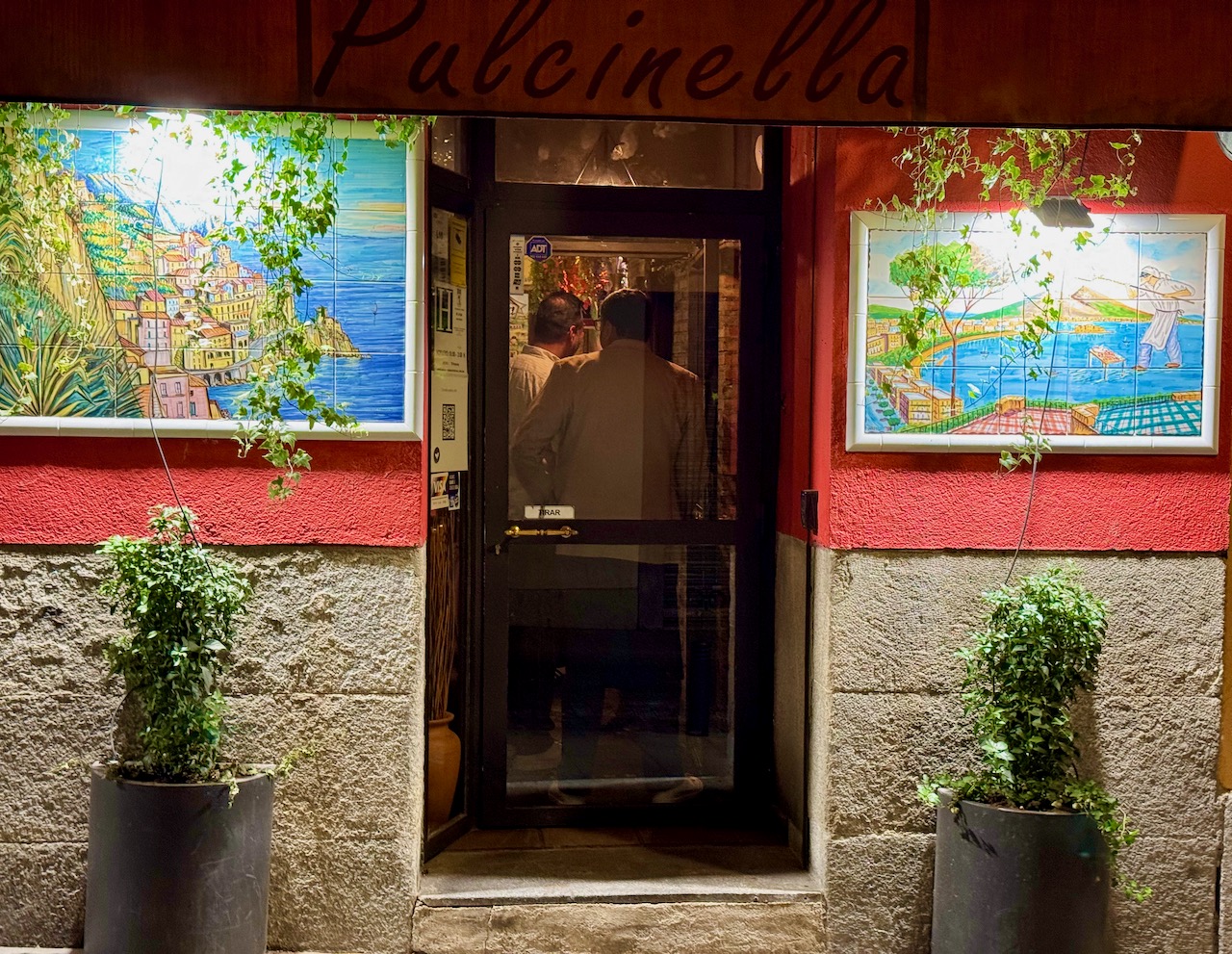
It’s a cozy neighborhood-type restaurant with brick walls covered with photos and artwork. The staff was very attentive despite being extremely busy, whizzing in and out of the kitchen in what Tracy described as “an amazing ballet of near misses.”
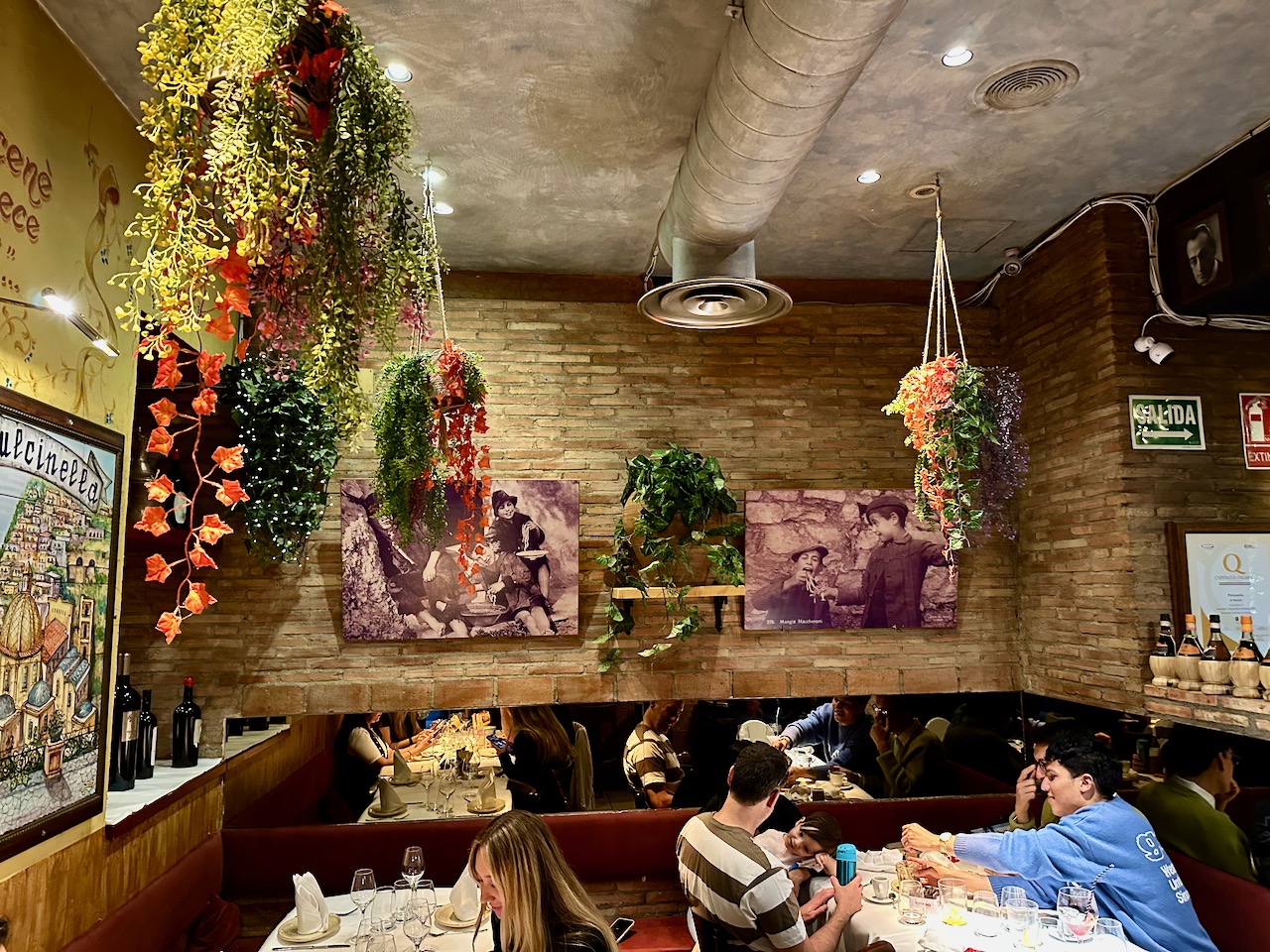
We started with a very large bruschetta (in fact, all the portions are very large).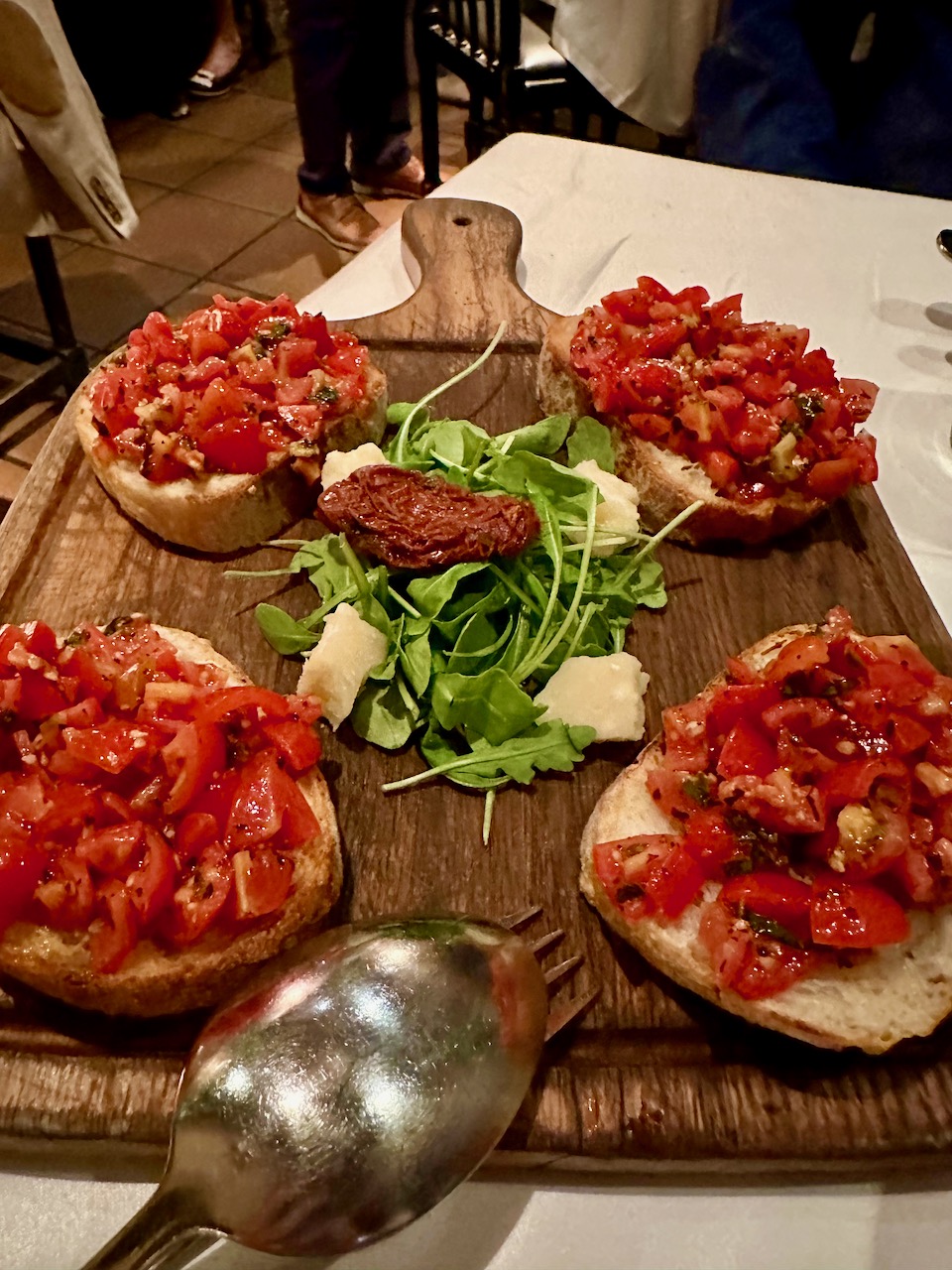
For dinner I opted for gorgonzola gnocchi while Tracy went with the Delizia Mamma Maria, Grandma’s Special, ravioli stuffed with ricotta and spinach in a pistachio pesto sauce. Not surprisingly, I still managed to save room for a Panna cotta, and even squeezed in the complimentary limoncello which arrived with our bill.
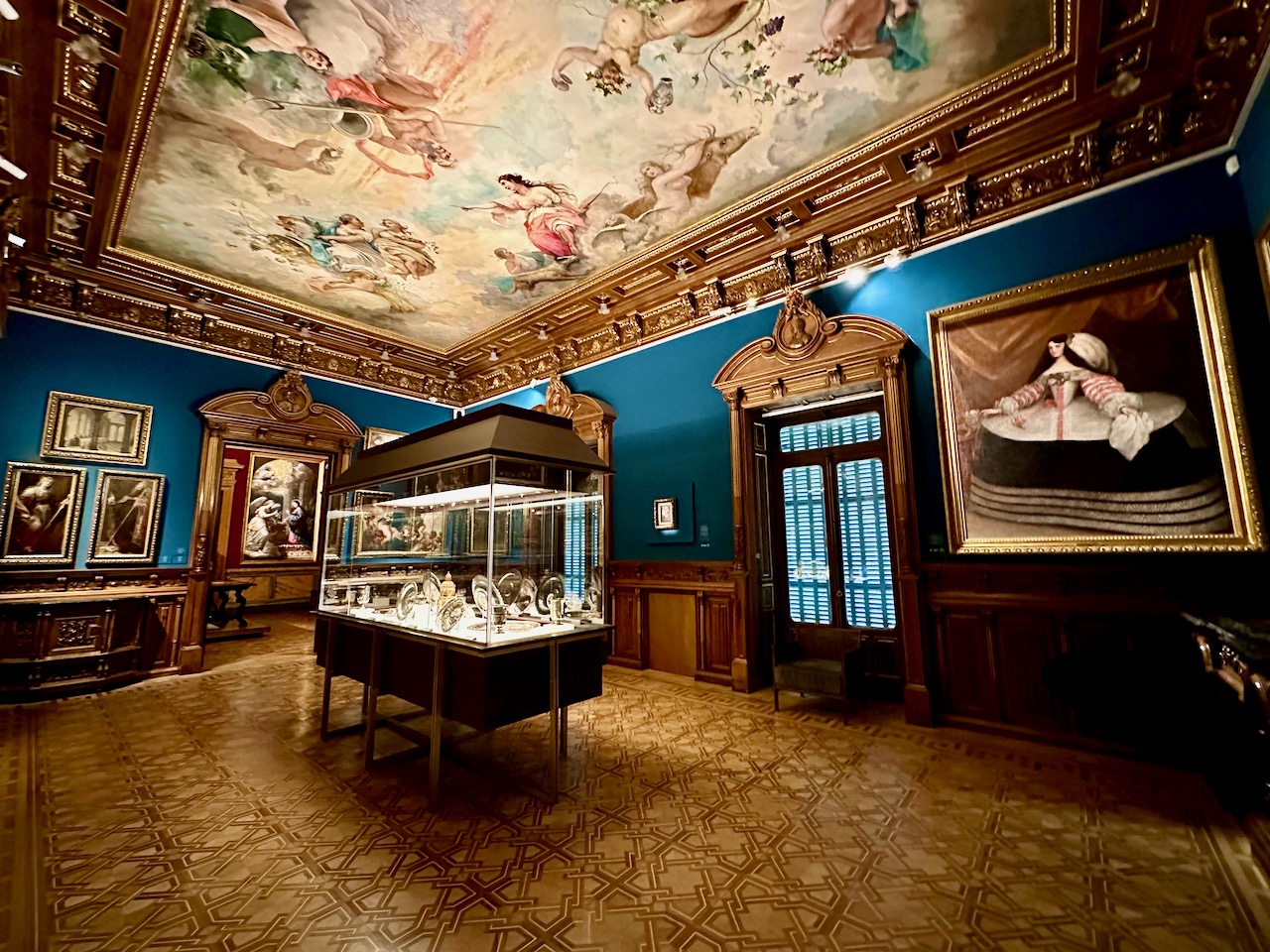 It turned out to be a late night (well for us, not the Madrid locals). The following day we would visit what turned out to our favorite Madrid museum of the trip, stopped into a Royal Church, made a shorter than anticipated visit to the Prado, had lunch at another old favorite, took a quick siesta and found some time later in the afternoon to enjoy a glass of vino at Mercado San Miguel. After an evening strolling along the Gran Via, we took a circuitous route back to a small restaurant recommended by friends back home.
Chapter Five: A Museum Less Traveled Highlights A Busy Day
Day Five: Transportation Choice, A Museum All To Ourselves, Should We Steal The Bosch Or The Goya?, Witchcraft, A Church & National Monument, The Trampling Tours, Visiting An Old Favorite, The Days Of Wine & Doughnuts, Feeling Blue and Basqueing in The Warmth Of Tomato Soup