Chapter Seven: Burgos Bound
January 12, 2026
Chapter Nine: Just One Of Those Days – On To León
March 6, 2026Celebrating España: MaiTaiTom’s Still “Insane For Spain”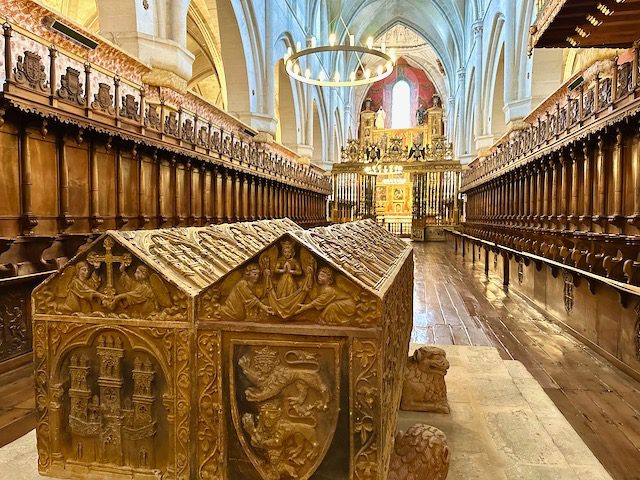
Chapter Eight: Marvelous Monasteries Of Burgos
Day Eight – Red Sky In The Morning…, Why Didn’t I Take That Extra Semester Of Spanish?, My Kind Of Town, En-Chanting, A Feast For The Senses, The Helpful Attendant, Stiffed, Chocolate & Olive Oil, Burgos In The Rain, None Shall Pass and A Change Of Attitude
There’s nothing quite like a beautiful sunrise, especially when it doesn’t happen until almost 8:30 am.

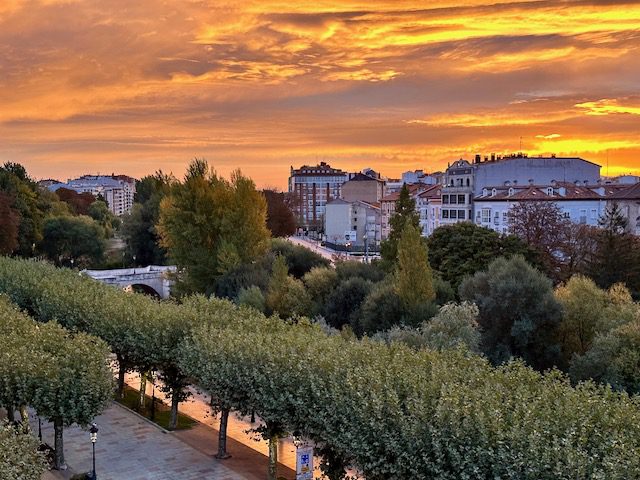
After a great night’s sleep we awoke to this view out our hotel window. Of course there is that old adage, “Red sky in the morning, sailor’s warning.”
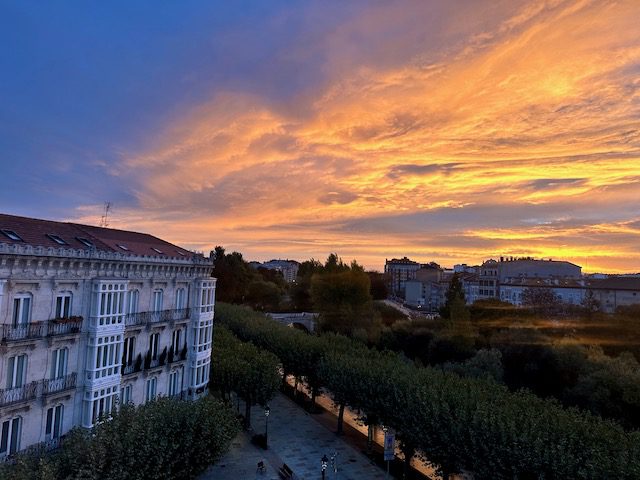
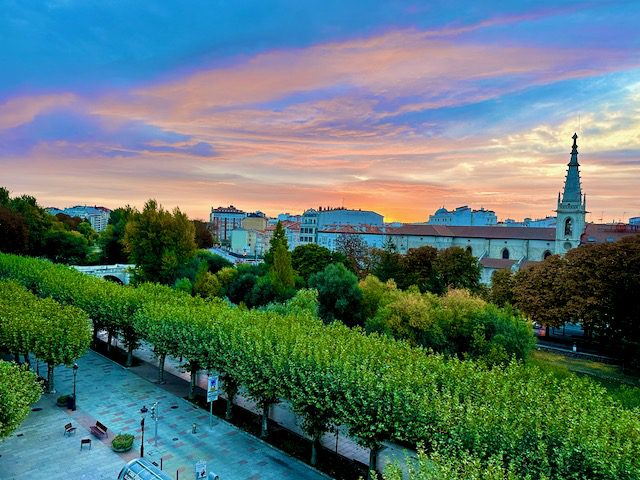
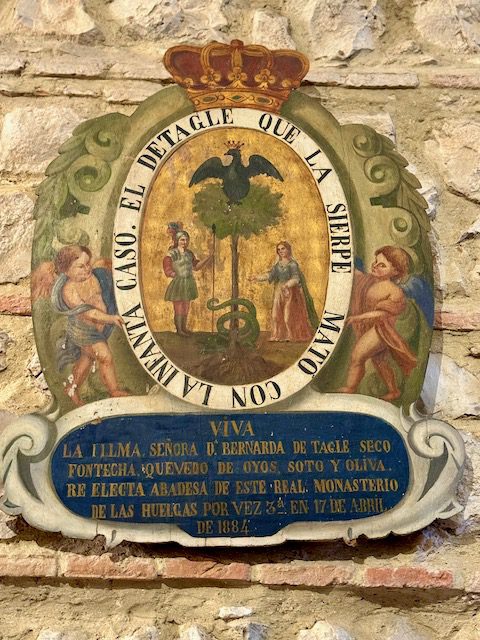
Sure enough, just as we were prepared to walk 30 minutes to our first destination, the skies opened up. Luckily, there was a taxi nearby and we were whisked to Monasterio de Santa María la Real de Las Huelgas, a Cistercian monastery founded in 1187 by the power couple of Alfonso VIII of Castile and Eleanor of Plantagenet (daughter of Henry II of England and Eleanor of Aquitaine). We had scheduled a 10:40 tour that once again was only provided in Spanish.
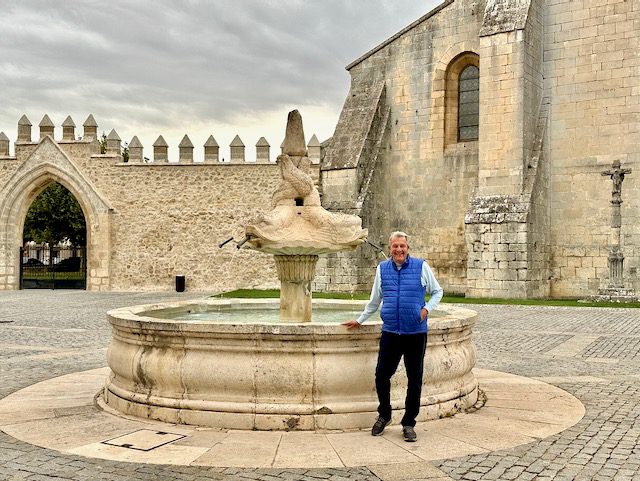

Thanks to a terrific tour guide, she brought this place to life even for the only two non-speaking Spanish people on the tour. It also helped that there were placards in English describing some of the more important aspects of the monastery. 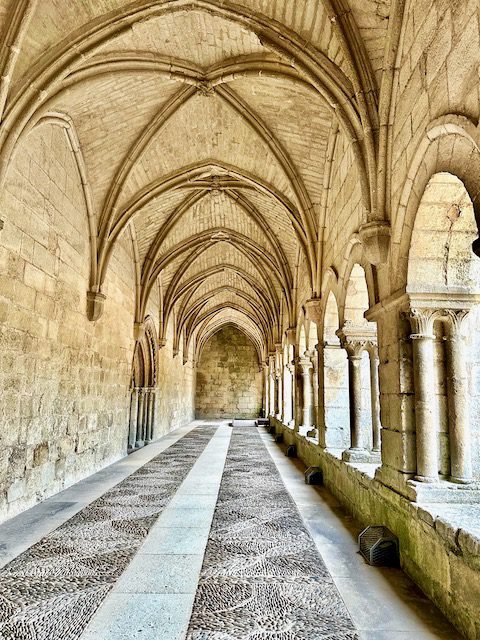
Just like the previous day, don’t miss the altarpieces.
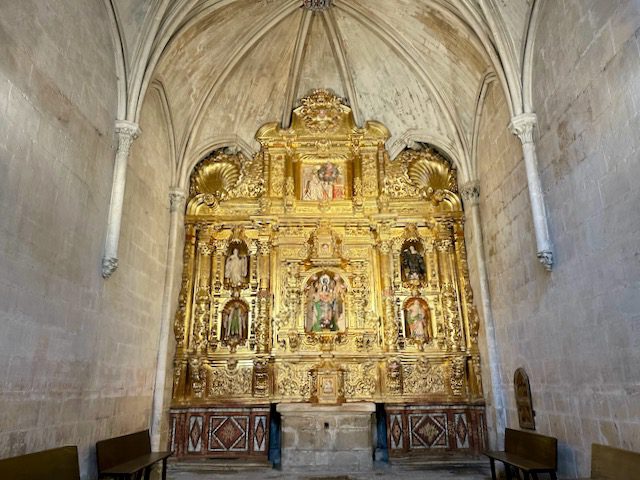
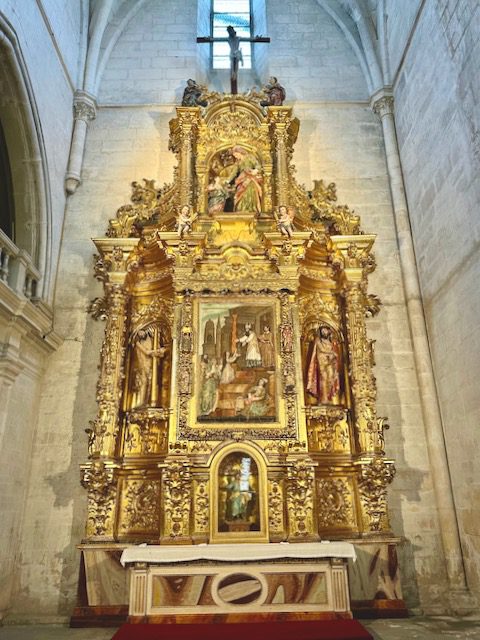
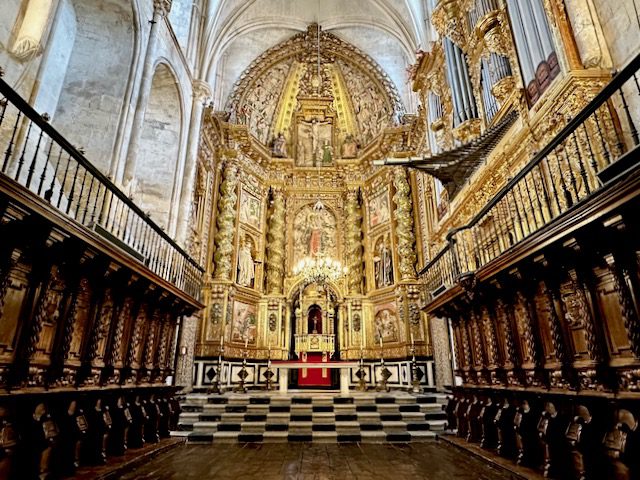
In the church, the Main Altar dates from the 17th century, with the baroque organ looming above the stalls.

Over the doorway was a very cool fresco painted in 1594 entitled Battle of Las Navas de Tolosa, which took place in 1212. Below the fresco are portraits of Alfonso and Eleanor. When Alfonso died in 1214, his wife of 42 years, consumed in grief, passed away just a few weeks later.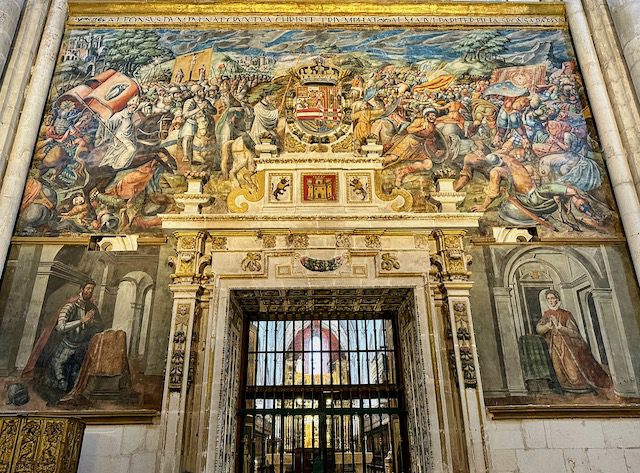
We passed by the Aisle of Saint Catherine. At the end of the 12th-century the monastery was dedicated as a Royal Burial Chamber. This area contains 16 royal tombs.
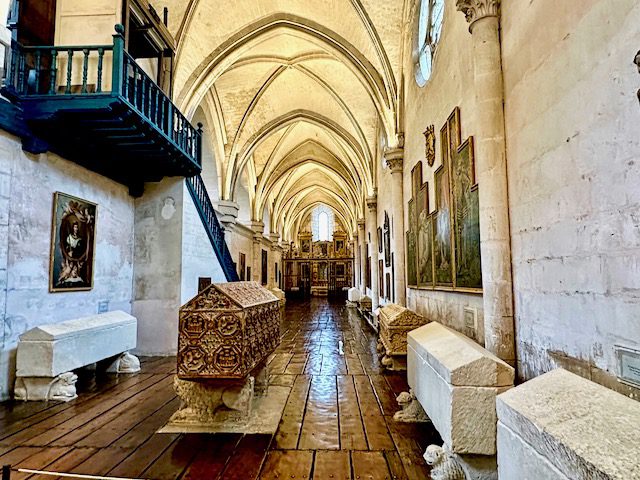
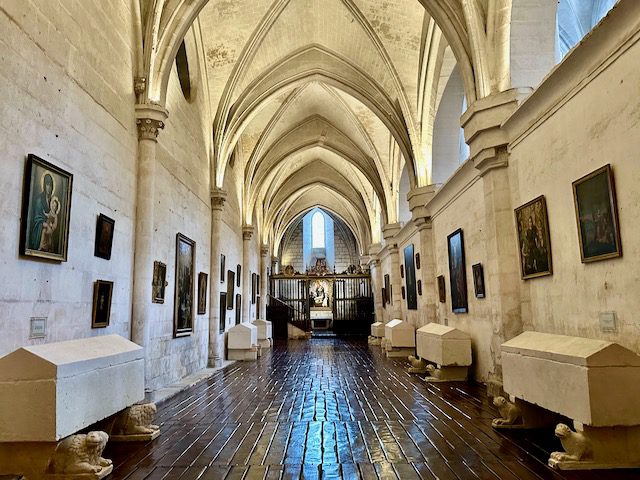
In the choir is the double sarcophagus of Alfonso and Eleanor decorated with heraldic motifs. (We were fortunate in that the guard here was once again lenient in letting us linger to take photos once the room was empty).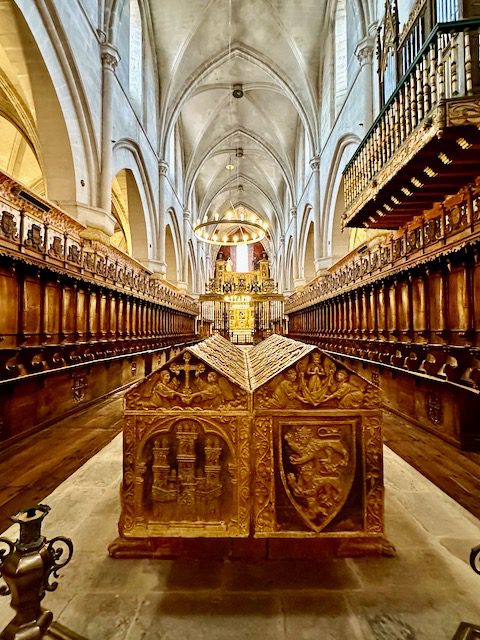
One more elegant altarpiece …
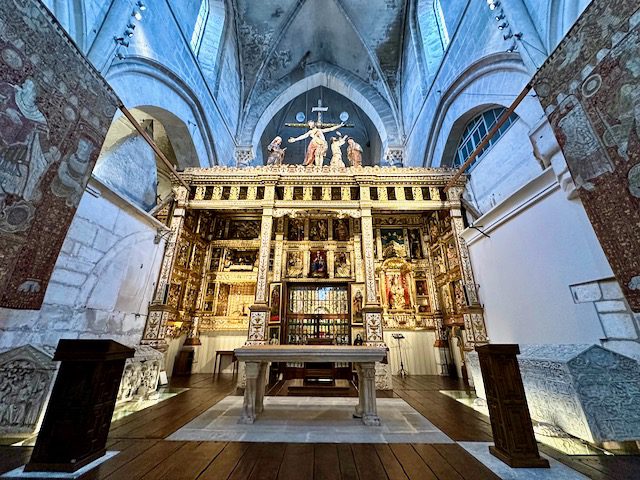
…and we headed toward the Chapter House, adorned with paintings of many of the monarchs.
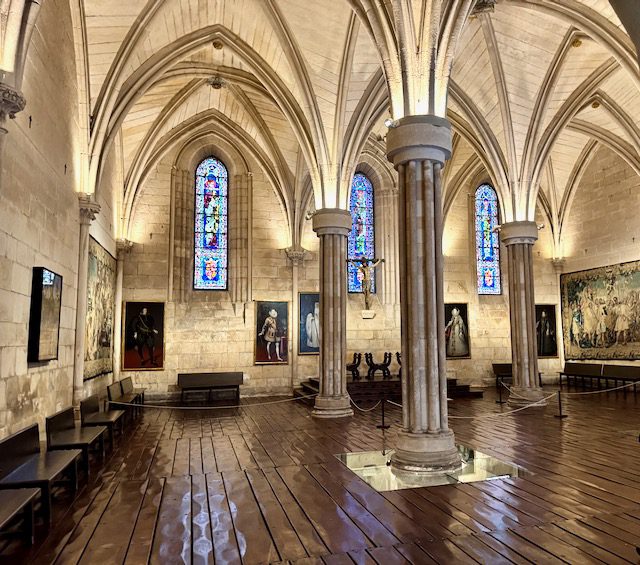
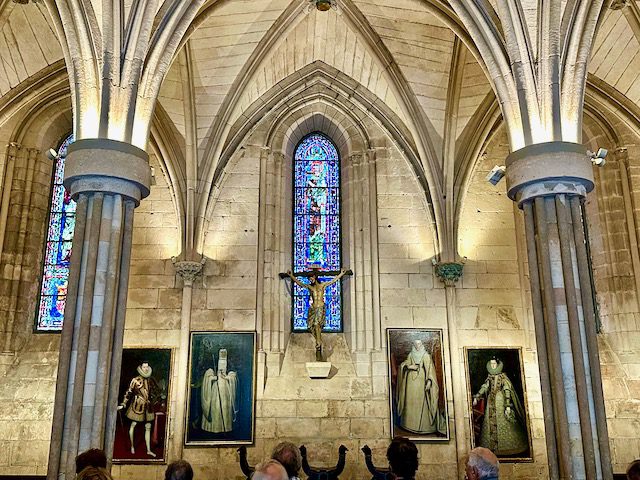
The columns and stained glass stood out.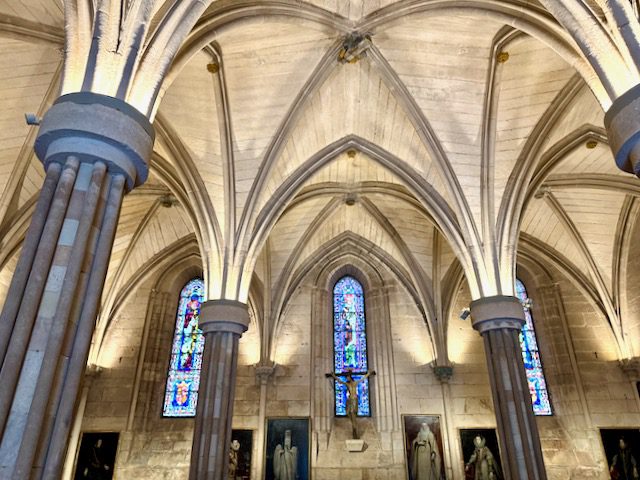
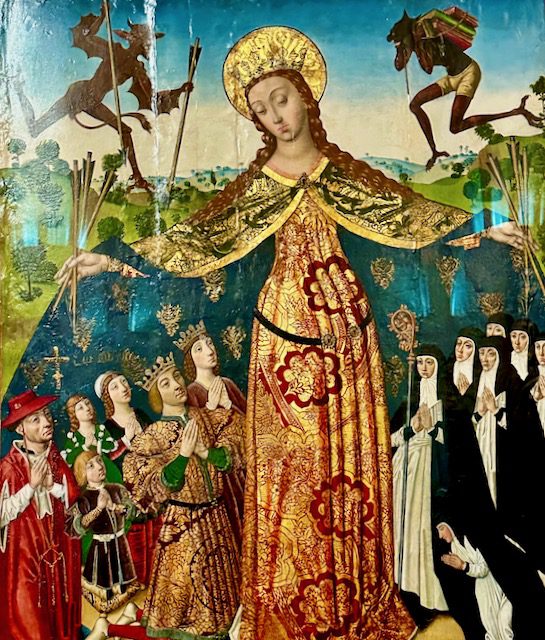
Virgen de la Merced con la familia de los Reyes Católicos by Diego de la Cruz is one of the Chapter House treasures. There was also an ancient tombstone protruding from the floor.

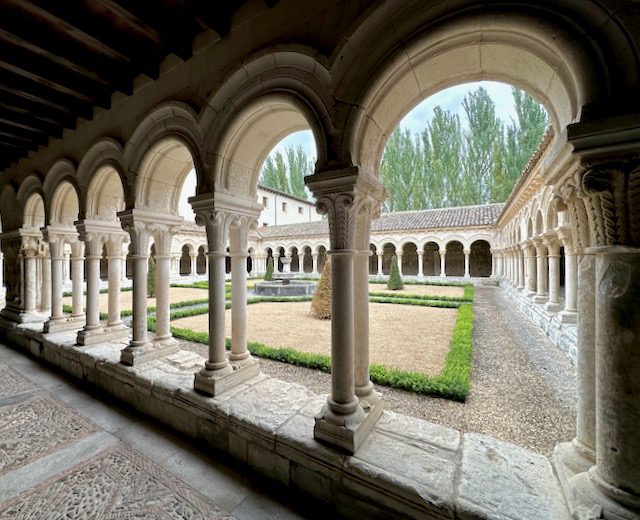
Las Claustrillas (Small Cloister) is one of the oldest areas in the monastery.

As the tour was nearing the end we stepped inside the Chapel Of The Assumption, dating to the late 12th-century. This is where Alfonso and Eleanor were originally laid to rest in 1214 until 1279 when they got their tomb upgrade.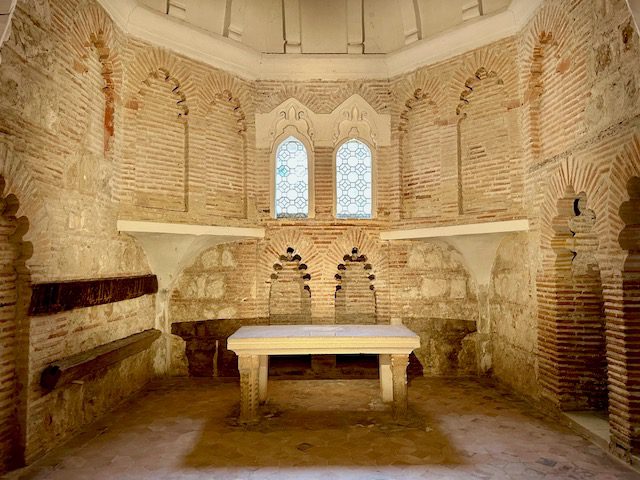
The Saint James Chapel has a Mudéjar high ceiling panel …
… along with the saint himself brandishing his sword.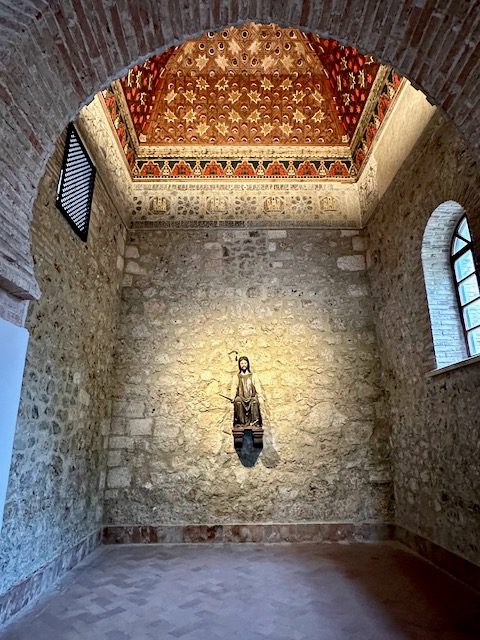
We checked out what we think was the Kitchen Garden (maybe we can sponsor it and call it MaiTai Tracy’s Kitchen Garden).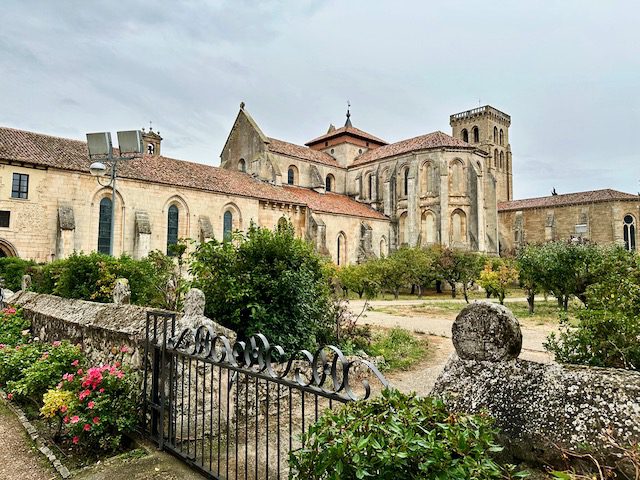
This very interesting (even for non-Spanish speakers) tour lasted about 70 minutes. Monasterio de Santa María la Real de Las Huelgas is an important stop along the Camino de Santiago (and especially its most traveled route, the 780 km Camino Francés). We know people who have walked a portion of the Camino, and they say it is really a fabulous experience.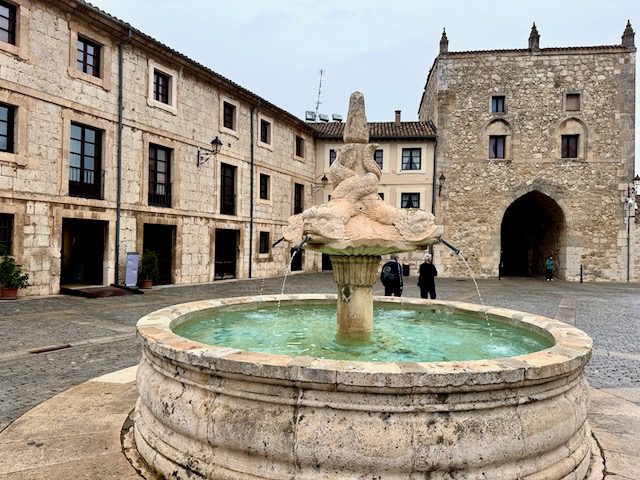
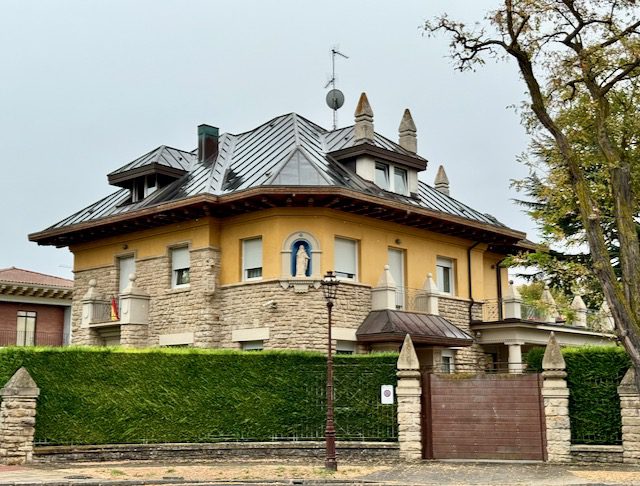
We planned to grab a cab to our next destination, but there were none in sight. Since the rain had stopped (briefly, as it turned out), we walked the mile back to our hotel (not quite Camino distance), admiring the tree-lined neighborhood of large gated homes. “Let’s move here,” I told Tracy. She replied I’d have to tell our dog and cat. Oh well, one can dream.
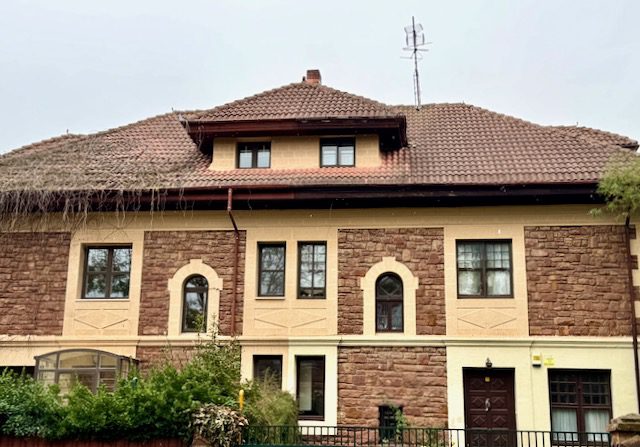
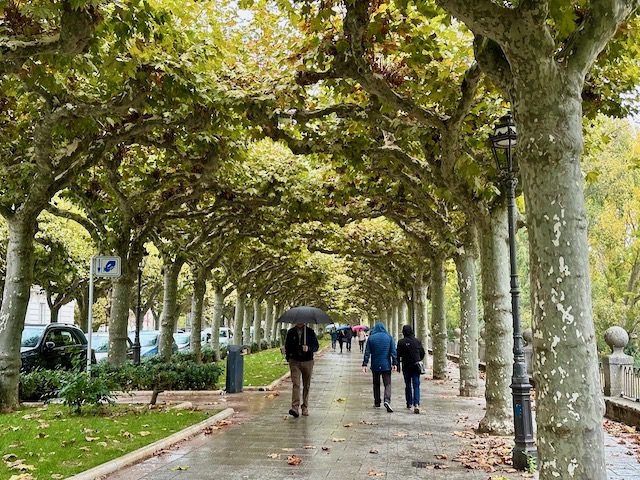
By the time we crossed the River Arlanzón and reached Paseo de la Audiencia, umbrellas were everywhere, except for the two Californians who had left their umbrellas in the room.
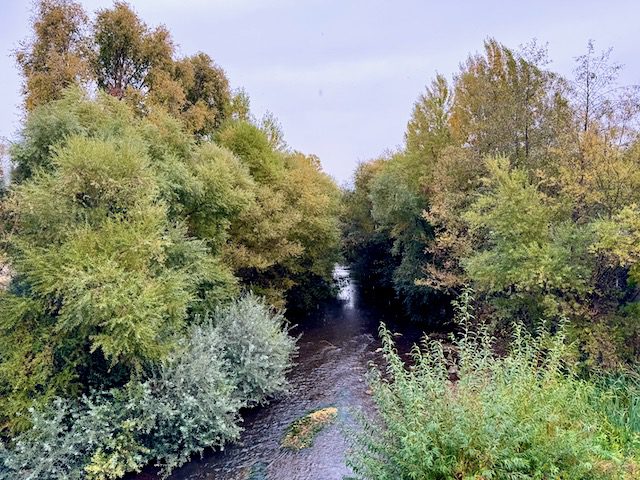
Back at the hotel, we called for a taxi to take us the 3+ miles to Cartuja de Miraflores (Miraflores Charterhouse), which is the final resting place of King Juan II of Castile and León (who founded the monastery in the early 1440s as a hunting lodge and had it redesigned ten years later after a fire) and his wife, Isabella of Portugal. However, it was their daughter, Queen Isabella I of Castile (she of Christopher Columbus fame), who really was the impetus of most of what you will see here. It has become one of the most important monastic buildings in the country.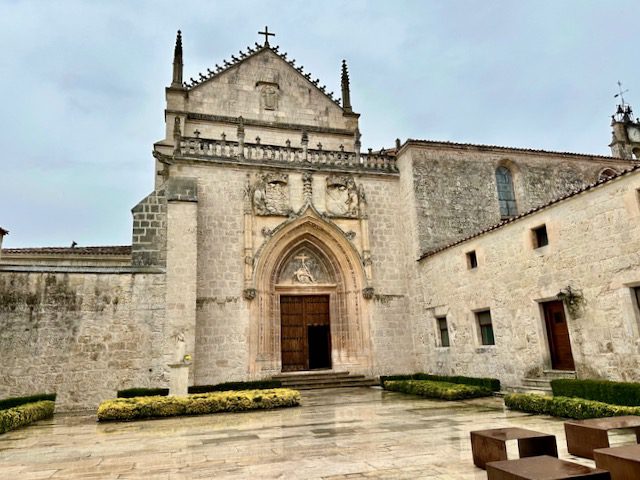
Besides holding royal tombs and many important pieces of artwork, the monastery continues to be home to cloistered Carthusian monks. Chanting could be heard in the courtyard before entering, but Tracy was listening for John Fogerty asking, “Who’ll Stop The Rain?”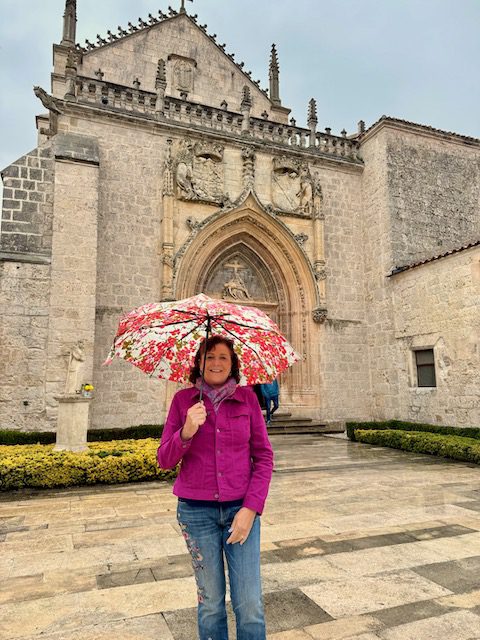
We entered through a doorway with a Pietá over it. There are informative QR codes available to listen on your phone.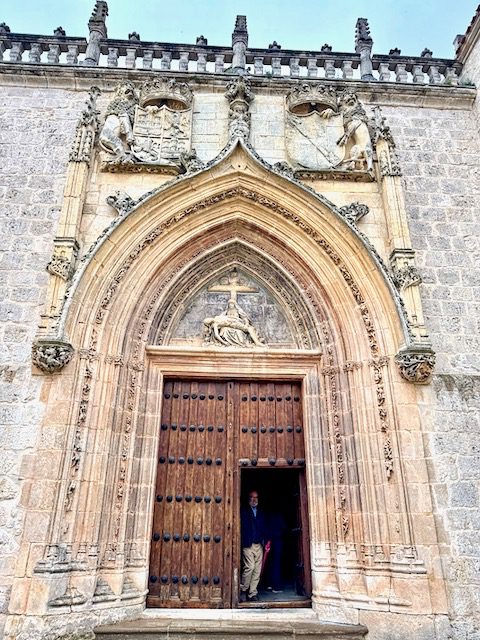
The Carthusian (Cartuja) Order of monks is also called the Order of Saint Bruno named after its founder in the 11th century. I’ve seen that “look” somewhere before. Channeling the 1960’s group The Tremeloes, he seems to be saying, “Silence is golden.”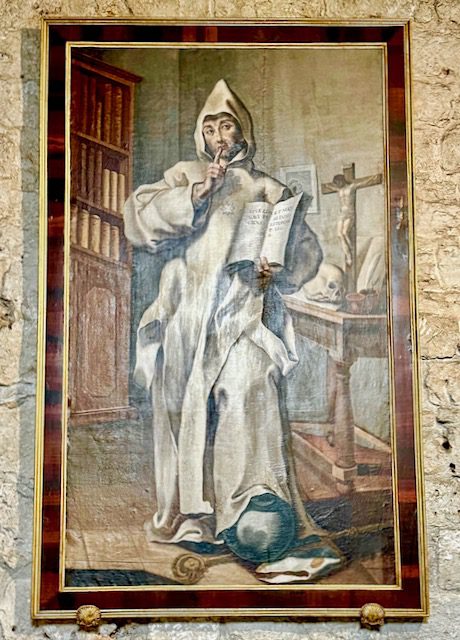
It’s located near The Virgin Enthroned with Child, created by the great master of 15th-century Castilian sculptor, Gil de Siloé.
The breathtaking entrance to the nave with its soaring ribbed vault ceiling, ironworks, and golden altars was for some reason unexpected to us given the rather plain exterior. However, given all the places of worship we have visited in our travels, we should not have been surprised.

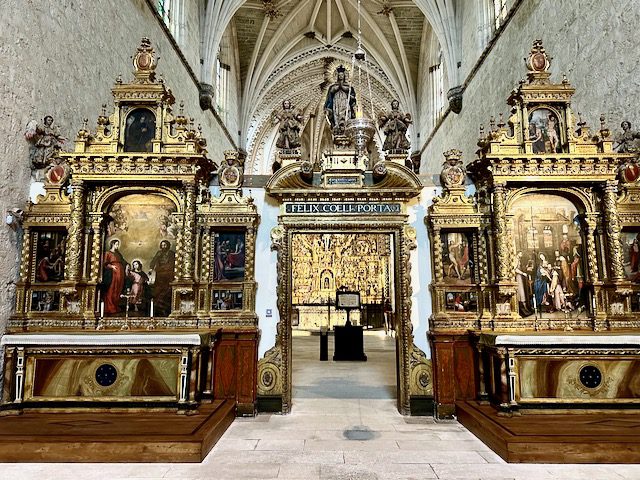
The main altarpiece from the late 1490s was carved in wood by Gil de Siloé and polychrome and gilded by Diego de la Cruz, who was supposedly funded with pillaged gold from the Americas. One of the altar’s highlights is an angelic wheel surrounding the crucifixion.


King Juan II of Castile died in 1454 at the age of 49, while Isabella of Portugal didn’t pass away until 52 years later. Their daughter, Queen Isabella I of Castile, commissioned Gil de Siloé to create a tomb for her parents and her brother, Alfonso, who died at age 14. The double Sepulchre of the King and Queen is in the form of an eight-pointed star. The King and Queen were then brought to the Charterhouse of Miraflores as their final resting place. (Photo on the left is a photo Tracy took of an enlarged photo of the top of the royal tomb which was displayed nearby as it is difficult to see the top of the tomb from the ground.)

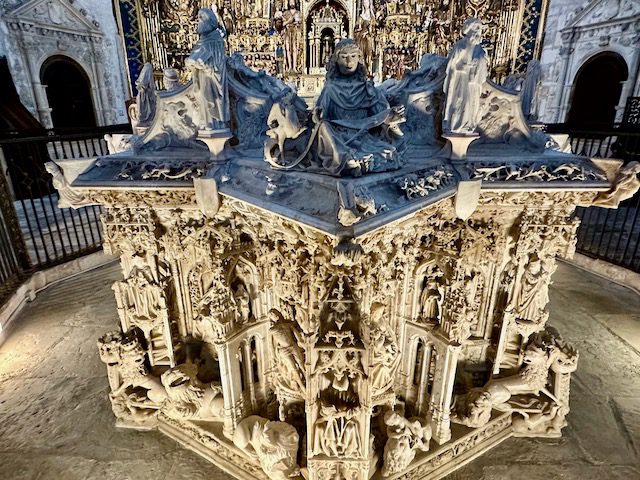
There are lots of small statues on the tomb, but it’s one that isn’t here anymore that has the most interesting story. (more on that later) As would be expected from a great sculptor, the tomb is quite elaborate and was carved from a block of alabaster from Guadalajara.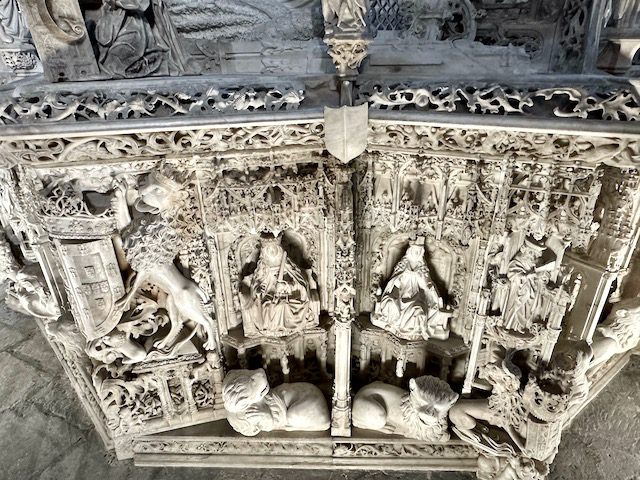
As is the one for Isabella’s brother, Infante Alfonso of Castile, who died at the age of 14.
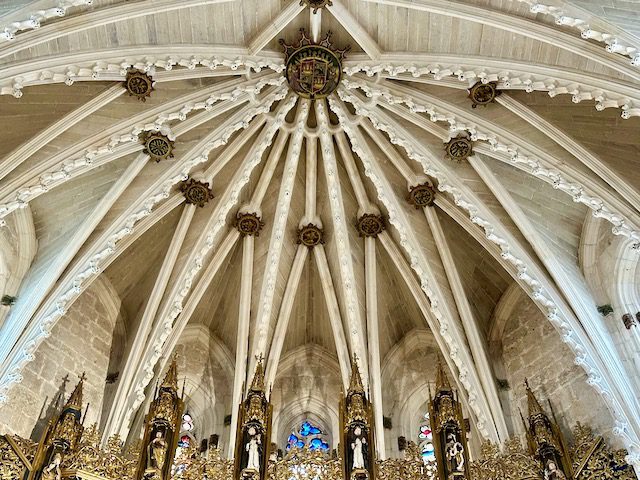
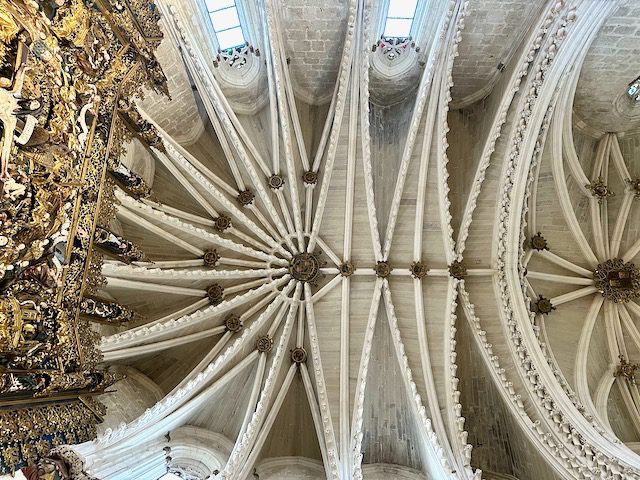
The ribbed ceiling overhead adds to the dramatic effect.
In the Sacristy was a “masterpiece of 17th-century cabinet making,” and yet another portrait of Isabella La Católica, although this one is a copy as the original was “taken” and is “now part of the collection at the El Pardo Royal Palace (Madrid).” We almost had her photo collection bingo card filled by now.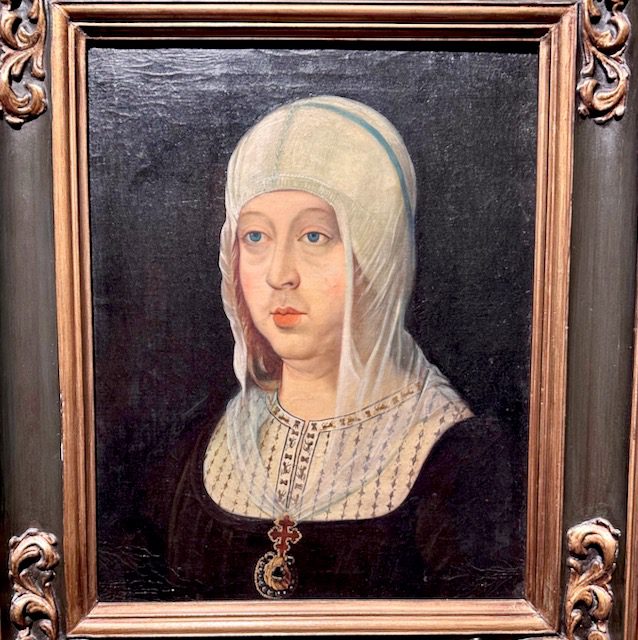
Isabella tidbit from my buddy Wikipedia: “Isabella was granted the title of “Catholic Monarch” by Pope Alexander VI… her sainthood cause was opened in 1958, and in 1974 she was granted the title of Servant of God in the Catholic Church…..However, her sainthood cause was stopped in 1991 by Pope John Paul II, one year before the commemoration of the fifth centenary of the discovery of the New World, due to her expulsion of the Jews.” Isabella is buried in Granada next to Ferdinand.
A couple of the more prominent paintings here are Annunciation (1490s) and Emperor Heraclius Before The Gate Of Jerusalem (1530).


The Capilla de Miraflores (Miraflores Chapel) is something to behold. Constructed in 1539, the ethereal 17-century mural paintings are absolutely mesmerizing.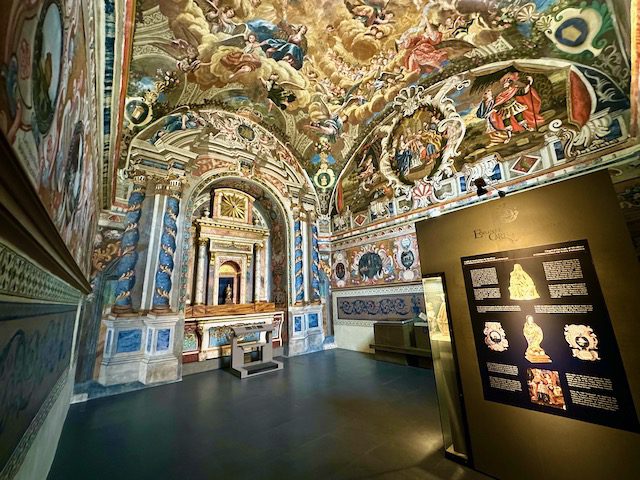
The chapel is dedicated to Our Lady of Miraflores …

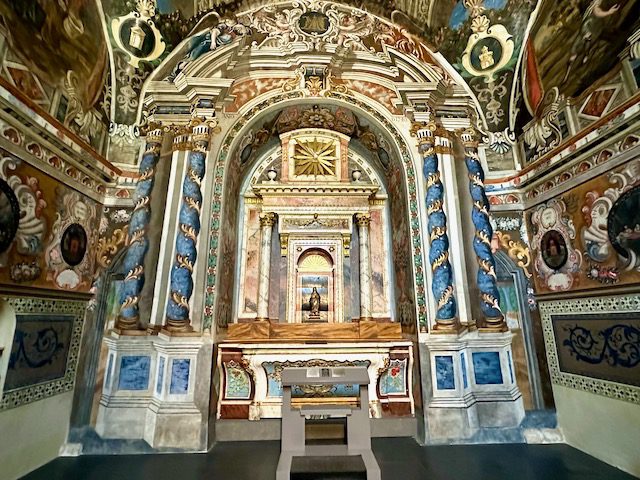
… and in its vault is the Assumption and Coronation of the Virgin.

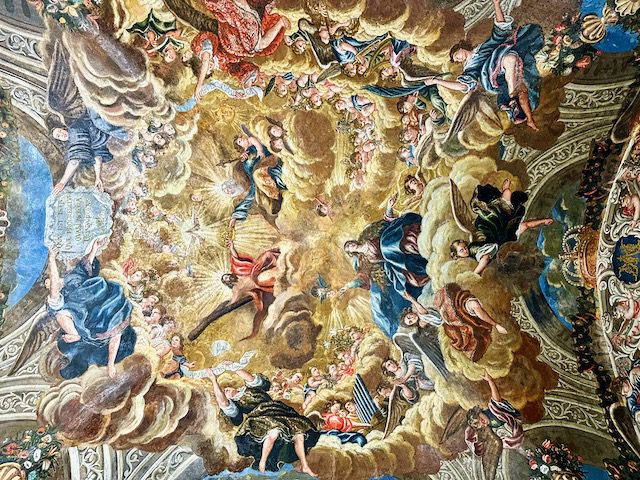
It all makes for an exquisite jewel-toned chapel.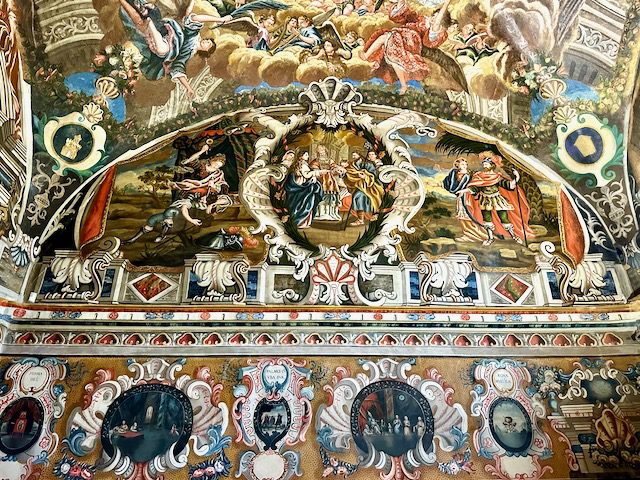
Afterward, we took a look at a small statue with a big story. Gil de Siloé sculpted Apostle St. James in 1490 to adorn the tomb of King Juan II and Queen Isabella of Portugal. This, however, is not the original. According to a placard, in 1914, “a wealthy aristocrat offered to finance a series of restoration work,” and he took this (and other pieces) to Madrid. Like Charlie on the MTA, St. James “never returned.” The wealthy aristocrat was actually broke and auctioned them off (including St. James) in New York. Bought by an American collector, the statue of St. James eventually ended up in New York at The Met’s Cloisters museum, where it remains today. In 2011, Cartuja Miraflores received this reproduction from The Cloisters.

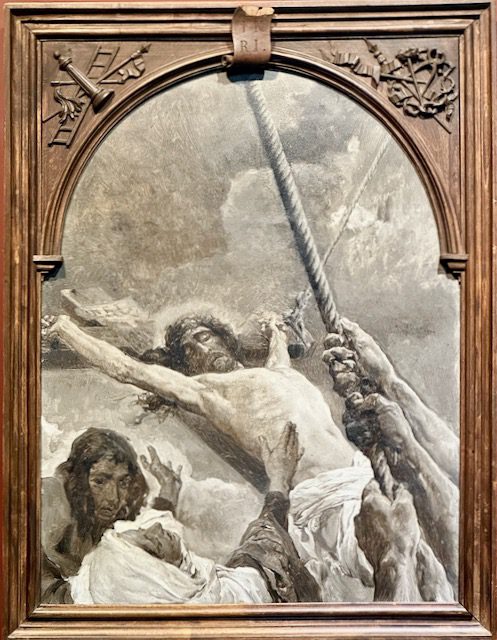
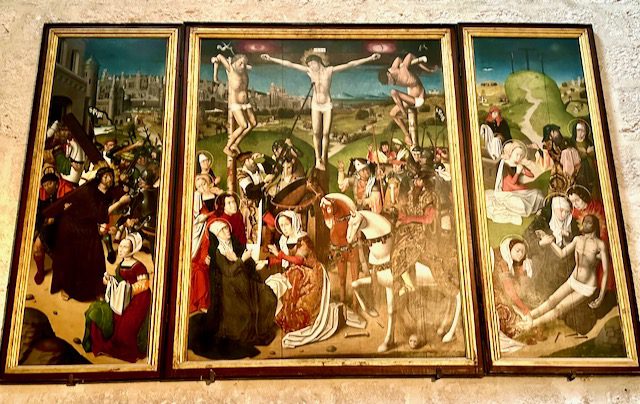
A couple of big ticket paintings were seen as we neared the end. Raising of the Cross by Valencian painter Joaquín Sorolla (unfortunately his museum in Madrid was closed for renovation) is one of his masterpieces. So is the below Flemish Triptych by an anonymous artist who is believed to be from the school of Rogier van der Weyden.
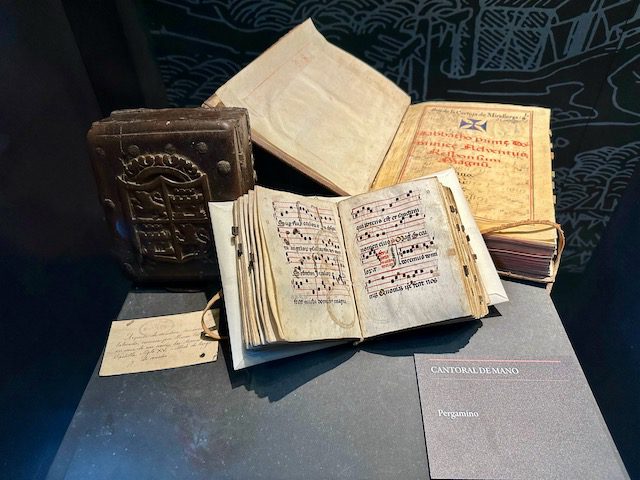
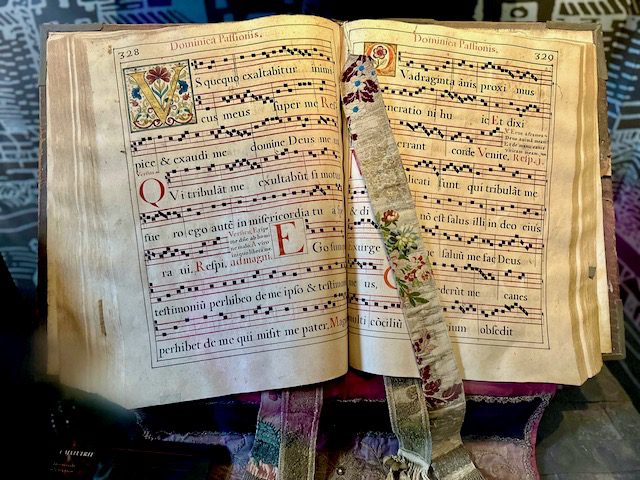
We viewed some ornate choir books, but decided against chanting.

The Chapel of San Bruno was our final stop inside with a life-like wooden carving of the Carthusian Order’s founder.

Outside we took a quick peek at a “secret garden,” and it was time to head back to Burgos.
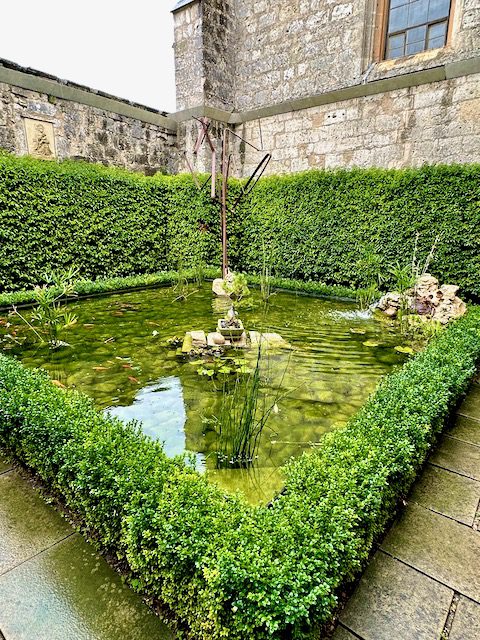
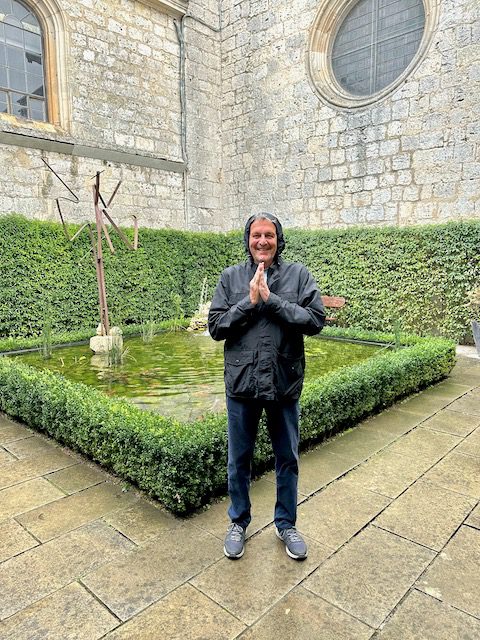
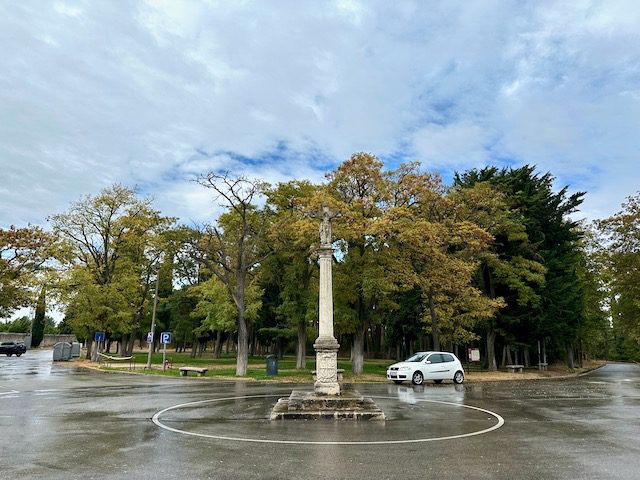
Once again, there were no taxis nearby, so while Tracy went inside to have the helpful desk person call for a ride, I took a couple of photos of the surrounding area, which looked relatively lush for a place where rain had been scarce … until today.
We dropped into a gourmet store near our hotel looking for some of those addictive candy pearls I had devoured the previous evening. No luck, but Tracy did score some olive oil and chocolate (not the bunny, however).
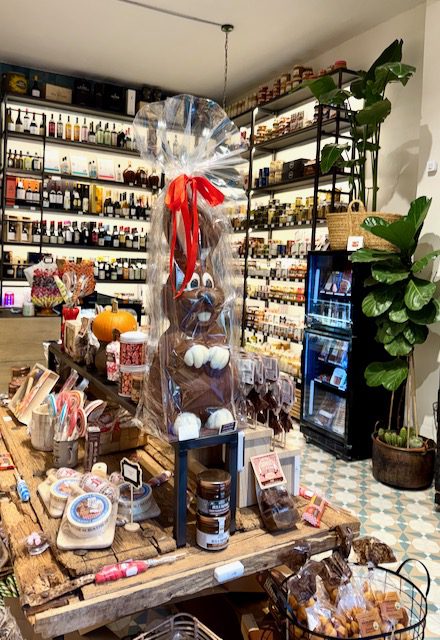

Afterward, I ran into the town’s spokes-man.
On a drizzly afternoon, the Plaza Mayor was virtually empty, except for a lonely tourist in search of nourishment.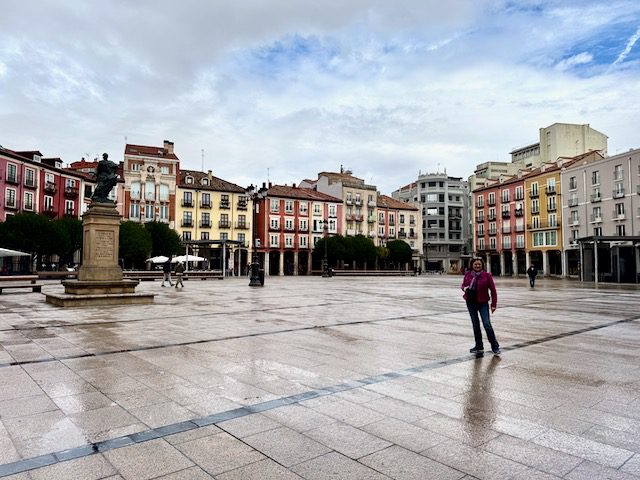
Everyone seemed to be having tapas at the restaurant we would dine at later this evening.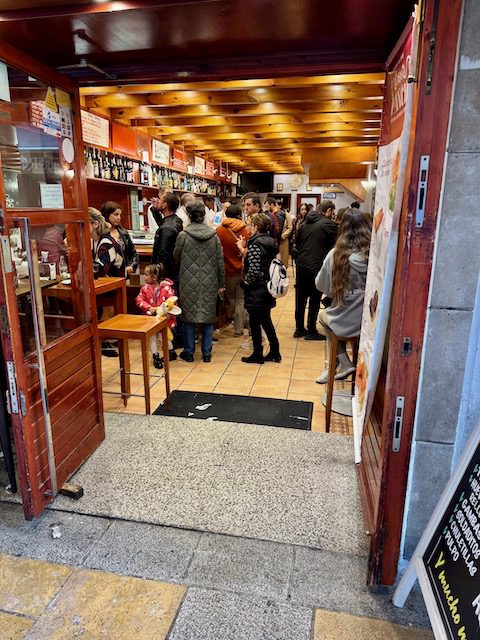
We continued down the alley stopping for a late afternoon pizza lunch to tide us over to dinner. The thin crust pizzas were good, but being stiffed on our change left a bad taste in my mouth. Unfortunately, I didn’t realize it until it was too late to rectify the situation.
Tempted by some candied apples in the window, a short siesta won.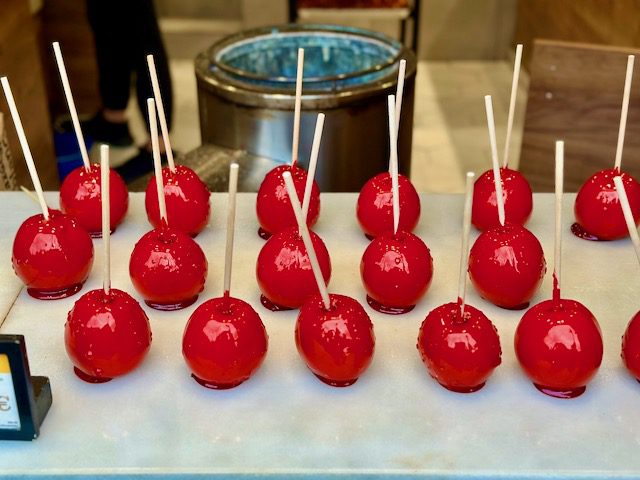
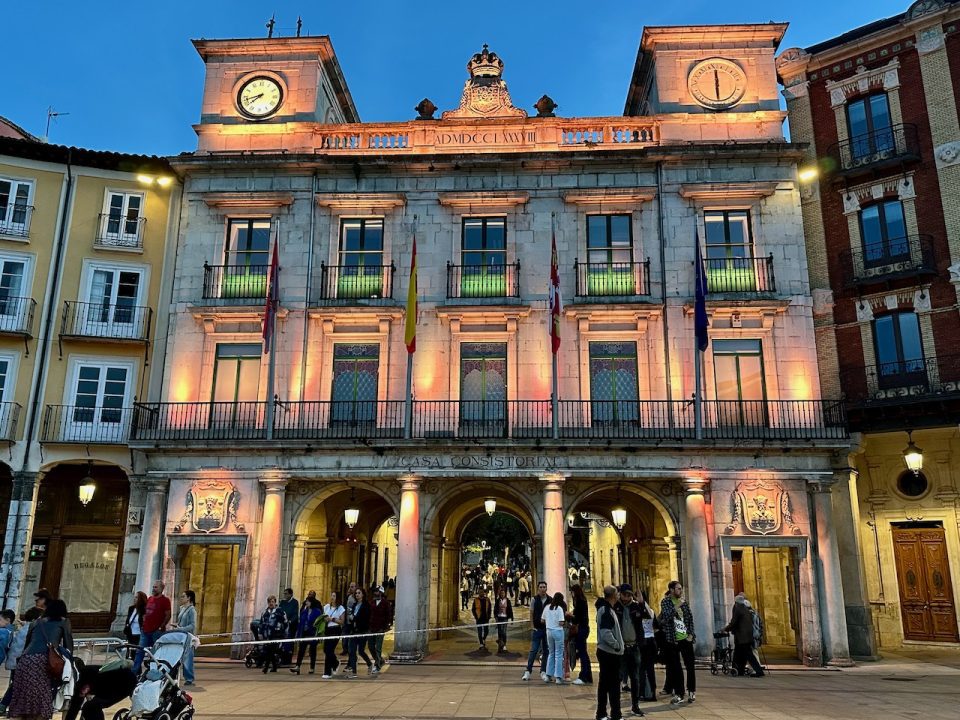
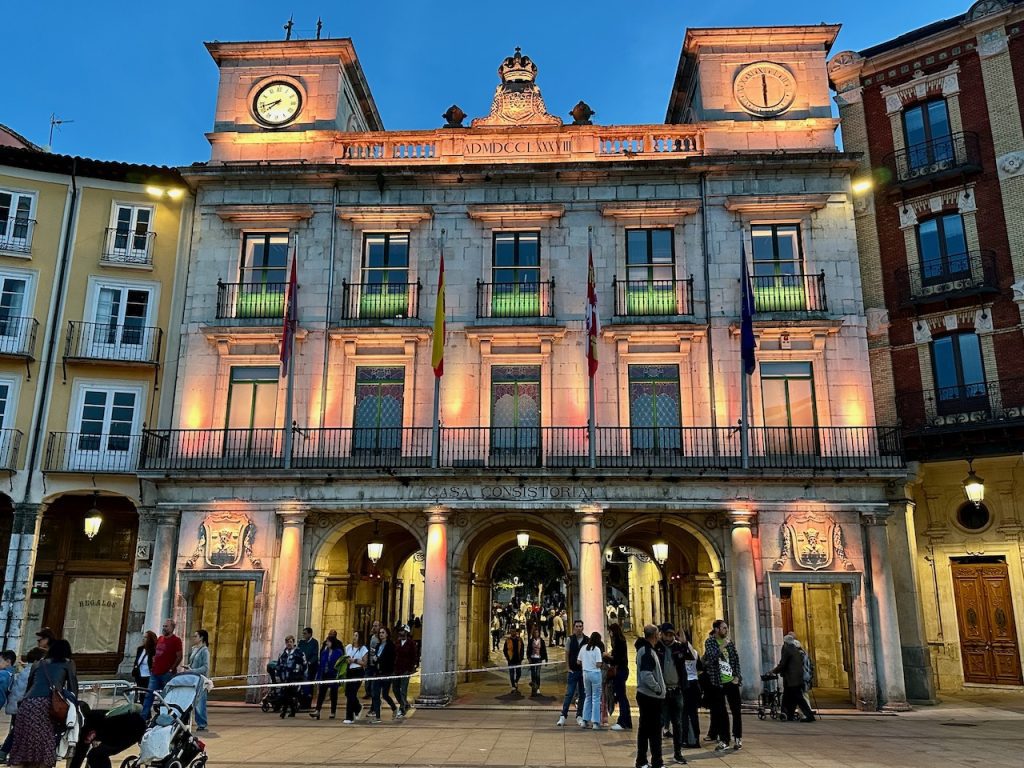
On a rainy night in Burgos (now that would have been a hit for Ray Charles), we wandered out for dinner. The Plaza Mayor glistened on a wet evening.
We made our way toward Casa Pancho.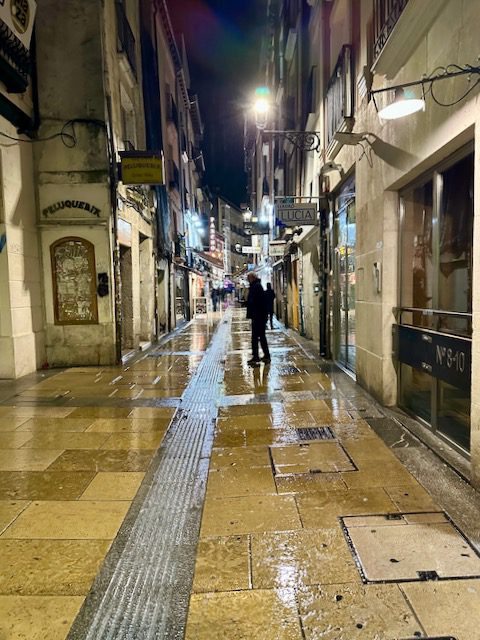
Not surprisingly, the tapas part of the restaurant was still packed.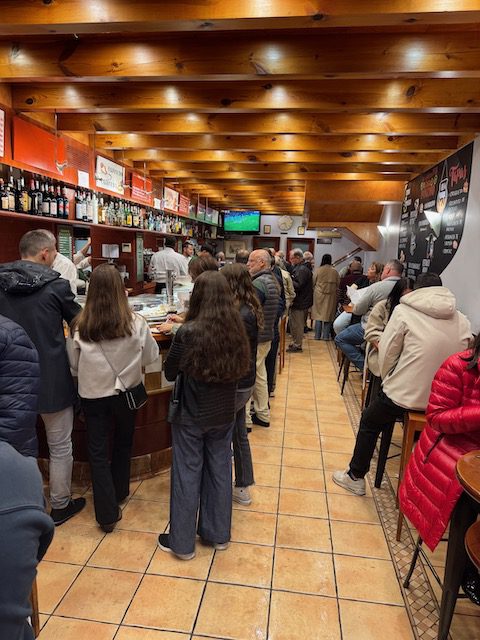
Wading through the crowd, Tracy and I headed upstairs toward the actual restaurant, but the bartender nearly leapt across the bar to to block our passage. I fully expected him to go into Black Knight from Monty Python and The Holy Grail, “None shall pass.” Fortunately I didn’t have to cut his legs and arms off to gain access. “We have reservations,” seemed to do the trick.
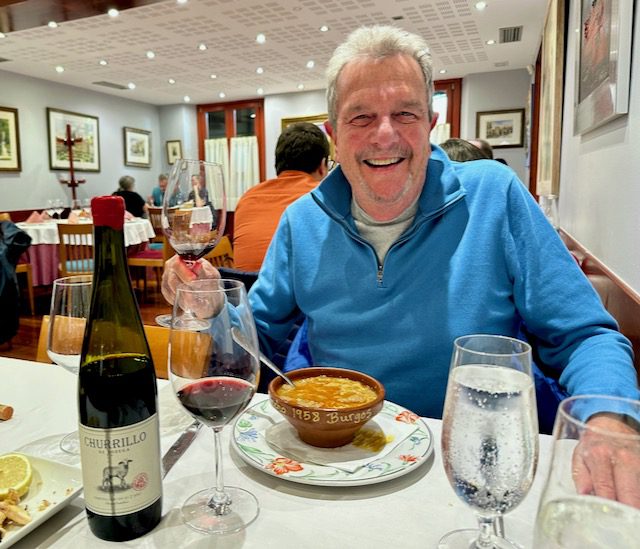
I don’t know if our waiter was having a bad day, because he was very tense and in a hurry when we first arrived. However, as the evening progressed he became quite jovial and put on quite the show when pairing wine with our meal. I’m surprised he didn’t tear a rotator cuff doing his gyrations of pulling out the cork. We had such a good time that although we were the second table seated, we ended up being the last to leave.
Dinner was very good. Tracy starting out with fried calamari …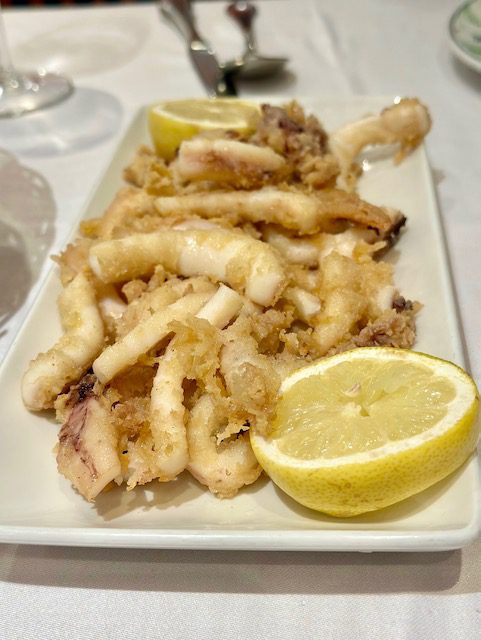
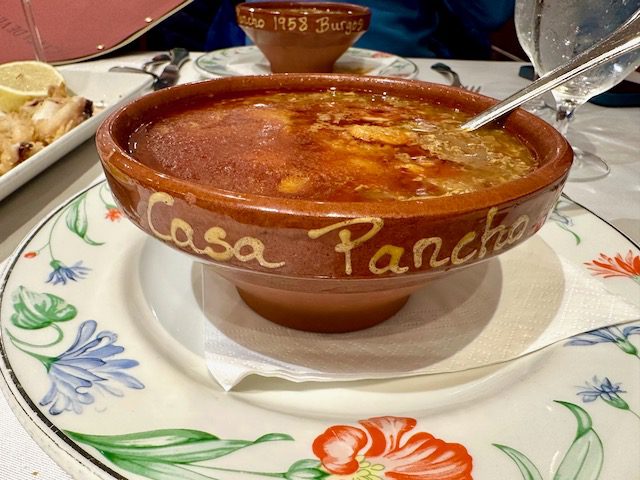
… while I was now semi-addicted to Sopa Castellana (garlic soup).
My steak with frites was good (although again … no veggies, well I guess technically potatoes are vegetables), while Tracy finally got some roughage with her goat cheese salad.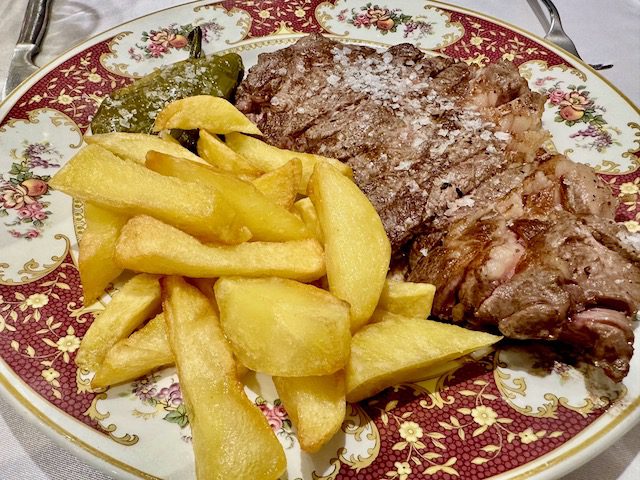
Tracy and I shared a coffee mousse for dessert. Perfect.

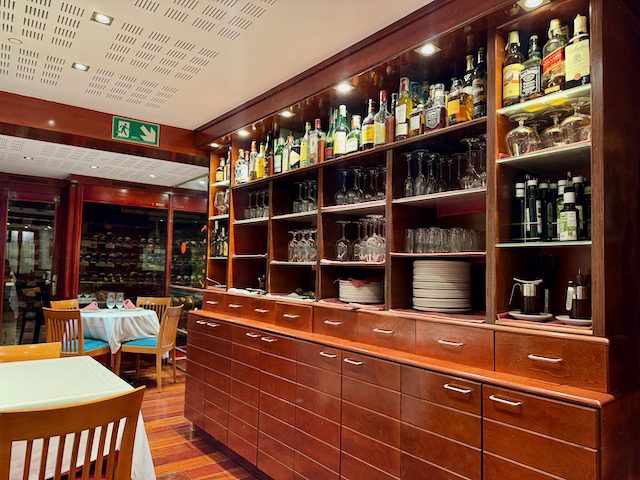
Casa Pancho was still kicking downstairs, but we knew we had to get some rest for our early morning (well, it was supposed to be) drive to León.
The streets were quiet …
… and a lone bicyclist entered the empty Plaza Mayor.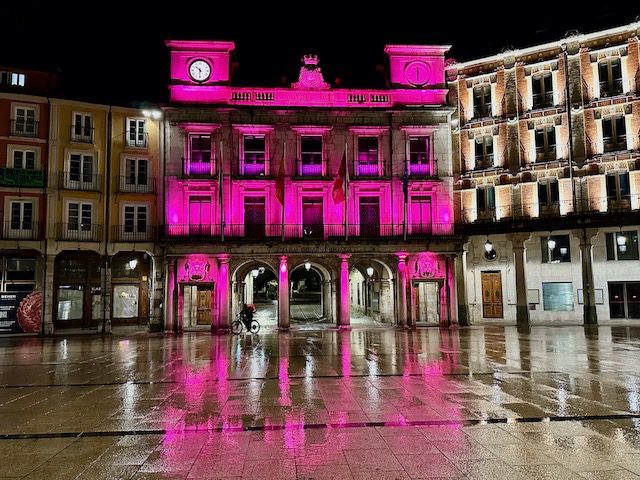
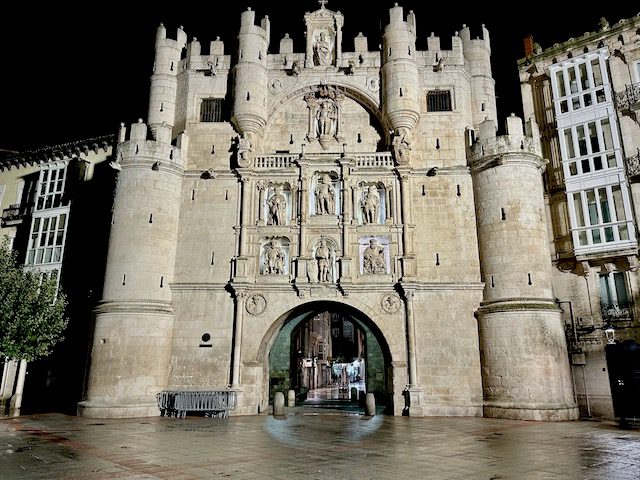
We bid a fond farewell to the Arco Santa Maria and el Paseo Espolón. We probably should have added one more day here.

Back at the hotel, the view out the window bookended our day.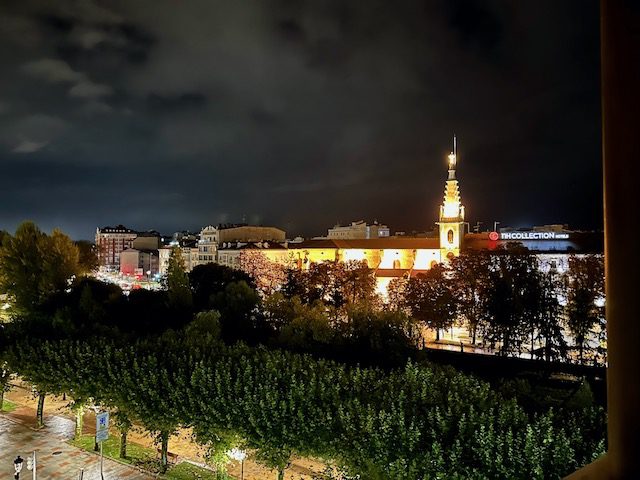
Tomorrow, we would be up very early to drive to León, where we would spend the next two days. However, that early drive would end up being later than we thought when we had a comedy of errors concerning (what else?) our rental car.
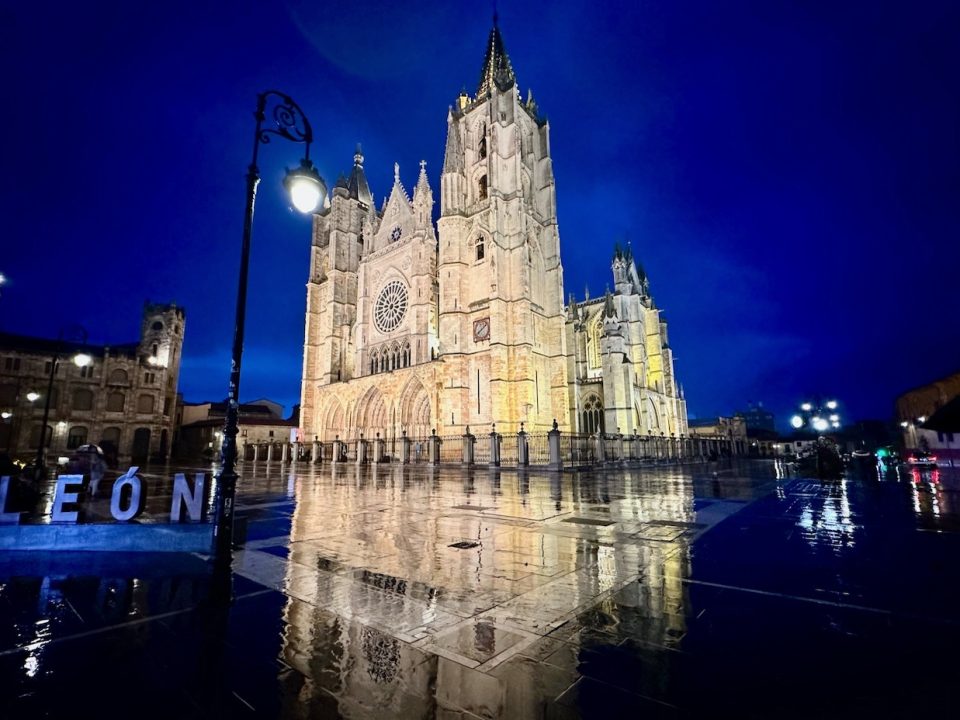
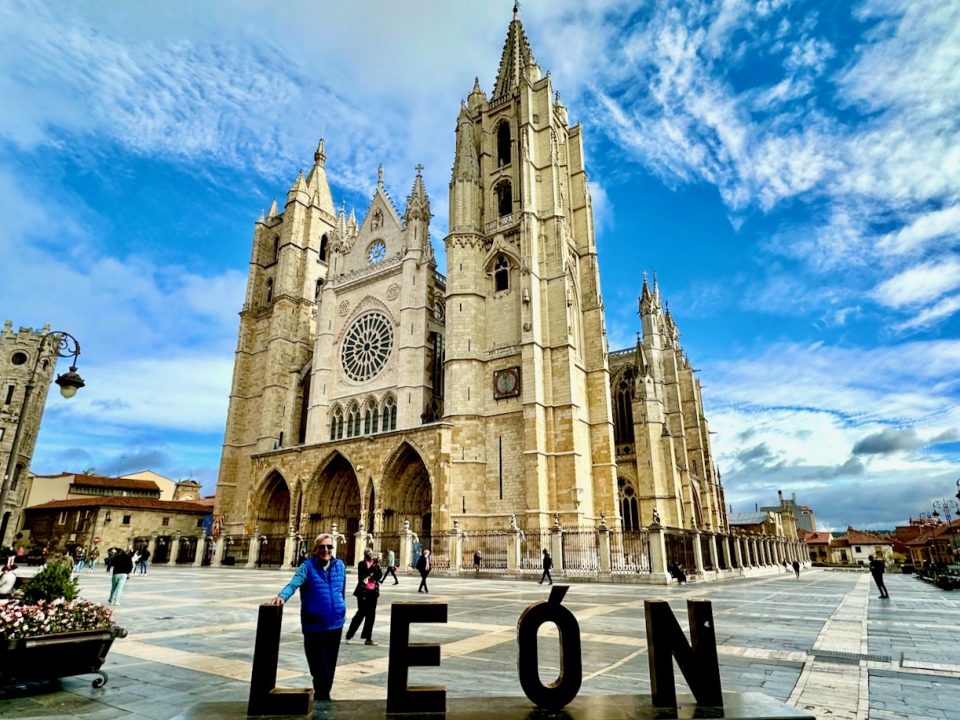
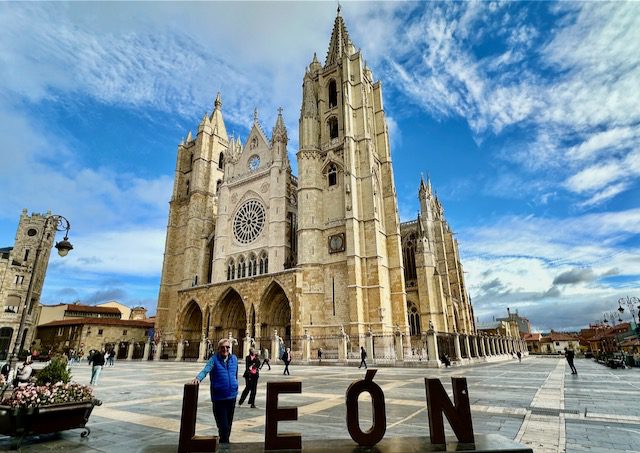 León is also situated along the Camino, so, of course, we started with León’s cathedral, which, despite its majestic stained glass windows, might have contributed to a slight feeling of church overload on this trip. However, when we came upon yet another beautiful, old square with a church, we had to check it out, too.
The day continued with a nondescript lunch followed by a nondescript museum. After checking into our hotel, and while Tracy napped, my next museum choice turned out to be a disappointment. Finally, one more church lured me inside.
Nighttime turned out to be much more entertaining in León due to some tasty tapas and wine in Barrio Húmedo, which quickly restored us to España-mode, followed by dinner in an elegant dining room to finish the day on a high note.
Chapter Nine: “Just One Of Those Days”
Day Nine – A Key Development Delays Our Drive To León, Tight Fit, “House of Light,” Losing My Religion (For The Moment), Closed Palacio, Important Stop On The Camino de Santiago Pilgrimage Route, Passing Up A Famous Museum (For The Moment), Unfortunately Not Passing Up a Non-Famous Museum, Tapas Time and An Elegant Dining Spot